




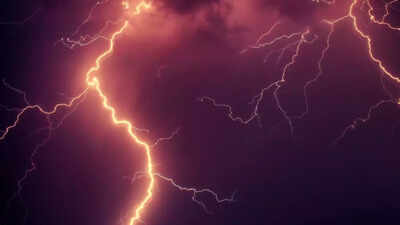
Lightning sits at the boundary between routine weather and sudden hazard. It appears briefly, illuminates a landscape, and vanishes before the eye adjusts, yet its physical effects persist in scarred trees, damaged wiring, and recorded injuries. Advances in detection now allow individual discharges to be tracked across wide regions, revealing patterns that were once invisible. Despite this, everyday responses to storms remain guided by sayings learned early and rarely questioned. These beliefs shape behaviour in parks, on roads, at work sites, and inside homes. Their endurance owes less to evidence than to familiarity, passing untested from one storm season to the next.
Why lightning myths continue to circulate
Ideas about lightning often arise from visible cues such as height, sound, and shelter, offering simple explanations for a complex electrical process. Some are reinforced by coincidence, where uneventful outcomes are remembered as proof. Others originate in older guidance stripped of context through repetition. Detailed strike mapping, injury surveillance, and structural assessments now allow these claims to be compared with observed behaviour. Analyses drawing on such records, including those reported by the Insurance Information Institute, show consistent gaps between popular belief and measured electrical activity.
10 widely accepted myths about lightning
1. Lightning never strikes the same place twice
This belief persists because repeated strikes are rarely noticed by casual observers. Instrumented towers and high-rise buildings show a different picture. The same structure may be struck many times within a single storm or over successive seasons. Lightning follows electrical field conditions that can remain stable around tall or well-grounded objects. Past strikes do not alter this environment in a lasting way, leaving the site exposed whenever conditions align.
2. Lightning only hits tall or isolated objects
Height influences strike likelihood but does not define the zone of danger. Many recorded injuries occur in open spaces with no nearby structures. When lightning hits the ground, electrical current spreads outward through soil, sand, or turf. People some distance from the strike point may experience current passing through their bodies without any direct contact from the main discharge channel.
3. Metal objects attract lightning
Metal is often blamed because it is associated with electricity in everyday settings. In storms, metal does not attract lightning from clouds. Strike attachment depends on the electrical field between the cloud and the ground. Once a strike occurs, metal shapes how current travels by offering a low-resistance path. This explains why metal frames may survive repeated strikes while nearby materials suffer damage.
4. Rubber soles or tyres provide protection
The scale of lightning overwhelms common insulating materials. The voltage involved far exceeds what rubber footwear can block. Shoes do not prevent current from entering or leaving the body. In vehicles, occupants are protected because the metal shell conducts current around them and into the ground. The tyres themselves contribute little to this effect.
5. If there is no rain, there is no danger
Rainfall is an unreliable guide to lightning risk. Thunderstorm anvils can extend far beyond the rain core, carrying electrical charge capable of producing ground strikes. Many injuries occur under clear skies when rain is visible only in the distance. Lightning mapping routinely shows strikes well outside areas of active precipitation.
6. Lying flat reduces the risk of injury
This idea conflicts with observed injury mechanisms. When lightning strikes nearby, the current spreads across the ground surface. A body lying flat increases contact with that surface, allowing electrical energy to pass through a larger area. Recorded cases show that ground current exposure can be severe even without a direct strike overhead.
7. A struck person is dangerous to touch
Fear of residual electricity has delayed assistance in some incidents. Lightning does not store charge in the body. Victims do not remain electrified after the discharge ends. Medical and emergency records show that immediate physical contact does not transmit electricity to helpers. The danger lies in the initial strike, not in contact afterwards.
8. Small shelters are safe because they provide cover
Open-sided shelters give a sense of protection because they block rain and wind. Many lack grounding systems or enclosed wiring that can channel electrical energy safely. Injuries have occurred in gazebos, bus shelters, and picnic structures struck directly or affected by nearby ground current. Cover alone does not determine electrical safety.
9. Indoor plumbing and appliances are safe during storms
Buildings reduce exposure but do not isolate occupants completely. Lightning can enter through external wiring or plumbing connected to the ground. Electrical energy may travel through pipes, taps, and corded devices. Injury reports include people bathing or using wired phones when nearby strikes transmitted current along these paths.
10. Heat lightning is harmless and distant
Heat lightning is not a separate phenomenon. It describes ordinary lightning seen without audible thunder. Sound may be absorbed by distance, terrain, or atmospheric conditions. Strike records show that visible flashes without thunder can still be associated with nearby electrical activity, particularly in large storm systems where discharges occur across wide areas.Also Read | What is the mysterious humming noise in New Mexico that scientists still cannot explain