




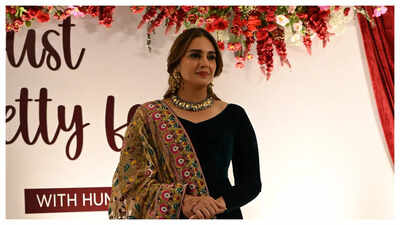
An actress who consistently prioritises substance over stereotypes, Huma Qureshi is as compelling in conversation as she is on screen. From redefining feminine archetypes to championing authentic empowerment, her perspective serves as a mirror to the evolving consciousness of the modern woman. During a recent visit to Ahmedabad for an event, Huma spoke at length about the complexities of womanhood, the fallacy of “angry” feminism, and why she refuses to be pigeonholed.‘To do the tried and tested (on screen) is boring’Huma’s career trajectory has been defined by a refusal to follow the “tried and tested” path, which she dismisses as “dead and boring”. People are always ready to put you in a box. I always say, ‘Give me something you think I haven’t done, and I’m going to do the character differently and prove you wrong.”
Huma says, “Today, audiences are very smart, and we must respect their intelligence by giving them something they can truly engage with. As an actor, I would get bored doing the same thing repeatedly. My pact with my audience is to bring them something new every single time.” Huma, who’s played layered, complex titular characters on OTT, admits that “Essaying intense roles like Rani Bharti in Maharani, Juhi Adhikari in Mithya, or dark, manipulative antagonists Badi Didi inDelhi Crime 3and Monica Machado in Monica O My Darling, which resonated with the audience, were deeply satisfying and enriching experiences.” These shows also let me experiment with intense, dark and morally ambivalent characters who were not just cardboard cutouts as leads or even the antagonist.” She adds, “Maharani really challenged me as a performer, and I want to bring the success I’ve had with Maharani on OTT to single-screen theatres as well. I want to be part of the kind of work that brings audiences back to cinemas.” Ask Huma what else lies ahead professionally, a genre she has yet to conquer, her answer is immediate: “Action.”‘Morally grey female characters are accepted’Reflecting on the industry’s shift, Huma admits that she’s “excited” about the “acceptance of morally grey and complex female characters, probably because they are more real and relatable. There is space for far more nuanced portrayals and an audience as well”. She says that the “damsel in distress or the one-dimensional vamp are relics of a time when cinema failed to represent real women. Audiences were always ready for layered stories,” she says, adding, “The fault was simply that we weren’t consistently representing the reality of women on screen.”‘I am not an angry feminist; we need to move beyond constant comparisons’Huma feels there’s an invisible weight often placed on women’s shoulders, and societal expectations can be a heavy mantle to carry. “It’s exhausting that women are often made to feel responsible for everything—the family’s honour, its dignity, and so much more,” she says. For Huma, feminism isn’t a battle of the sexes. “I don’t believe in ‘angry’ feminism,” she says. “The idea is not to be against men; the real issue is patriarchy—a system sustained by men and women. We need to move beyond constant comparison.” She credits her own confidence to the secure men in her life, specifically her father and brother, saying that their “support allowed her the freedom to own her journey, mistakes and all. I believe that behind every successful woman, there are also secure and supportive men.”On her connection with AhmedabadHuma’s connection with Ahmedabad runs deep, fuelled by film shoots and a close circle of friends and not just promotional tours. She says, “I love Ahmedabad. I think it’s the best city ever. I get so much love here. I’ve visited Ahmedabad not just for promotional tours; I have shot movies here, and I have a lot of friends here. My connection with this city is beautiful. I haven’t been able to travel around much, though I have been here many times, but someday I would really like to explore it as a tourist.”-Ancela Jamindar