




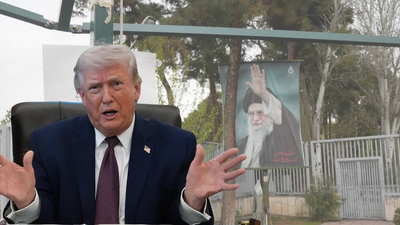
TOI Correspondent from Washington: US President Donald Trump on Wednesday escalated his rhetoric against Iran to a new pitch, appearing to endorse the idea of eliminating Iranian leaders who oppose a deal, two weeks after he threatened to annihilate a civilisation — even as he doubled down on claims of US military dominance over the Strait of Hormuz.In a series of posts that blended dark threats, bravado, and exhortation, Trump portrayed Iran as internally fractured and militarily weakened, while signaling a readiness to intensify US action if Tehran does not come to the negotiating table. He also reposted a clip from a commentator that recommended killing Iranian leaders who oppose the deal and destroying Kharg island, from where Iran exports 90 percent of its energy. “Iran is having a very hard time figuring out who their leader is! They just don’t know!” he wrote, describing “CRAZY” infighting between “Hardliners,” whom he said were “losing BADLY on the battlefield,” and “Moderates,” whom he dismissed as “not very moderate at all (but gaining respect!).”The US president went on to assert sweeping American control over the Strait of Hormuz, declaring that “no ship can enter or leave without the approval of the United States Navy” and that the vital maritime artery was “sealed up tight” until Iran makes a deal. The claim, while reflecting the presence of formidable US naval forces in the region, has been met with skepticism among analysts who note that the waterway remains contested and that Iran retains the capacity to disrupt shipping through asymmetric tactics.In a separate post, Trump sharpened his military directive, saying he had ordered the US Navy to “shoot and kill any boat, small boats though they may be,” if they are found laying mines in the Strait. “There is to be no hesitation,” he wrote, adding that US mine-sweeping operations were underway and would be expanded to “a tripled up level.” The language marks one of the most explicit public authorizations of lethal force by the president in the current standoff, effectively lowering the threshold for direct confrontation at sea.The rhetoric comes against the backdrop of a volatile and fast-evolving confrontation that has oscillated between threats of large-scale military action and tentative diplomatic outreach. Trump’s latest comments about potentially targeting Iranian leaders who oppose a deal—without naming individuals—have further raised the stakes, prompting concerns about escalation even as Washington maintains that it is open to negotiations.A growing number of domestic critics, including some of his former MAGA acolytes, are saying Trump has gone batty and senile and needs to be removed by invoking the 25th amendment. Last week, media reports in Wall Street Journal among other outlets caused a stir in Washington with reports that suggested senior Pentagon commanders and administration officials were keeping the President out of the loop on the Iran developments because of his volatile demands and responses. Officials in Tehran have so far responded with a mix of defiance and derision to Trump provocations, rejecting what they describe as coercive diplomacy. Iranian state-linked voices have pushed back against the narrative of internal disarray, instead framing the US posture as erratic and driven by political considerations. On social media, pro-government commentators have mocked Trump’s claims of total control over the Strait, pointing to recent incidents involving the harassment and seizure of vessels as evidence that Iran retains operational leverage in the narrow waterway.Independent analysts in Washington and the Gulf region caution that while the US enjoys overwhelming conventional military superiority, the dynamics of the Strait of Hormuz favor neither side decisively. Iran’s use of small boats, mines, and coastal missile systems has long been viewed as a potent asymmetric counter to US naval power, raising the risk that even limited engagements could spiral into broader conflict.Trump’s comments also underscore the increasingly personalized nature of the standoff. By framing the issue in terms of Iranian leadership divisions and suggesting that certain figures could be “eliminated,” the president appears to be targeting not just policies but individuals—a move that could further complicate diplomatic channels. Experts note that such rhetoric risks hardening positions within Iran, empowering hardliners who argue that engagement with Washington is futile.At the same time, the administration continues to signal that a negotiated settlement remains possible. Backchannel contacts, including those reportedly facilitated by Pakistan, have not been formally abandoned, and there remains speculation about whether senior US officials, possibly including Vice President JD Vance, could travel to the region for talks if conditions align.Yet the gap between rhetoric and diplomacy appears wider than ever. Trump’s alternating signals—threatening force while inviting talks—have become a defining feature of the crisis, leaving allies uncertain and adversaries cautious but unyielding. The president has insisted that maximum pressure will ultimately bring Iran to heel, but critics argue that the approach has instead produced a cycle of escalation and pause, without a clear pathway to resolution.