




The London Marathon plans to stage a two-day event in 2027, opening up the streets of the capital to as many as 100,000 runners across Saturday 24 and Sunday 25 April next year.
Permission has yet to be granted for the “innovative” format, with Hugh Brasher, the head of the London Marathon Events, insisting it would be a “one-off”. But London mayor Sadiq Khan is a supporter of the idea as talks with key stakeholders continue.
London is one of the world’s major marathons, and the event has been growing in popularity and size since its inaugural edition in 1981. Over 1 million people applied to take part in this year’s race, while a record 59,000 finishers are expected today.
Armed with data on the surge of interest from Gen Z, particularly women aged 18 to 29, organisers also believe hosting the world’s biggest marathon and bringing people together could act as a counterbalance to troubled times: amid fears over the climate emergency, global conflict, and the negative consequences of AI, to name but a few.
But staging one mass participation event in a major city is a colossal undertaking – putting on two, on consecutive days, would be, well, a marathon effort in itself: one that could risk “diluting the magic” and “losing the love” that London has worked so hard to build.
Doubling the London Marathon: How would it work?
If all goes to plan, there would be two “mass” starts: a London Marathon on a Saturday for the first time in the event’s history, using the same, traditional route from Greenwich to Westminster, followed by another London Marathon on the Sunday.
The ballot for next year’s event has been open since Friday and will close on Friday, 1 May at 4pm. Applicants are automatically entered for both Saturday and Sunday events and, if successful in the lottery, would be placed into one of the days, but not both. Additional charity and good-for-age places would also be available on both days. In total, up to 50,000 people could take part on each day, with organisers looking to achieve balance in terms of numbers across the weekends. But the men’s and elite women’s races would take place a day apart.
“There’s a lot of work gone into this about how it would both be similar and different,” Brasher says. The job of his team over the next few weeks will be consulting with the emergency services, the police, ambulance and fire brigade, as well as Transport for London (TFL) and the various London boroughs whose residents and businesses are impacted by the marathon passing through its streets. Around 800,000 people travel across London on marathon day, and the pitch to double that next April comes while Tube drivers have been on strike in the days before this year’s race.
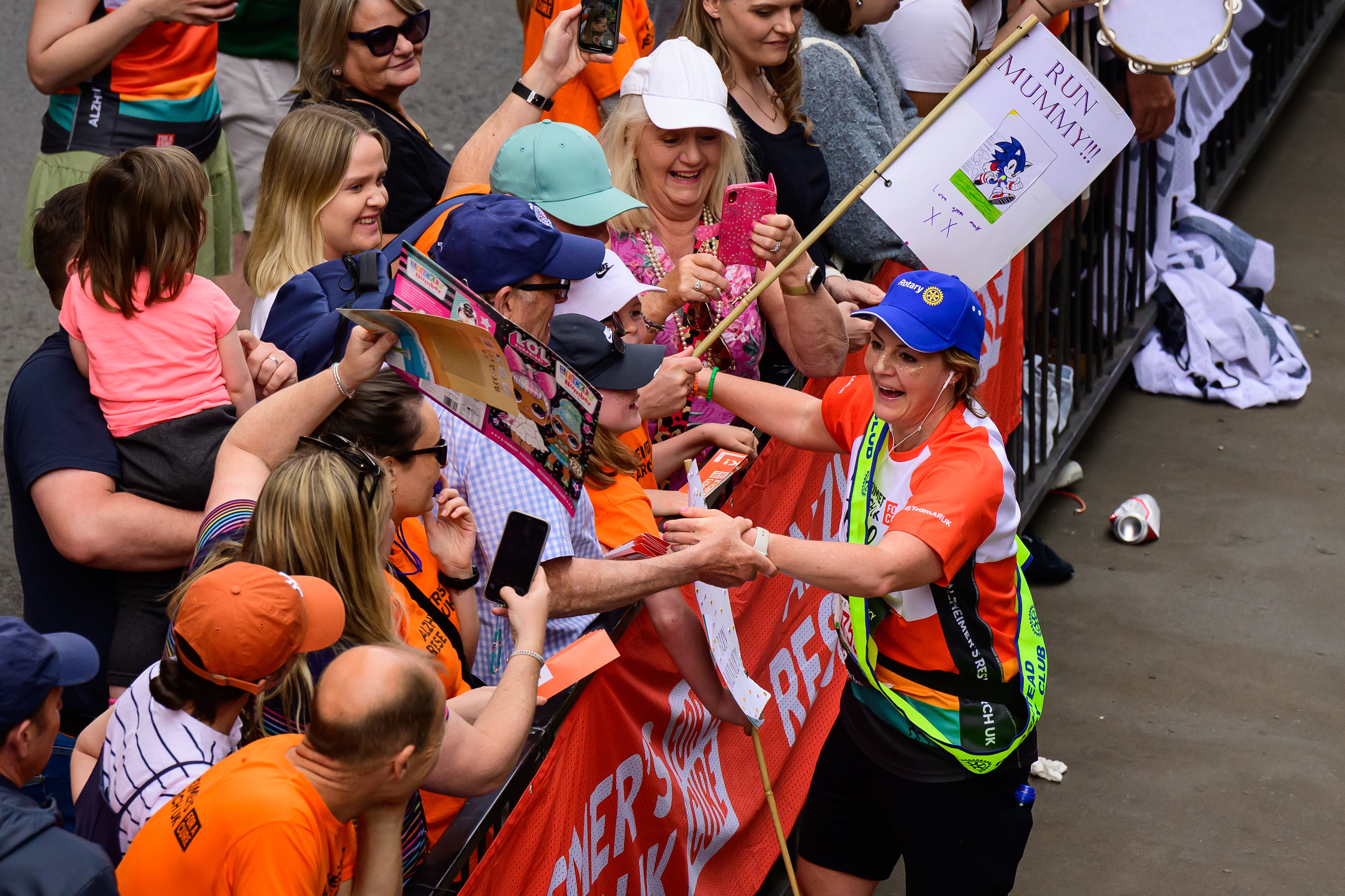
‘To show some joy and happiness in a troubled world’
When Brasher’s father, the former Olympic steeplechase medalist Chris Brasher, set out with John Disley to organise the first London Marathon in 1981, they did so with the intention of showcasing the “very best of the capital” and to “provide some happiness and sense of achievement in a troubled world”. That sentiment, Brasher now argues, is more relevant than ever before.
Brasher estimates that a two-day event would bring more than £130m in fundraising for charities and good causes, more than doubling last year’s record, while research from Sheffield Hallam University predicts a wider benefit of £400m to the economy.
There’s then the societal boost. As a widely accessible sport that brings both physical and mental health benefits, running has experienced a resurgence in popularity since the pandemic. In an online world, running clubs offer community and social opportunities for people of all ages and backgrounds.
“It can really bring people together,” said Andrew Smith, a former race director at the London Marathon and now the CEO of the organiser of the Manchester Marathon. “You can find your team, your tribe. You can be inspired and supported. And doing a marathon is the pinnacle of that. For months, you can train, you can get fitter, healthier, have all those positive benefits, and then you get to the day itself, and you can be the star of the show.”
Of the 840,000 UK-based people who entered the ballot for this year’s marathon, more than a third were in the 18-29 age group. That demographic, which saw a 105 per cent increase last year and now stands as the second-largest age group overall, has been fuelled by women, who make up the majority of entrants in the 18-29 category. In an age of increasing screen times, there also is a greater draw, Brasher said, for “these IRL [in real life] experiences”.
But unless you are good-for-age or commit yourself to raising potentially thousands of pounds for charity, running the London Marathon can be like winning the lottery. The sheer number of applicants means the odds of the ballot are now stacked against you, with this year’s chances of successful entry approximately one in 14.

For one year only, though, doubling the London event increases those odds, opening the opportunity to up to 50,000 more people, as well as some who may have previously been unable to race on a Sunday due to other factors, such as religious reasons.
‘We have to be mindful’: London’s bid to stay ‘loved’
The London Marathon retains great support from local residents and the atmosphere created by the tens of thousands who line the streets along the 26.2-mile course is quite rightly hailed as the loudest in the world. But Hugh Brasher also acknowledges that support for the event at local level could be impacted by demanding too much from those who live and work closest to the route. “You can lose that love very, very quickly, and we have to be mindful of that,” Brasher warned.
Doubling the marathon would mean an additional day of street closures for residents and businesses, and both may be impacted more on a Saturday than they are used to on a Sunday. The first half of the race, before crossing Tower Bridge, runs through predominantly residential areas, with supermarkets and shopping centres nearby. “It’s interesting, with clubs, organisations, football… people’s movements are different on a Saturday to Sunday,” Smith explained. “They have 45 years of experience with how they interact on the Sunday, but a Saturday is different.”
Then there’s the in-race experience. Would a two-day London Marathon impact the number of spectators who line the course and create its famous atmosphere? It’s certainly hard to imagine the mass crowds being as loud and passionate when spread across two days. An amateur runner could dream of running the course for years and train for months, only to take part in a diminished version before it’s repeated the next day. “Would it dilute the magic?” Smith asks. “It’s difficult to know for sure until that happens.”
Smith echoed the economic, health and social benefits of a two-day event but admitted he was worried by the prospect of “events up north being left behind” by the world’s biggest marathon commanding even more attention. “I love to use an analogy of a pizza,” Brasher said. “You can have a seven-inch pizza and people argue about how big their slice is. What I actually prefer to do is say, ‘let’s make a 12-inch pizza’, and then we can all eat to our hearts’ content.”
But if the two-day London Marathon proves to be a success, Brasher maintains they would resist the temptation to devour any more. “It absolutely is a one-off,” he said. “This absolutely should be properly explored, which is what we’ve been doing for some time. We hope that we get to a position where we can announce it.”