





This wasn’t supposed to happen. Mass layoffs right after a Pandemic that already had the whole world reeling. For decades, the societal script was simple and predictable: study hard, secure a stable job, climb the ladder, and achieve success. In the first four months of 2026, however, this story has collapsed for over 100,000 technology professionals worldwide – often delivered through a cold calendar invite or a templated email. The generations that came after the 1990s, Millennials to Gen Alpha, were told one thing. Success was just a few degrees away. It was a sureshot. If we really start to think about it, Boomers and Gen Xers actually had a pretty good balance of work and home life, when work-life balance wasn’t a term in vogue. The super-ambition and super-success were for Millennials and Gen Z. In a traditional country like India, they were the first generation in urban India with both parents making money. This was also the generation told they could reach for the stars and the moon, and there’s nothing wrong with that. The world was advancing at a break-neck speed, with digital progress, and the advent of social media. For a while success was easy, at hand’s reach. And life was good.

The generations that came after the 1990s, Millennials to Gen Alpha, were told one thing. Success was just a few degrees away. It was a sure shot. Things have changed.
Everything has changed. The whole identity of generations built on self-sufficiency from very early in life are seeing their hard work literally down the corporate ladder. In fact, there is no ladder. Just the exit door. Between 2024 and 2026, the technology sector has shed hundreds of thousands of jobs globally. And this surge reflects a broader shift, where work has transcended its economic function to become a core identity anchor.

The whole identity of generations built on self-sufficiency from very early in life are seeing their hard work literally down the corporate ladder. In fact, there is no ladder. Just the exit door. Between 2024 and 2026, the technology sector has shed hundreds of thousands of jobs globally.
When severed, the resulting disorientation exposes how deeply productivity has been internalized as the primary vocabulary for self-worth. If you want to know the scale. In early 2026, several “billion-dollar giants” announced massive cuts that crystallized this transition: Oracle Corporation: Up to 30,000 employees (roughly 18% of its global workforce), tied explicitly to aggressive AI data center expansion and infrastructure investments. India was hit particularly hard, with an estimated 12,000 roles eliminated. Employees in hubs like Bengaluru, Gurgaon, and New Delhi often received abrupt 6 AM emails, with access to systems revoked almost immediately. Amazon: 16,000–30,000 roles, framed as AI restructuring and operational efficiency gains. Meta Platforms: 8,000–16,000 positions, as part of an AI capability transformation. Block: Nearly 4,000 jobs (almost half the workforce), to transition toward greater reliance on intelligence tools. Snap Inc.: About 1,000 roles (16% of staff), citing AI automation of repetitive tasks and projected savings of over $500 million by late 2026. Nokia: Around 14,000, linked to telecommunications infrastructure realignment.
In early 2026, several “billion-dollar giants” announced massive cuts that crystallized this transition: Oracle Corporation: Up to 30,000 employees. Amazon: 16,000–30,000 roles, framed as AI restructuring and operational efficiency gains. Meta Platforms: 8,000–16,000 positions, as part of an AI capability transformation. Block: Nearly 4,000 jobs to transition toward greater reliance on intelligence tools. Snap Inc.: About 1,000 roles (16% of staff), citing AI automation of repetitive tasks and projected savings of over $500 million by late 2026. Nokia: Around 14,000, linked to telecommunications infrastructure realignment.
Do you hear that? There is a particular kind of silence that follows a modern layoff. It is neither the explosive clamor of immediate panic nor the dramatic outward expressions of grief. It is quieter, more unsettling – a profound pause in the linear narrative that individuals have traditionally constructed to give their lives coherence. This existential audit is not merely a personal psychological event.
What is an existential audit?
It is the sudden and often uncomfortable self-examination people are forced into when their job—long tied to their identity, routine, and sense of worth—is taken away. It goes beyond worrying about income and pushes individuals to question deeper assumptions: who they are without their role, whether their work truly mattered to them, and what success should look like going forward. In essence, it’s a moment where a professional disruption becomes a personal reckoning about meaning, purpose, and the shape of one’s life.It is an involuntary reckoning triggered by the convergence of post-pandemic economic adjustments and the rapid acceleration of artificial intelligence. The scale of workforce reductions in early 2026 confirms that the AI-led job crisis is no longer speculative but a structural reality. But what replaces the security of a paycheck is a deeper, more corrosive inquiry: “Who am I, if not this?” This has become the central existential audit of a generation raised to view white-collar labor as inherently stable.
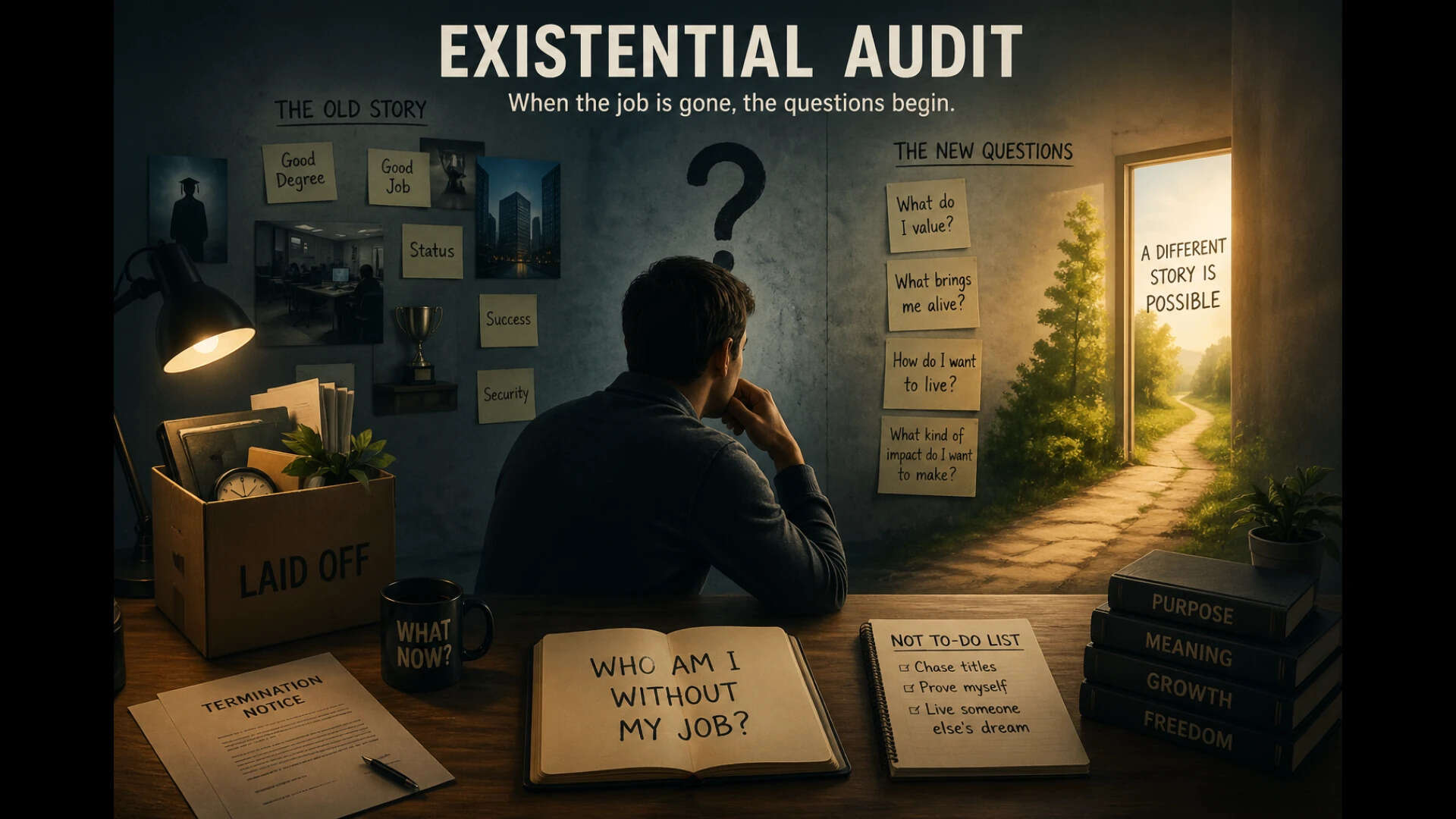
An existential audit is the sudden and often uncomfortable self-examination people are forced into redundancy. It goes beyond worrying about income and pushes individuals to question deeper assumptions: who they are without their role, whether their work truly mattered to them, and what success should look like going forward. (AI generated)
Who am I without my work?
In urban, upwardly mobile contexts, professional roles serve as shorthand for self-introduction and social positioning. A layoff does not merely remove income; it erases the vocabulary used to navigate the world. Conversations with those affected often reveal hesitation not just about next steps, but about answering “What do you do?” The embarrassment of replying “I’m figuring things out” underscores how profoundly the ideology of constant productivity has been internalized. Ambiguity feels like personal failure rather than a systemic outcome.Digital sociologists note that layoffs force a confrontation with a self that exists outside structured output – a version many of us find unfamiliar and even frightening. The result is an “existential audit”. For years, the narrative of “finding your passion” blurred livelihood with purpose. Layoffs are now exposing its fragility. Loss rarely feels like pure heartbreak; instead, it surfaces a mix of relief, anxiety, and quiet admission that “passion” was often retrofitted onto pragmatic decisions about pay, prestige, and expectations.What mass layoffs are doing is disrupting the legibility of prestige and self-worth associated with having a job. It is forcing all of us to confront a version of the self that exists outside structured productivity – a version most of us are unfamiliar with, and, if we’re honest, slightly afraid of. This interruption creates space for uncomfortable questions: Was I ever truly passionate, or did I simply excel at something rewarded by the market? The distinction between competence and meaning, long conflated, becomes unavoidable.
The myth of passion
For years, we have been sold a comforting narrative: find your passion, and work will never feel like work. It is a seductive idea, one that collapses the distinction between livelihood and meaning. But mass layoffs expose the fragility of this belief. If work were truly an expression of passion, its loss would feel like heartbreak. Sometimes, it does. But just as often, what surfaces is something more complicated: relief mixed with anxiety, exhaustion disguised as ambition, a quiet admission that the “passion” may have been partly constructed. Many careers are built not on intrinsic calling but on a series of pragmatic decisions: what pays well, what seems prestigious, what others expect. Over time, these choices are retrofitted into a narrative of passion. We learn to love what we do because we have invested too much to question it.A layoff interrupts that narrative. It creates a rare gap between what we were doing and what we tell ourselves we care about. In that gap lies an uncomfortable question: Was I ever passionate about this, or did I simply become good at it? This is not an easy question to answer. Nor is it one that guarantees clarity. But it does open the possibility of distinguishing between competence and meaning—two things we often conflate.
Success, rewritten
If identity is shaken and passion is questioned, then success itself begins to look unstable. For a long time, success has been defined in fairly standard terms: upward mobility, financial security, recognisable brands on a résumé. These markers are not meaningless. They do shape material realities. But they also create a narrow template against which lives are measured.Layoffs disrupt this template in two ways. First, they reveal how little control individuals have over outcomes often attributed to personal merit. High performers, loyal employees, people who did everything “right” – all find themselves equally vulnerable.Second, they expose the transactional nature of work relationships. The idea that commitment would be reciprocated with stability begins to erode. What remains is a more pragmatic, sometimes cynical understanding of work as an exchange rather than a bond. This shift can feel disillusioning, but it also creates space for redefining success. If the old markers are unreliable, what replaces them?

For some, success becomes about autonomy; the ability to choose how one spends time. For others, it shifts toward sustainability – work that is less intense, more humane. For many, it becomes more personal and less performative, less about external validation and more about internal coherence.
For some, success becomes about autonomy; the ability to choose how one spends time. For others, it shifts toward sustainability – work that is less intense, more humane. For many, it becomes more personal and less performative, less about external validation and more about internal coherence. These redefinitions are not always neat or immediate. They often emerge slowly, through trial and error, through periods of doubt and recalibration. But they mark a departure from inherited scripts toward something more self-authored.
Time, suddenly unstructured
One of the most underestimated consequences of layoffs is not financial but temporal. Work structures time in ways we rarely notice: meetings, deadlines, routines. Without it, days can stretch out in unfamiliar, sometimes unsettling ways. The first few days often feel like a break, an unexpected pause. But soon, the absence of structure begins to weigh. There is a pressure to remain productive even in unemployment—to upskill, to network, to “make the most” of the time. This pressure reveals how deeply productivity has become tied to self-worth. Idleness is not experienced as rest but as failure. And yet, there is something quietly radical about unstructured time. It creates the possibility—however uncomfortable—of encountering oneself outside the demands of output. Of sitting with questions that are usually deferred: What do I enjoy? What do I avoid? What kind of life am I trying to build?These are not questions that yield quick answers. In fact, they often produce more uncertainty. But they are also the kinds of questions that structured, high-intensity work rarely allows.The challenge is not just to use time efficiently, but to tolerate it—to resist the urge to immediately fill it with another version of busyness.
Choosing differently the second time
The existential audit does not always lead to dramatic reinvention. Not everyone quits their industry or starts something entirely new. For many, the next job looks similar to the last one, shaped by practical constraints and financial needs. But even within continuity, there can be subtle shifts.People become more cautious about over-identifying with work. They diversify, not just financially, but psychologically. Investing more in relationships, hobbies, aspects of life that are less contingent on employment. There is often a recalibration of boundaries. Work remains important, but it is less likely to be all-consuming. The illusion of permanence having been broken, there is less incentive to sacrifice everything at its altar. Some do make larger changes towards roles that feel more aligned, or at least less draining. But even these choices are rarely driven by sudden clarity. More often, they emerge from a process of elimination: a clearer sense of what one does not want, rather than a perfect vision of what one does. This is perhaps the most honest outcome of the audit. Not a grand revelation, but a quieter, more grounded understanding of trade-offs.

There is often a recalibration of boundaries after layoff. Work remains important, but it is less likely to be all-consuming. The illusion of permanence having been broken, there is less incentive to sacrifice everything at its altar.
Living with questions
It is tempting to look for resolution. A neat ending where the laid-off professional finds a new path, a new purpose, a better version of success. But the reality is less tidy. The questions triggered by layoffs do not disappear once a new job is secured. They linger, sometimes faintly, sometimes insistently. They resurface in moments of stress, in periods of transition, in the quiet recognition that stability is never as solid as it appears.Perhaps the point of the existential audit is not to find definitive answers, but to become more comfortable with the questions themselves. To accept that identity can be fluid, that passion can be constructed, that success can be redefined, and that uncertainty is not an aberration but a condition of modern life. This is not a comforting conclusion. But it is, in its own way, liberating.Because once the illusion of a fixed, linear path is broken, there is space… however daunting to imagine alternatives. To choose, even within constraints, with a little more awareness and a little less blind adherence to inherited scripts.Layoffs, in this sense, are not just economic events. They are moments when the stories we tell about work and self are interrupted. What we do with that interruption—whether we rush to restore the old narrative or allow ourselves to question it—shapes what comes next.And perhaps that is the quiet opportunity hidden within the disruption: not to rebuild the same story more quickly, but to ask whether it was ever the right one to begin with.