






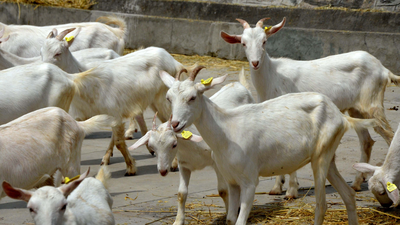
Saanen goats are being introduced to Kashmir as high-yield dairy animals, notably by institutions like MRCS&G Shuhama, to boost milk production
SRINAGAR: GOAT is how visitors are pitching a new arrival at Sher-e-Kashmir University of Agricultural Sciences and Technology in Srinagar, where a Swiss dairy breed has set tongues wagging and phones ringing. Just two weeks in Kashmir, and Saanen goats are already the talk of the valley, drawing daily crowds and a steady stream of calls from would-be buyers. The answer, for now: hold your horses — three years.Twenty-four animals, including 20 females, landed at the university’s research centre as part of a structured study to test milk output, indoor rearing, disease resistance and reproduction. “Though Kashmir and Switzerland share some weather patterns, we need to see if yields of five to six litres a day hold up here and how well they cope with a changing climate,” said senior scientist Dr Parvaiz Ahmed Reshi. “Only then can we recommend wider use.”The buzz has a simple cause: more milk for less feed, and a temperament that makes them easy to keep — almost like pets — through long winters when barns turn into living rooms. Researchers said Saanens can be reared in compact indoor spaces, a crucial edge in a high-altitude, land-squeezed valley where fodder runs about 60% short and homes are getting tighter.Originating in Switzerland’s Saanen Valley, these goats are typically white or cream, medium-to-large (about 50–60kg), and known for a calm, docile temperament that suits close handling. Bred primarily for milk rather than meat, they can yield around 5–6 litres a day under good management, often with a high twinning rate.A crossbreeding plan is also on the table. Scientists aim to pair Saanens with local, low-yielding Bakerwal goats, which produce roughly a litre a day, to lift productivity without losing hardiness. “This is the first time the breed is being studied at this scale under a structured programme in India,” Reshi said.For households counting every bale of hay, arithmetic is compelling. Saanens need about one-fifth the fodder of a cow. “Cows give more milk overall but demand far more space and feed,” Reshi said. “If this works, urban homes could keep Saanen goats like pets.”Health claims are adding fuel to the fire. The milk carries about 3–4% fat, is easier to digest and lacks the strong odour often linked to goat milk. Researchers said it is rich in A2 beta-casein protein, drawing interest from patients undergoing chemotherapy or dealing with dengue.For now, excitement is on a tight leash. Scientists will track performance across seasons before any rollout. Until then, Kashmir’s newest Swiss import remains a pet-sized dairy dream — a “greatest of all time” in waiting.