

Today, we are exploring a question that sits at the very heart of our democracy: Are traditional news channels losing the public’s trust? The latest data from 2026 suggests we are living through a period of profound volatility and transformation in how the world-and specifically India-consumes information.
A Global Trust Deficit
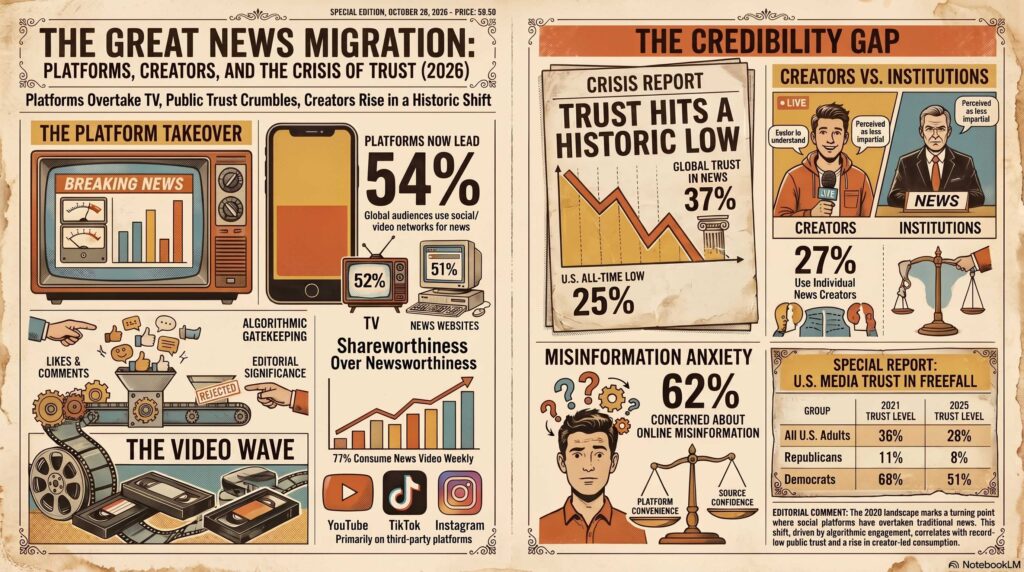
The numbers are startling. Global trust in news has fallen to 37%, the lowest level recorded since the Reuters Institute began tracking this metric in 2015. In the United States, that figure is even grimmer, with trust hitting a record low of 25% to 28%. This decline isn’t just about a lack of faith in the stories themselves; it’s a reflection of wider anxieties regarding institutions and a noisier, more fragmented information environment.
In India, while the digital landscape remains relatively free and adaptive, we are not immune to these trends. Interestingly, while trust in news “overall” is slipping, trust in specific, established news brands often remains more resilient, suggesting that the public still values a reliable anchor in the storm.
The Platform Takeover
For the first time, social media and video networks have overtaken both television and news websites/apps as the primary source of news globally. We are moving away from “appointment viewing” toward a “drift” where news is encountered incidentally while scrolling through TikTok, Instagram, or YouTube.
This shift has given rise to the “News Creator.” About 27% of global audiences now get their news from independent influencers rather than traditional anchors. In India, this trend is even more pronounced, with 46% of people using news creators weekly. While these creators are often seen as more relatable and easier to understand, the public still views them as less impartial and less trustworthy than traditional newsrooms.
Algorithms vs. Editorial Judgment
Why is this happening? A major factor is algorithmic curation. Social media algorithms are optimized for engagement, not journalistic significance. This redefines newsworthiness as “shareworthiness,” prioritizing content that triggers emotional reactions—likes, shares, and comments-over investigative depth.
Furthermore, research shows that cable news is becoming increasingly polarized. Major networks are diverging in the topics they cover and the language they use, creating “separate realities” for viewers. When news feels like a partisan weapon rather than a public service, trust inevitably erodes.
The AI Frontier
As if the landscape weren’t complicated enough, AI chatbots are now entering the news cycle. Weekly use of tools like ChatGPT and Google Gemini for news has grown to 10% globally. Users appreciate them for summarizing complex stories and answering follow-up questions. However, trust in AI-generated news is currently very low, at just 20%. Most users are currently using AI as a “power tool” for depth rather than a primary news source.
Rebuilding the Relationship
So, how does journalism survive? The solution may lie in a return to basics. As noted in recent collaborations between Indian and German journalists, “Trust is not a metric; it is a relationship”.
To win back audiences, newsrooms must prioritize:
- Transparency: Showing how stories are reported and admitting when mistakes are made.
- Listening: Moving away from a one-way broadcast model to a participatory one where audiences can challenge assumptions.
- Local Focus: Local newspapers remain more trusted than national media because their journalists are active, accountable members of the communities they cover.
At voicesofindianews.com, we believe the future of news depends on whether audiences feel journalists are working in the public interest, not just for clicks or corporate owners. The tools we use to get the news will continue to change, but the human need for a trusted relationship remains.