




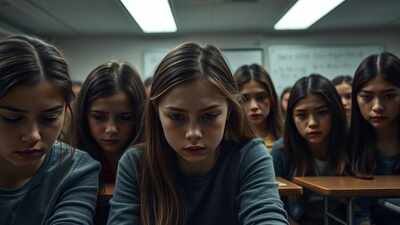
Women’s Day is around the corner. We will again hear familiar narratives of empowerment and access. But when we look closer, the picture appears fractured. Girls are enrolling, excelling, and aspiring in record numbers. Yet beneath the report cards and entrance exam dreams lies an emotional crisis that is disproportionately female. The IC3 Student Well-being Pulse Report (2025), drawing on responses from students across schools, exposes a widening gender gap in stress, anxiety, and emotional security.Nearly 1 in 3 female students rarely or never feel calm and relaxed, compared to about 1 in 4 boys, according to the IC3 report. Confidence follows a similar pattern: 1 in 5 girls rarely feels confident, double the proportion among boys (about 1 in 10).More troubling is the prevalence of sadness. While 1 in 4 students frequently experience sadness or loneliness, girls are nearly twice as likely as boys to report persistent sadness, roughly 1 in 4 females versus 1 in 8 males.The report also identifies a high-risk emotional group, about 1 in 5 students, who rarely experience positive emotional states such as excitement, motivation, or calmness. Female students are overrepresented in this cohort.
Academic pressure is equal, emotional burden is not
Academic stress dominates student life. About 1 in 5 students cite academic performance as their leading stressor, while 1 in 6 worry intensely about future careers, and another 1 in 6 feels overwhelmed by schoolwork or homework. But the pressure fractures differently across genders.Boys are more likely to report stress from schoolwork and homework. Girls, however, are significantly more likely to report stress linked to family expectations, social perception, and personal inadequacy. The stress for girls is less about the assignment due tomorrow and more about the life script being silently drafted around them.Nearly 1 in 2 students admit they sometimes feel “not good enough”, with girls expressing greater vulnerability. Close to 1 in 3 female students often compare themselves to others and feel worse as a result. In a culture saturated by curated social media lives and competitive academic benchmarks, comparison has become a daily ritual.
The career guidance gap
If adolescence is a bridge between aspiration and adulthood, many girls appear to be crossing it without a map. The IC3 report notes that nearly half of students do not receive structured career counselling in school, with 1 in 4 saying “No” outright and another 1 in 5 unsure. At the same time, nearly one-third of students report high anxiety about their future, and an additional 1 in 4 remain uncertain. Female students are significantly less confident about their futures without structured guidance.
Coping in silence
When distress peaks, students overwhelmingly turn to friends, followed by family. Formal support systems, teachers, school counselors, and therapists remain marginal.Nearly 60% of students say they are uncomfortable or unsure about approaching school staff for personal or career counselling. Almost 40% do not know where to seek professional help within their school. Alarmingly, 1 in 5 students say they have no one to turn to when they need emotional support, and another 1 in 3 sometimes feel this way.Female students are significantly more likely than males to rely on themselves during distress. On the surface, this self-reliance appears resilient. In reality, it often signals internalisation, stress turned inward rather than spoken aloud.Stigma compounds the problem. Nearly half of students are neutral, unsure, or negative about mental well-being support and therapy.
Sleep: The silent casualty
The emotional toll is visible in sleep patterns. By Grade 12, nearly 3 in 4 students do not get the recommended 7–8 hours of sleep on school nights, up from 1 in 2 in Grade 8. The proportion of students sleeping less than five hours nearly doubles from 1 in 10 in middle school to 1 in 5 in senior grades.More than half of students report daytime tiredness at least sometimes, with nearly 1 in 3 female students reporting persistent fatigue.Academics and overthinking are the primary sleep disruptors. Over half of students say stress, worry, or mental overload most affects their sleep. Girls are significantly more likely to report overthinking and anxiety as sleep barriers. Screens and social media follow as the second major disruptor.Nearly half of students primarily engage in passive social media use, scrolling and watching rather than interacting. As screen engagement intensifies, both personal and school life satisfaction decline “consistently and meaningfully,” the IC3 report observes.
Progress without protection
India has made undeniable strides in improving girls’ access to education. Enrolment gaps have narrowed, ambitions have expanded, and role models are more visible than ever. But the IC3 Student Well-being Pulse Report (2025) suggests that access has outpaced emotional infrastructure.School life satisfaction is the lowest among all satisfaction categories measured. Male students consistently report higher satisfaction and well-being scores than female students. Non-binary students report significantly lower satisfaction overall.Nearly 1 in 3 students perceive low school support for mental well-being, and another 1 in 4 remain neutral, a sizeable bloc of students whose expectations are either unmet or undefined. If classrooms are meant to be spaces of growth, many girls experience them as arenas of quiet endurance.
The structural question
Why are more female students stressed? The data suggests it is not simply about academic load. It is about layered expectation, academic excellence, social conformity, emotional composure, physical appearance, and future planning, all converging during adolescence. It is about being told to aspire without being taught how to navigate the path.It is about internalising pressure in environments where seeking help feels uncertain or unsafe. As India celebrates women’s advancement, the IC3 findings offer a sobering reminder: Empowerment cannot be measured only in enrolment ratios or examination results. Emotional safety, structured guidance, and accessible mental health pathways must keep pace.Otherwise, progress risks becoming performative, and young women will continue to carry the invisible weight of ambition alone.