




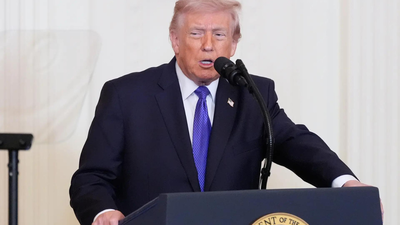
TOI Correspondent from Washington: US President Donald Trump on Sunday offered a raft of explanations for launching “Operation Epic Fury,” the devastating air campaign against Iran that killed its supreme leader Ali Khamenei, including one gotcha justification: “I got him before he got me.”In a series of interviews with several USmedia outlets – ten by one count – Trump wove a complex, sometimes contradictory narrative to justify a war that, going by various polls, has filled Americans with doubt and disquiet. The centerpiece of this rhetorical offensive came during a Monday afternoon call with ABC News when he was asked about the specific targeting of Iran’s highest religious and political authority. “I got Khamenei before he got me,” the President bluntly told correspondent Jonathan Karl. “They tried twice, I got him first.”In other interviews, some of them short phone-ins, Trump laid out a triple-threat rationale for the sudden, violent escalation against Iran at the end negotiations, telling one outlet about “specific, highly classified intelligence” that showed an Iranian cell was within days of an assassination attempt on U.S. soil, while asserting to another that Iran was interfering in US elections. Perhaps the most urgent claim—repeated in interviews with CNBC and The Washington Post—was that Iran was “weeks, maybe days” away from a functional nuclear warhead. However, intelligence agencies have not revealed any definitive evidence to back these allegations, even as critics are suggesting the President is gaslighting the public to provide a legal veneer for regime change brought about at the instigation of Israel and Saudi Arabia. Polls show a majority of Americans oppose military action against Iran, with only about one in four – mainly Republicans – supporting Trump on the issue. The sheer volume of Trump interviews – and social media posts – suggests a strategic attempt to saturate the news cycle and “flood the zone” with the President’s version of events before domestic opposition can solidify. By speaking to multiple outlets, he is able to tailor his message: talking of “freedom for the Iranian people” to liberal outlets like The Atlantic, while emphasizing “annihilating their navy” to a more red-blooded Fox News audience. However, this strategy has exposed significant inconsistencies. On Sunday, Trump told The New York Times that the operation followed the “Venezuela model,” implying a quick transition of power. Yet by Monday, he was admitting to CNN that the strikes were so successful they had “knocked out most of the candidates” for a successor. “It’s not going to be anybody we were thinking of because they are all dead. Second or third place is dead,” he boasted to ABC, asserting with his the trademark bravado and self-aggrandizement: “Nobody else could have done this but me.”Trump also revealed a surprise contact from “one of the few remaining people who are still alive” in Iran’s leadership and suggested sanctions relief for a “pragmatic” successor. In one interview, he floated three competing post-Khamenei scenarios: the Islamic Revolutionary Guard Corps (IRGC) surrendering weapons to the populace, a Venezuela-style decapitation leaving most bureaucrats in place, or Iranians themselves seizing power. “We have work to do and we’ve done it very well,” he said, claiming the campaign was “quite ahead of schedule” after destroying much of Iran’s navy and decapitating command. The decapitation paradox leaves a vacuum that contradicts his earlier calls for the Iranian people to “take back their country.” Without a clear leadership tier left intact, the four-week timeline Trump mentioned in one interview is viewed with skepticism by military analysts who fear the U.S. has once again entered an open-ended conflict without a Plan B. Despite the ongoing bombardment, the US President also remains obsessed with the image of the negotiator. He has claimed that remaining Iranian officials “want to talk,” even as Tehran’s Supreme National Security Council denies any agenda for dialogue. “They want to talk. I said “Too Late!” he boasted in a social media post.By keeping the messaging fluid—alternating between the roles of the vindictive commander and the peace-seeking deal maker —Trump is attempting to cover all angles. If the regime falls quickly, he claims a historic victory for freedom. If the war drags on, he points to the “imminent threats” he successfully “neutralized” to protect American lives. For now, the world watches as the U.S President continues to narrate a war in real-time, one phone call and one social media post at a time.