





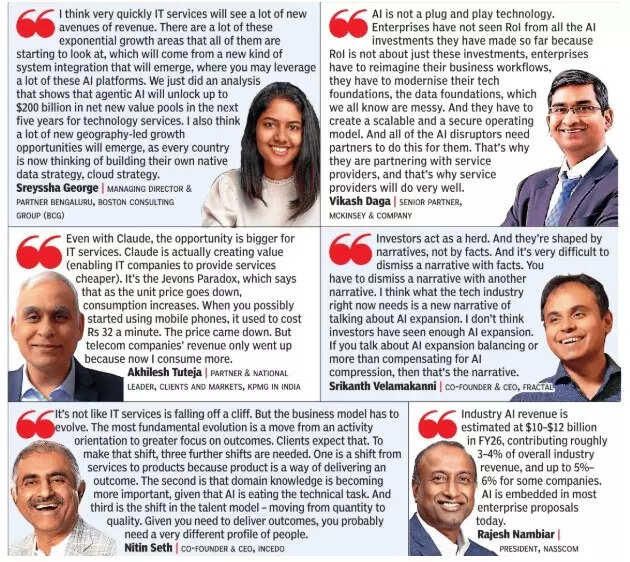
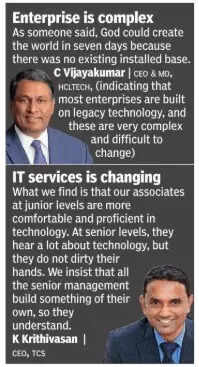
IT services stocks have crashed; industry says investors don’t understand enterprise complexityJust days after Vinod Khosla and Citrini Research predicted doom for IT services, the industry they expect to die met in Mumbai for the annual two-day Nasscom Technology & Leadership Forum. Halls were packed as always. You had to literally squeeze through crowds of people in the corridors.In discussions, while there was uncertainty on exactly how AI will impact the business, there was absolute unanimity about one thing: Enterprises are complex beasts, and no AI tool can perform magic without IT services coming in to prepare the organisation for it, and then managing the entire process.Vikash Daga, senior partner at McKinsey & Company, noted that AI investments pay off only when enterprises reimagine workflows, and have infrastructure and data that’s AI-ready. Reimagining workflows starts with identifying bottlenecks that can be automated, then testing AI solutions on them, and, if one works, then scaling it. For this, data needs to be clean, it cannot be in silos across divisions or functions. IT services companies will be indispensable in all of this.Akhilesh Tuteja, partner in KPMG in India, noted that code generation – which is where Anthropic’s Claude seems to have made a big difference – is a small part of IT services’ revenue. “Even if code gen cost comes down dramatically, the other things are not going away. The hardware, the network, deployment, integration, security, change management, training, ongoing maintenance – those are 2x to 3x the cost of creating code,” he said.
.
Jevons ParadoxAlmost everyone seemed to also be talking about Jevons Paradox. Proposed by economist William Stanley Jevons in 1865, it occurs when technological progress increases the efficiency with which a resource is used, but the falling cost of using that resource causes total consumption to rise rather than decrease. The best example of that came from Fractal Analytics founder & CEO Srikanth Velamakanni, and soon, everyone was talking about it. He referred to Anthropic’s claim that Claude can understand and modernise programming language Cobol, to say that if that was indeed the case, it would be a big opportunity for Indian IT. Currently, he said, migrating Cobol code is about $15-$20 per line. For a 50-millionline system, that could amount to $700 million to $1 billion and would take some 18 months. “The risk is high, complexity immense, and CIOs naturally avoid such highstakes projects unless necessary. With AI-assisted modernisation, the cost per line could drop to about $2. That turns a $1-billion, 18-month project into $100 million,” he said, and noted that many more CIOs would now be eager to do the conversion, and conversion of the entire 800 billion lines of Cobol code would be a $1.6 trillion opportunity for Indian IT.
.
Boiling frogBut everyone also admitted there are big challenges ahead. The boiling frog story is one that we kept hearing. The story is a metaphor claiming that a frog placed directly into boiling water will jump out, but if placed in cold water that is gradually heated, it will not perceive the danger and will cook to death. It warns against ignoring slow, incremental changes in dangerous situations.Tuteja narrated it in the context of programmers, who today may be lulled by AI that’s making their jobs easier – “enjoying the warm water” – and not seeing that it could make them irrelevant (dying when the water turns hot) if they don’t learn new skills. “We’ve had a boiling frog issue in every technology shift, but this one is more intense,” he said.Nitin Seth, co-founder & CEO of Incedo, mentioned the story in the context of IT services companies. “The path is becoming harder. And the business model has to evolve fast,” he said, especially in the direction of delivering outcomes – instead of people – to clients.Sreyssha George, partner in Boston Consulting Group (BCG), said while some companies are worried about the cannibalisation of their revenue by AI productivity tools, there are others who are starting to build new revenue sources – with new roles and new offerings. “Even from a leadership perspective, the talk has to really change into everybody getting into doing it to see how it works. I’m doing some vibe coding myself right now,” she said.