
India’s mobility landscape is undergoing a structural metamorphosis. What was once a futuristic aspiration has become a foundational pillar of the nation’s climate strategy and industrial policy. As we move through 2026, the shift toward electric vehicles (EVs) is no longer just about meeting environmental goals; it is about unlocking a $200 billion economic opportunity and positioning India as a global manufacturing hub.
The Numbers: A Decisive Half-Decade
India’s EV penetration stood at 7.66% in 2024, a significant rise from the negligible levels seen a decade ago. To meet the national target of 30% EV sales by 2030, the industry must now increase penetration by over 22% in the next five years alone. While global EV sales reached 18.78 million in 2024, India recorded roughly 2.08 million sales that year, showing that the transition is picking up pace.
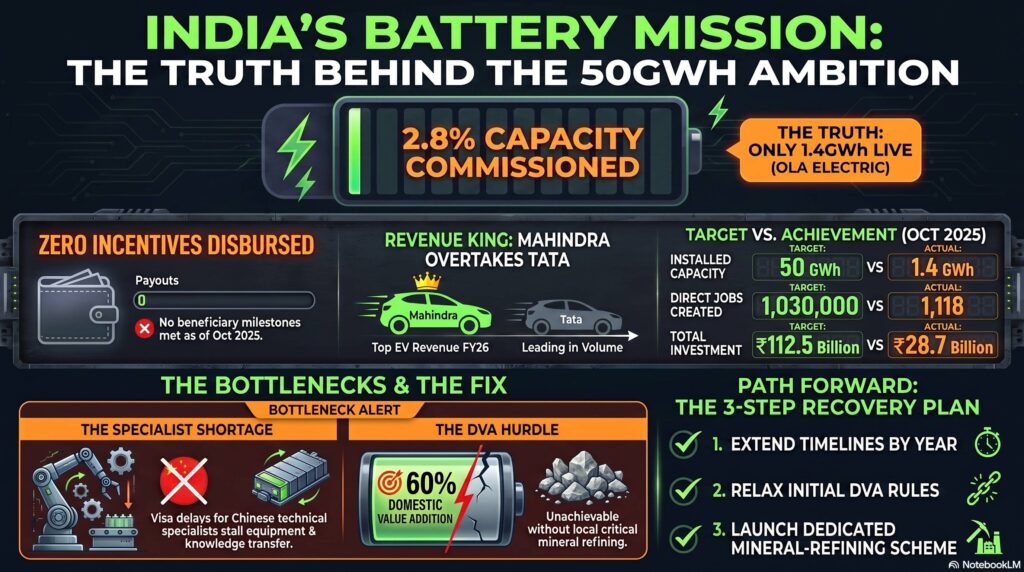
The market dynamics are shifting rapidly. In a landmark development for FY26, Mahindra & Mahindra edged ahead of Tata Motors to become the top electric car player in revenue terms, driven by the successful launch of new electric SUVs. However, Tata Motors remains the volume leader, maintaining a 39% market share as of mid-2026.
Policy as a Catalyst: FAME III and PM E-DRIVE
Government intervention remains the primary driver of adoption. The FAME III scheme, announced with a budget exceeding ₹10,000 Crore, provides critical demand-side incentives for electric cars, two-wheelers, and buses. This is complemented by the PM E-DRIVE scheme, which focuses on infrastructure and ecosystem readiness.
Beyond subsidies, the Union Budget 2026-27 introduced vital indirect gains, including customs duty exemptions on capital goods used for lithium-ion cell manufacturing and critical mineral processing. These measures are designed to lower battery costs—which can reach $80-90/kWh by 2030—and improve supply chain resilience against global price volatility.
The Manufacturing Frontier: ACC PLI Challenges
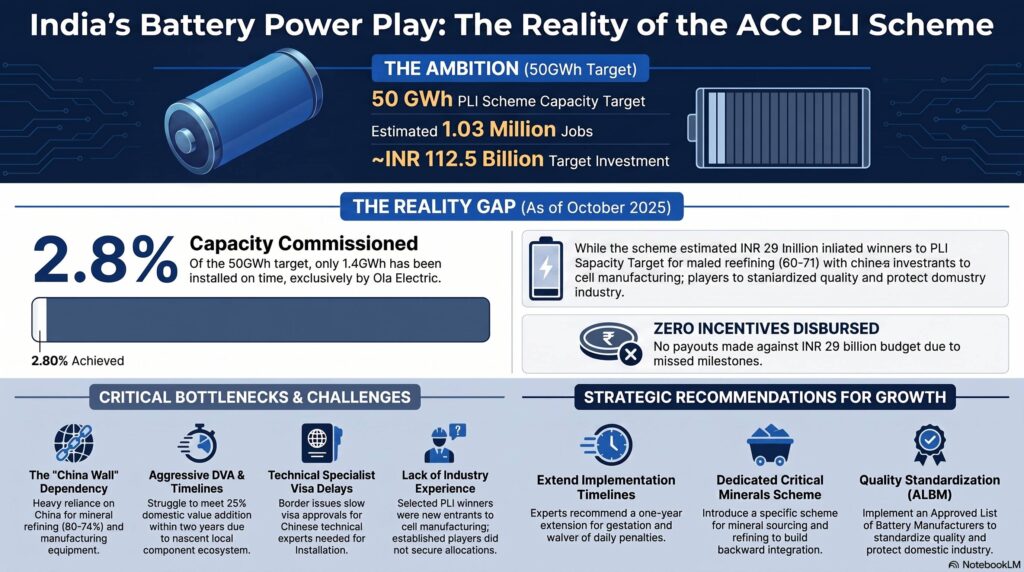
To achieve “Atmanirbharta” (self-reliance), the Ministry of Heavy Industries launched the Advanced Chemistry Cell (ACC) PLI scheme with an outlay of ₹181 billion. The goal is to develop 50GWh of domestic cell manufacturing capacity.
Progress, however, has been measured. As of late 2025, only 2.8% (1.4GWh) of the targeted capacity had been commissioned, entirely by Ola Electric. Other major players like Reliance New Energy are advancing their facilities, with plans to start commercial production by FY2027. The sector faces significant bottlenecks, including a heavy reliance on China for manufacturing equipment and critical minerals like lithium and cobalt.
Infrastructure: Solving the Charging Paradox
One of the most persistent hurdles is the “charging paradox.” India currently has an EV-to-charger ratio of 235:1, far below the global standard of 20:1. Furthermore, 62% of the country’s 29,277 public charging stations are concentrated in just five states: Karnataka, Maharashtra, Uttar Pradesh, Delhi, and Tamil Nadu.
To address this, the industry is turning toward Integrated Solar + BESS (Battery Energy Storage Systems). Since EV charging demand often peaks between 6 PM and 11 PM—when solar power is unavailable—integrated storage allows stations to capture daytime solar and release it during peak hours. Real-world deployments have already shown a 40-60% reduction in demand charges for operators.
The Road to 2030: Innovation and Sustainability
The future of Indian mobility will be defined by technological sophistication:
- Battery Swapping: This model is gaining ground for two-wheelers, significantly reducing upfront costs and allaying range anxiety.
- Segment-Wise Growth: While two-wheelers and three-wheelers lead the charge, the next phase will see the electrification of private intercity mobility and corporate fleets.
- Recycling: India’s EV battery recycling market is projected to expand to 128 GWh by 2030, ensuring that 90% of constituent metals can be recovered and reused.
Conclusion India stands at a pivotal juncture. The transition is moving from a policy-led initiative to a structural transformation. By integrating domestic manufacturing, innovative financing, and clean energy storage, India is not just electrifying its transport; it is carving out a model for sustainable mobility that the rest of the world will follow.