




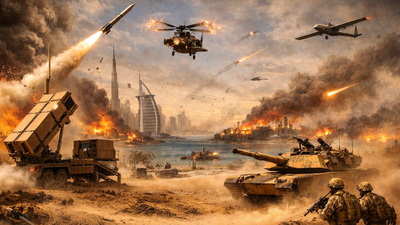
When one thinks of the decisions taken by strategists in Washington DC, Riyadh and Abu Dhabi; what comes to mind are that these decisions are shaped by intelligence feeds, depleting missile stockpiles and diplomatic rammifications. One of the most important consideration that is often left out of public discourse is the effect of the environment, a key consideration for strategists.In the current conflict the scorched, sand-swept terrain of the Arabian Peninsula and the shimmering, humidity-soaked waters of the Persian Gulf are not passive backdrops. They are active participants in the conflict as it unfolds.To understand how the environment interacts with strategy, we spoke to Brigadier SK Chatterji (Retd), former DDG, Strategic Communication, Indian Army, author and strategic analyst, who walked us through the full spectrum of how terrain and climate shape battlefield outcomes in a possible strike environment involving Saudi Arabia or the UAE. Brigadier Chatterji has vast experience of operating in different types of terrains, including in the deserts. In the first hours of March 1, 2026, the skyline above Dubai flickered with the light of intercepted drones. Iranian missiles and Shahed-type unmanned aerial vehicles had crossed into UAE airspace in the hundreds — 165 ballistic missiles and 541 drones in the opening days alone, according to the UAE’s Ministry of Defence. Debris from intercepted projectiles set fires at the Ruwais refinery complex, forced a shutdown at ADNOC’s 922,000-barrel-per-day facility, and sent glass raining onto the streets of Palm Jumeirah. Across the border, Iranian drones struck Saudi Arabia’s Ras Tanura oil complex, one of the largest refining facilities on earth, forcing a temporary halt to operations. What had been a theoretical question in war colleges suddenly became a live one: in this environment, how do weapons actually perform?Operation Epic Fury, the US-Israeli air campaign against Iran that began on February 28, 2026, has drawn the Arabian Peninsula into the most kinetically intense conflict the region has seen in decades. The UAE and Saudi Arabia- home to some of the world’s most advanced air defence batteries, Western-supplied fighter fleets and enormous oil infrastructure- were not combatants. They became targets anyway. Iran’s logic was blunt: any country hosting American military bases was fair game for retaliation.
The environment as a combatant
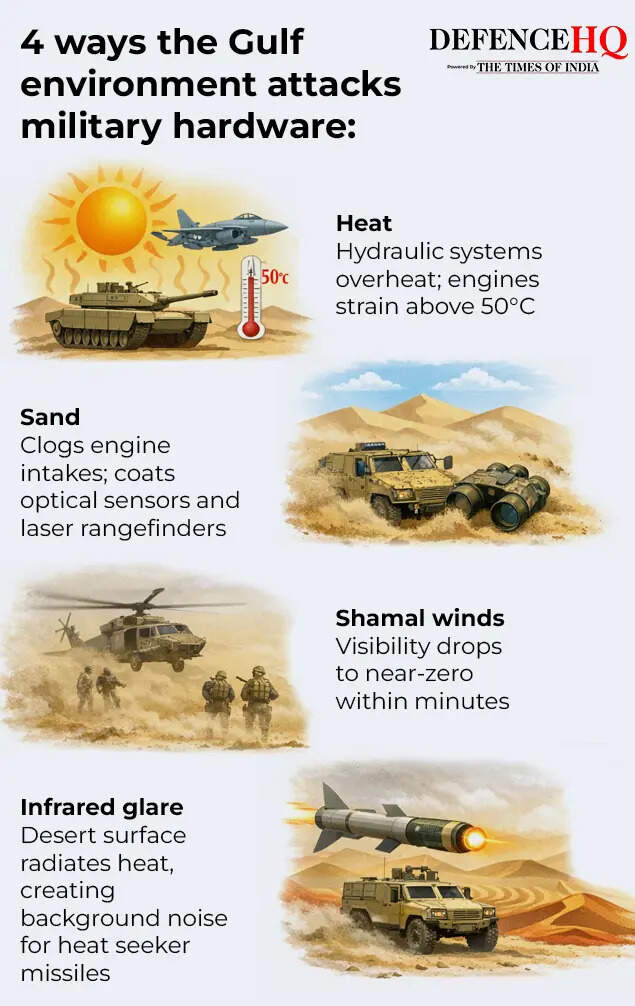
Wars in the Gulf are never simply fought between armies. They are fought between armies and their environment. The Arabian Peninsula’s combination of extreme heat, fine silica dust, open terrain and unpredictable weather creates a battlespace unlike any other on earth. Summer temperatures in eastern Saudi Arabia regularly exceed 50 degrees Celsius. The shamal- a fierce northwesterly wind- can reduce visibility to near-zero within minutes, blanketing armour columns, helicopter pads and missile batteries in a choking, abrasive screen of fine dust.“Terrain, climate and weather conditions are compelling influences in any battlespace,” Brigadier Chatterji notes. “These factors will have a decisive effect on the type of operation any force would opt for.”The absence of vegetation has profound tactical consequences. Advancing columns can be detected and tracked from far greater distances than in jungle or urban terrain. There is no tree line, no ridge, no built-up area to offer concealment. Every armour vehicle, every logistics convoy, every forward operating base is visible from the air — and often from the ground. “Movement can be detected from longer distances,” Brigadier Chatterji observes, “and engagement of advancing columns carried out with greater accuracy.“
“Desert terrain is often termed as a tactician’s paradise holding, while simultaneously being a logistician’s hell.”
Brig SK Chatterji
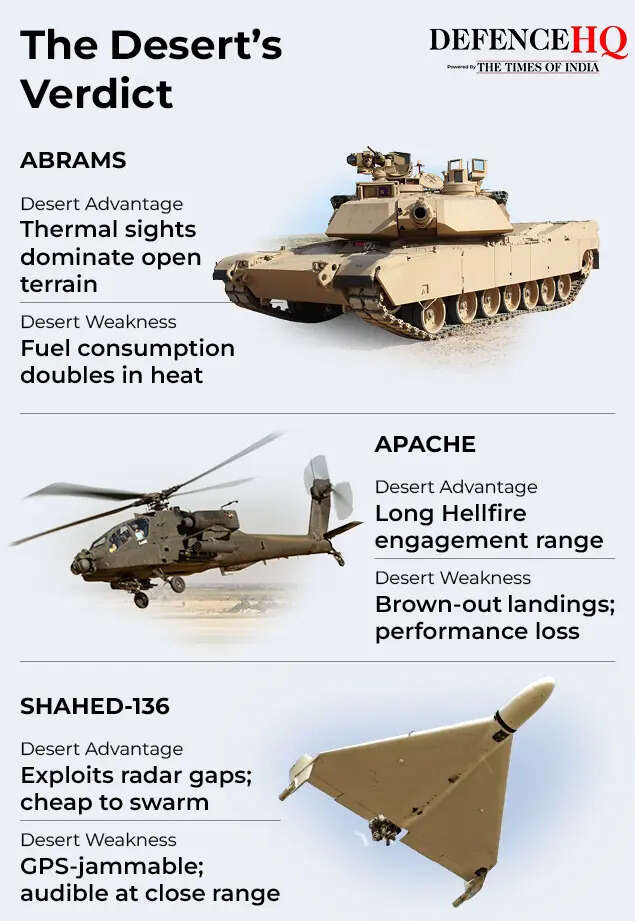
That observation was dramatically confirmed during Operation Desert Storm in 1991, when the US-led coalition used the open terrain of Kuwait and southern Iraq to devastating effect. M1A1 Abrams tanks scored first-round kills on Iraqi T-72s at ranges exceeding 3,000 metres — possible precisely because the desert offered no cover to the defender. Not a single Abrams was destroyed by Iraqi fire during the entire ground war.
Sand in the gears: Real problem, manageable solution
The Gulf’s physical environment poses well-documented challenges for military hardware. Engine intakes ingest fine particulates. Optical sensors are coated with windblown sand. Barrel wear accelerates as tiny sand particles nick them from the inside. Hydraulic systems overheat. The question is not whether desert conditions degrade equipment; they do, but whether modern militaries and weapons manufacturers have kept pace.The evidence is broadly reassuring. South Korea’s Hyundai Rotem, marketing its K2ME main battle tank to the UAE and Saudi Arabia, has redesigned the vehicle’s cooling architecture specifically for Gulf conditions, adding a larger radiator, enhanced hydraulic oil cooling, and fuel tanks rated above 50 degrees Celsius. The standard K2 Black Panther needed significant modification before it could be offered to Gulf customers with a straight face.Western OEMs face the same pressure. Brigadier Chatterji is measured, “Americans sell their equipment globally. To be selling equipment in such an environment, these issues would have to be built-in at the design stage or through modifications.” The operator’s responsibility is equally demanding: tighter servicing schedules, prepared surfaces for aerial platforms, and pre-positioned spare parts deep enough to absorb accelerated desert wear. During Desert Storm, the Abrams performed beyond expectations — its thermal sights were effective “not only at night, but also in the dust and smoke of Kuwaiti daytime.” The lesson was clear: equipment can perform in desert conditions, but only when logistics and maintenance receive the same priority as combat capability.
The Kopp-Etchells effect
There is a phenomenon that pilots operating in the Gulf’s sand-choked airspace know well, even if they rarely discuss it in briefings. Under the right conditions, a helicopter descending through a dust cloud, rotors churning at full pitch, the blades erupt in a swirling corona of sparks, like a miniature galaxy spinning at the tips. It is simultaneously one of the most visually arresting and operationally ominous sights in desert warfare. It is called the Kopp-Etchells Effect.The real mechanism is both simpler and more violent than early theories suggested. Rotor blades are fitted with abrasion-resistant strips along their leading edges, typically made from titanium or nickel alloys. When a helicopter flies through a sand-laden air mass, particles strike these strips at enormous velocity and shear off microscopic fragments of metal. Those fragments, dispersed as fine metallic powder, are pyrophoric — they ignite spontaneously on contact with oxygen. The brilliant halo is not electricity. It is the rotor blades burning, fragment by fragment, in real time.In the Gulf’s operational environment, the effect signals acute stress on aircraft already being pushed hard. Sand abrades composite blade surfaces, is ingested into engine intakes causing accelerated wear, and — most dangerously — triggers what pilots call “brownout.” As a helicopter descends toward a desert surface, its own downwash kicks up a swirling mass of fine particulate that engulfs the aircraft from every direction, destroying a pilot’s visual and vestibular orientation in seconds. It is not merely poor visibility. It is the complete disintegration of spatial awareness at the moment of maximum vulnerability.
The drone and missile test, and the desert’s verdict
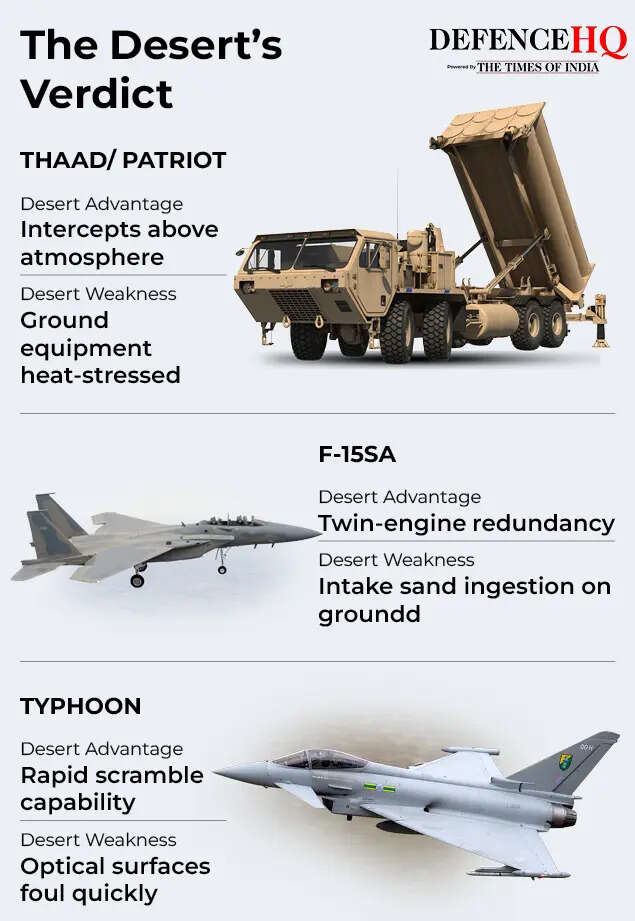
The opening weeks of Operation Epic Fury have provided the most intensive live test of Gulf-theatre air defence in history. Iran’s strategy has been to saturate defences with ballistic missiles, cruise missiles and Shahed-type loitering munitions- the latter flying low and slow, designed to evade conventional radar built for fast, high-altitude targets.UAE Patriot and THAAD batteries managed to destroy 152 of 165 ballistic missiles and 506 of 541 drones in the opening days: an intercept rate that would have seemed extraordinary even five years ago. But “extraordinary” is not the same as “complete.” The 35 drones that penetrated UAE’s defences struck civilian infrastructure. The Ruwais refinery too was shut down. Airports in Dubai and Abu Dhabi were hit. Even successfully intercepted projectiles left debris that sparked fires across populated areas — a reminder that in an urban desert environment, the effects of successful interceptions can itself become a hazard.Saudi Arabia’s Ras Tanura complex was forced to halt operations after Iranian drone debris caused fires at the facility. QatarEnergy declared force majeure after repeated strikes on Ras Laffan, the world’s largest LNG terminal. Across the Gulf, the International Energy Agency reported more than 40 energy assets “severely damaged” within weeks of the conflict opening.For aircraft operating in the Gulf’s thermally intense environment, a long-debated concern is whether ambient heat degrades heat-seeking missiles by raising background infrared noise. Brigadier Chatterji’s view is that this is not a decisive operational problem. Modern IR-guided weapons distinguish aircraft signatures from background clutter, and the principal countermeasure remains effective. “There are more potent ways by which aircraft escape when locked on by a heat-seeking missile,” he notes. “They release flares that lead the missile off the aircraft.”
Marines, paratroopers and the logistics of desert power
As Operation Epic Fury has deepened, the United States has moved substantial ground combat power into the region. The 31st Marine Expeditionary Unit departed Sasebo aboard USS Tripoli in mid-March; the 11th MEU aboard USS Boxer is also heading to the theatre. Together, they give American planners roughly 4,500 Marines and sailors capable of amphibious operations. The famed 82nd Airborne Division’s Immediate Response Force, with approximately 2,000 paratroopers trained to conduct parachute assaults and seize airfields anywhere in the world within 18 hours of ordered, is also now in the region.Attention has focused on Kharg Island — an Iranian island through which approximately 90 percent of the country’s oil exports flow. Brigadier Chatterji lays out the options: “The Americans could opt for an amphibious assault. They could also opt for an airborne assault with elements of the 82nd Airborne being available. The Pentagon also has the option of a heliborne landing. Kharg has an airstrip, which would be a great asset post-landing to build up logistics.“What every option shares is a brutal logistics demand. Sustaining thousands of troops on a seized island in 50°C heat, with no local resources and under potential Iranian counterattack, is an undertaking of enormous complexity. The desert and the Gulf’s open water give no credit for combat capability that cannot be kept in the field.
Gulf States in the crossfire
There is a painful irony in the current conflict for Riyadh and Abu Dhabi. Both states invested enormously in Western military hardware as a deterrent. Both warned Washington, alongside Oman, Qatar and Egypt, in January 2026 that a strike on Iran would drag the region into a war it did not want. The strikes went ahead. Gulf capitals were not given advance notice. Iran’s retaliatory missiles were already in the air before their governments of these nations fully understood what was happening.The result, as the Soufan Center has documented, is a “huge trust gap” between the Gulf states and Washington and between the theoretical security guarantees that anchor American basing agreements and the reality of what those agreements delivered when the missiles started falling.What the conflict has demonstrated, more vividly than any peacetime exercise could, is that the environment enforces its own logic regardless of political preferences. Air defences that perform well in cool European test ranges must be re-validated against thermal noise, GPS interference and sheer volume-saturation of a real Gulf conflict. Oil infrastructure on exposed coastal terrain cannot be hidden from drones that fly at rooftop level and cost a fraction of the interceptors sent to destroy them.The desert does not take sides. It imposes costs on everyone who enters without respecting it. In the spring of 2026, Saudi Arabia and the UAE are learning that lesson not in a war they chose, but in one that arrived at their doorstep, and the weapons they spent billions acquiring are being tested not in theory, but in the blinding, sand-swept, missile-hit reality of the Gulf’s most dangerous season in decades.