




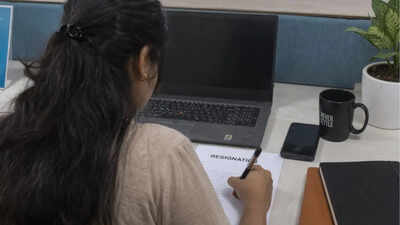
The resignation didn’t come after months of deliberation. It came quickly, almost abruptly and despite what most would consider a dream offer. A salary twice as large as her previous one. A role that promised growth. A company that, on paper, seemed progressive. And within days, something did not feel right. It wasn’t the workload. It wasn’t the people. It wasn’t even the expectations. It was something far subtler and far more unsettling. Cameras.Not the usual security cameras placed in corners or entry points. These were different. These were designed to observe, measure, and interpret human behavior at a microscopic level. They tracked eye movement. They monitored blinking patterns. They quietly collected data about how attentive employees were at any given moment. And for her, that was enough. She walked away.When observation turns into surveillanceThe story, shared by a career coach @Simon_Ingari, quickly gained traction online—not because people were surprised someone quit a job, but because of why she did it. It raises many uncomfortable questions. Employers today have access to increasingly sophisticated technology. Tools that measure keystrokes, track screen time, analyze communication patterns, and now—even study biological cues like blinking. The justification is often simple: better data leads to better performance management. But this incident reveals the other side. When every movement is tracked, work stops feeling like work. It starts feeling like a test you didn’t agree to take. Experts argue that such systems don’t just monitor productivity—they reshape behavior. Employees begin to act not naturally, but strategically. They perform “being productive” instead of actually focusing on meaningful output.A decision that sparked debateWhat makes this case more striking is the reaction from leadership. The company’s CEO reportedly saw no issue with the system. If we look from the perspective of the management, it makes sense. A deep analysis of employee behaviour may play a role in boosting productivity. And it goes without saying that it will promote better accountability.But that perspective didn’t sit well with everyone. Critics point out that the issue does not lie with the cameras-which anyways most offices already have. But it is about the intent. If a company feels the need to measure how often someone blinks, what does that say about how it views its employees? As the discussion spread, many professionals began questioning whether such practices were the future of work—or a step too far. The fake illusion of a dream jobOutwardly the decision of the employee may appear quite irrational, but in reality it just says a lot about the company and its attitude towards its employees. But this story highlights a deeper truth: compensation alone doesn’t define a good job.A role can offer financial rewards and still fail to provide psychological safety. In fact, high-paying jobs can sometimes mask deeper issues. The promise of money can delay difficult questions:Do I feel respected here?Am I trusted to do my job?Can I work without constant scrutiny?In this case, the answers became clear very quickly. And when they did, the salary no longer mattered. The psychology of being watchedThere’s a reason surveillance in the workplace triggers strong reactions. Human beings behave differently when they know they are being observed. This isn’t just anecdotal—it’s backed by decades of psychological research.Constant monitoring can lead to:
- Increased stress and anxiety
- Reduced creativity
- Lower intrinsic motivation
- A sense of loss of autonomy
Instead of fostering productivity, it often creates pressure to appear busy rather than actually being effective. In extreme cases, it can even drive people away—exactly what happened here. The irony is hard to ignore: a system designed to improve performance ended up costing the company a valuable hire.Trust vs. controlAt its core, this story is not about cameras. It’s about philosophy. Some organizations operate on trust. They believe employees will deliver results if given autonomy and clarity. Others operate on control. They believe performance must be measured constantly to be ensured. Technology has made the second approach easier than ever. But easier doesn’t always mean better.Career experts argue that over-monitoring can backfire. Several jobs that involve creativity, knowledge-based roles, problem-solving abilities, and deep thinking are essential, cannot be measured or controlled with ‘devices’. You can measure time. You can measure activity. But measuring thinking—the kind that leads to real breakthroughs—is far more complicated.A wider shift in workplace expectationsThis incident is not isolated. It reflects a broader shift in how people think about work. Today’s professionals—especially younger ones—are increasingly prioritizing:
- Flexibility
- Autonomy
- Purpose
- Mental well-being
Salary still matters, but it’s no longer the only factor. In fact, stories like this show that people are willing to give up good job opportunities if the work environment doesn’t fit with their values. The old saying that “money is everything” is slowly losing its power. This situation is a good example of a common mistake that modern businesses make: over-optimization. Companies sometimes use tools without thinking about how they will affect people in their quest for efficiency. What starts out as a harmless metric, like keeping track of attention, can turn into something much more intrusive. And when that happens, workers don’t just feel like they’re being watched. They feel less than they are—just data points, patterns, and metrics. The change can be small, but it has big effects. Because once people feel like they aren’t people at work, they will probably stop caring about their jobs.Why she decided to go and a lesson for everyone The employee in this story had to make a decision that came down to one question: What kind of place do I want to work? She could have stayed there. She could have changed. She could have put up with the pain and focused on the money. But she didn’t. Instead, she chose to put something less concrete, but arguably more important, at the top of her list: her sense of independence and dignity. And that choice is what struck a chord with so many people. This story teaches us one thing: technology alone can’t make a great place to work. Tools can help you get more done, but they can’t take the place of trust. If companies rely too much on surveillance, they risk making their workplaces feel more like prisons than places where employees can be themselves. And in these kinds of places, keeping people becomes hard.After all, skilled workers have choices. And this case shows that they are willing to walk away from even high-paying jobs if those jobs offer something that money can’t buy.The more important questionAs technology in the workplace keeps getting better, things like this will probably happen more often. This makes me think of an important question: Just because you can measure something doesn’t mean you should. At this time, there isn’t a single answer. But for one worker, the answer was clear enough to give up a good job and start over somewhere else. And by doing this, she may have brought to light a truth that many people are just starting to see: A job that pays well to watch you blink might be too expensive.