
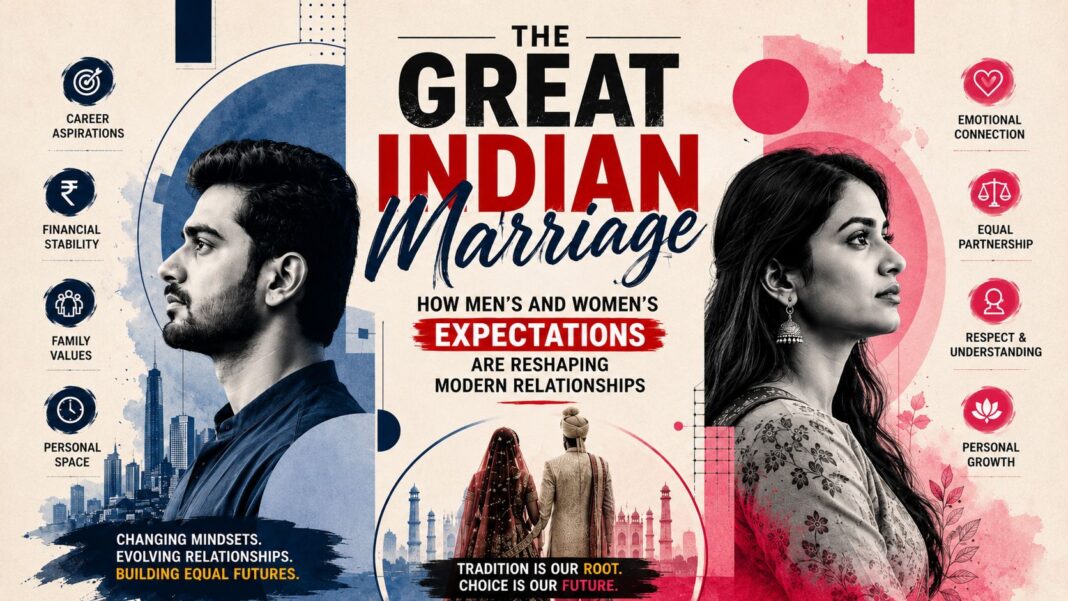
Marriage in the 21st century has transitioned from a rigid social imperative into a complex psychological and emotional commitment. In the Indian context, while individual preparedness is often still influenced by deep-rooted cultural customs and family pressure, a significant shift is occurring in how young men and women perceive their roles at the altar. Understanding these diverging mentalities is essential for fostering healthy, long-term partnerships.
The Gendered Gap in Marriage Preparedness
Recent research highlighted in the Online International Interdisciplinary Research Journal indicates that there is a measurable difference in how young Indian adults prepare for marriage. In a study of B.Ed. students, female students exhibited higher levels of emotional and social preparation for marriage compared to their male counterparts.
This aligns with broader psychological theories suggesting that girls are often socialized from a young age to envision their future lives as wives and mothers, viewing marriage as a “package deal” that includes a home, children, and a social identity. Conversely, many men tend to enter marriage specifically “for the woman” rather than for the institution itself, often feeling like they are “last on the list” after children, careers, and extended family.
The “Provider’s Clock” vs. the “Biological Clock”
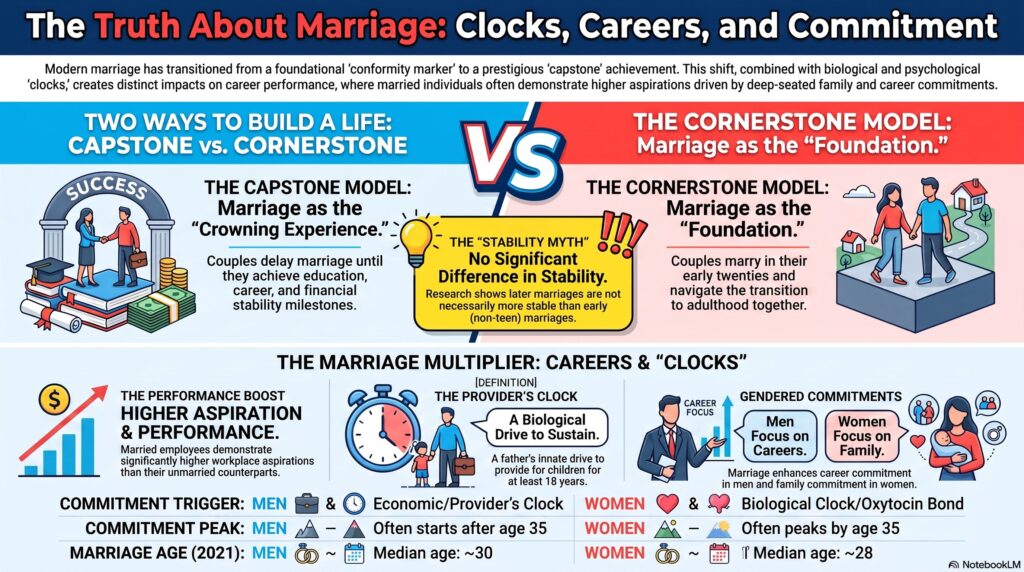
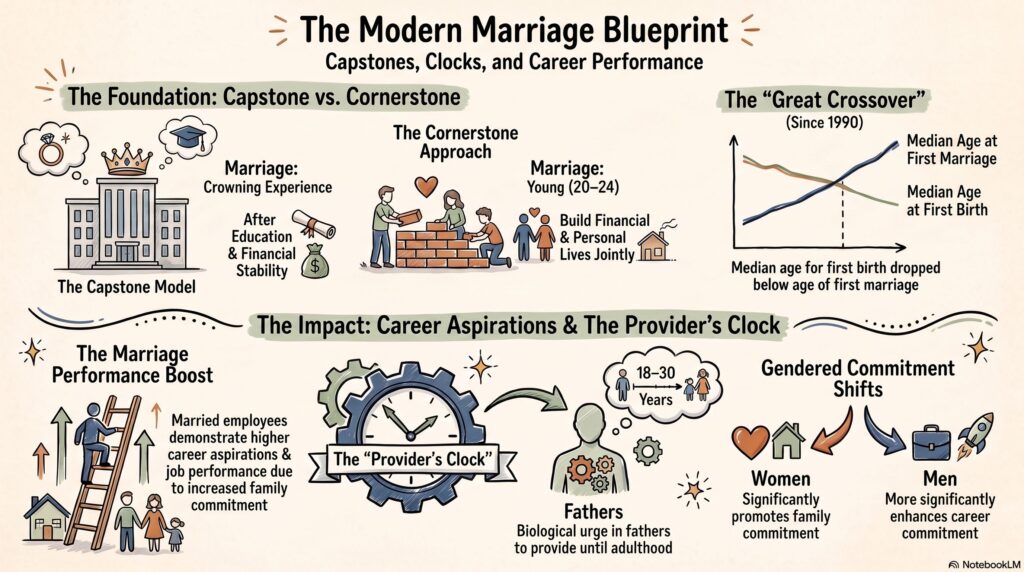
A significant driver in male mentality is what experts call the “Provider’s Clock.” Just as women often feel the pressure of a “Biological Clock” regarding childbirth, men often experience an innate, DNA-encoded drive to provide for their families for at least 18 years following the birth of a child.
This “Provider’s Clock” often dictates a man’s professional behavior. Interestingly, married employees—both men and women—frequently demonstrate higher career aspirations and job performance than their unmarried peers. This boost is primarily driven by an enhanced commitment to family and career that marriage brings, though the pressure to be the primary earner can still weigh heavily on the traditional male psyche.
Marriage as a “Capstone,” Not a “Cornerstone”
Modern mentalities are shifting away from the “cornerstone model,” where marriage is a foundation to build a life upon, toward a “capstone model.” In this framework, marriage is viewed as a “crowning experience” or a status symbol that occurs after one has “made it” into adulthood.
Young adults today, including those in India, often voluntarily delay marriage to focus on:
- Completing higher education.
- Establishing a career.
- Achieving financial stability.
- Fully exploring their own identities.
The Role of “Partner-Ideals” and Satisfaction
The success of a modern marriage often hinges on the alignment between “partner-ideals” (the traits we want) and “partner-perceptions” (the traits our spouse actually has). Research shows that smaller discrepancies between these ideals and reality predict higher relationship satisfaction.
However, men and women often prioritize different ideals. Historically, evolutionary perspectives suggested women valued a mate’s resources while men valued reproductive capacity. In modern egalitarian settings, these differences are shrinking, yet men who adhere strictly to traditional masculinity norms—such as “restrictive emotionality” or “dominance”—frequently report lower relationship satisfaction and may struggle with healthy conflict resolution.
Communication: Logical vs. Experiential
A common psychological gap exists in communication styles. Women tend to share more information from an emotional or experiential perspective, whereas men are often socialized to be more logical and decision-oriented. Misunderstanding these styles can lead one partner to feel unloved and the other to feel unappreciated or pressured.
Conclusion: Toward a Modern Partnership
The shift from traditional to modern marriage reflects a move toward personal happiness, emotional ties, and fairness. As gender roles continue to evolve, with more households seeing both partners sharing financial duties and household chores, the mentalities of both “boys” and “girls” must adapt.
For the modern Indian couple, the goal is no longer just social stability, but a partnership based on mutual respect and shared aims. By recognizing the inherent differences in commitment styles—whether driven by “dedication” (the desire for the relationship) or “constraint” (the cost of leaving)—couples can better negotiate their roles rather than assuming them based on outdated cultural scripts.