




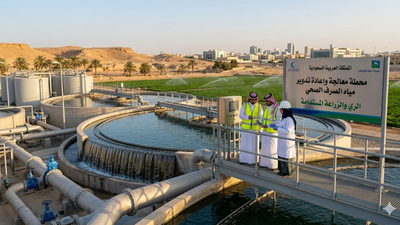
In Saudi Arabia, there have been attempts to redefine the utilisation of water in such regions, whereby the use of treated water has been employed as an innovative way of restoring the environment. In this context, Saudi Arabia’s strategy has helped to establish a continuous green belt through the efforts of transforming the deserts of Saudi Arabia. This is one of the efforts geared toward the achievement of sustainability in the future. The recycling of the water has not only led to the conservation of water but also to addressing desertification and poor air quality, among others.
Saudi Arabia is transforming wastewater into a sustainable resource
The wastewater reuse plan in Saudi Arabia is directly connected to the country’s efforts at transformation, including its Vision 2030 initiative. It is noteworthy that up to 70% of treated wastewater will be reused by Saudi Arabia, which is far more than it had planned to reuse over the last several decades. As MEWA states, treated wastewater is used in the process of irrigation, landscaping, and afforestation.Specifically, MEWA emphasises that:“Treated wastewater is a precious resource which contributes to sustainability and reduces dependence on finite natural resources, especially non-renewable groundwaters.”This approach adheres to global trends in the field, which are widely recognised around the world. Wastewater reuse has become the cornerstone solution in terms of overcoming water shortages. Treated wastewater is a great source of irrigation water and nutrients for crops.
Green corridors in the desert: Combating desertification
Green corridor formation is one of the notable results of wastewater reuse. They act as a way to keep soil stable, control sandstorms, and help the formation of microclimates that allow for biodiversity.As explained in research titled “Monsoonal imprint on late Quaternary landscapes of the Rub’ al Khali Desert”, done by King Abdullah University of Science and Technology (KAUST), wastewater reuse projects bring along positive results for the environment. One of them is the following:“Vegetation improvement in desert environments can be achieved through irrigation using treated wastewater, which improves soil fertility.”These projects, apart from being beneficial to the environment, have an impact on the improvement of the quality of life as well. For example, green belts make cities cooler and give their inhabitants more recreation spots. This is seen in cities like Riyadh, which now boasts parks and tree-lined streets.
Innovative water management and future expansion
Moreover, the Kingdom of Saudi Arabia remains devoted to adopting novel methodologies in treating water by ensuring that the recycled water fulfils the standards of safety both for the environment and public health. At present, the existing state-of-the-art plants rely on multi-stage filtration and purification, hence rendering the water useful for irrigation.As in the report by the Saudi Water Partnership Company (SWPC), it is necessary to pay special attention to innovation in the industry because:“Public-private partnerships are promoting efficiency and innovation in wastewater treatment and reuse.”In future, the further development of the project will prove to be highly important in accomplishing the goals associated with sustainable development. As a result of the process, it becomes possible to create bigger green corridors, turning more desert territory into a sustainable ecosystem.Innovation, coupled with sustainability, is now being implemented in Saudi Arabia, even though the country belongs to the most arid territories on Earth.