




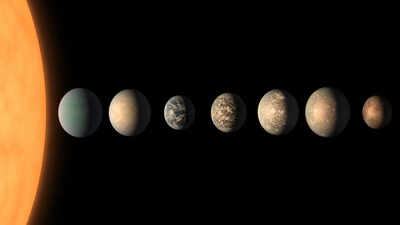
The discovery of Earth-sized planets outside our own solar system has completely changed our way of viewing the universe, but none has done so to the degree that TRAPPIST-1 has managed to do. This planetary system is located some 40 light-years from us and comprises seven rocky planets, which share many of the characteristics of Earth in terms of size. However, recent discoveries through the use of space telescopes have shed some light on the difference between the day and night sides of two planets within this system.
TRAPPIST-1 system and Earth-sized exoplanets
The TRAPPIST-1 system is regarded as one of the most important discoveries made by astronomers in recent times. As described in the NASA overview on TRAPPIST-1, this system includes seven Earth-like planets that orbit around a red dwarf star, making it “the most studied planetary system” apart from our own.The seven planets in the TRAPPIST-1 system orbit the central star at very close distances, taking only a few days to complete one revolution. Due to this proximity, many of these planets may be tidally locked; that is, one face of each planet will always be facing the star, whereas the other side will remain dark forever.
Day–night temperature divide on TRAPPIST-1 planets
Recent studies done by the James Webb Space Telescope have helped understand the aforementioned conditions. For instance, in the paper titled “Thermal emission from the Earth-sized exoplanet TRAPPIST-1 b using JWST“, it was shown that one of the planets experienced heating on the day side with minimal transfer of the heat across the surface of the planet.The scientists concluded that the temperature on the day side is much higher compared to that of the night side, indicating that there might be no dense atmosphere that would move the heat. Put simply, only one half of the planet would be very hot, whereas the other half would stay extremely cold.Indeed, according to the results presented in the paper mentioned above, there is clear proof that there is no redistribution of the heat on such planets at all.
What this means for habitability and future research
However, this dramatic difference between day and night creates huge implications for the existence of life. In the absence of an atmosphere that would stabilise the temperature regime, these planets might be too hostile for life forms similar to those existing on Earth. Nevertheless, this does not exclude the presence of other types of life.The TRAPPIST-1 planetary system will continue to intrigue researchers with its unusual composition and planets resembling our planet. According to NASA, there is “a tantalizing question of whether this system can host life.” Future exploration missions and researches might reveal the presence of an atmosphere, ocean, or the very ability to support life in some of these planets.In conclusion, these findings show that Earth is not necessarily a standard habitat, which means that new unexpected discoveries are still to come.