



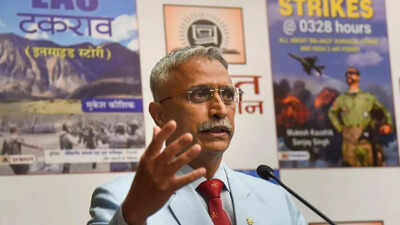
NEW DELHI: Former Army Chief General (Retd) M M Naravane on Friday said that the armed forces must be kept away from political narratives, while clarifying that individual personnel still retain democratic rights such as voting and personal political views.Speaking to reporters, Naravane stressed the need to maintain institutional neutrality of the armed forces amid political debates. “The armed forces should be kept as far away from politics as possible. The Indian armed forces pride themselves on being a very apolitical Army, Navy, Air Force,” he said. He added that this principle is essential for India’s democratic framework.“If you see what is happening in the country’s periphery, it is a strength that we have never even sought to get involved in political matters and that’s what makes our country strong. That’s what makes our democracy strong, that we are one of the pillars of governance, along with the judiciary and the press. This is a strong pillar on which the country is doing so well.”However, Naravane clarified that institutional neutrality does not mean denial of individual rights.“But that does not mean that we cannot have our own political affiliations, that we cannot cast our vote. You have to differentiate between the organisation and the individual. As an organisation, we are totally apolitical. But as individuals, we have full democratic rights to cast our vote.”
What triggered the row?
The remarks come in the backdrop of a controversy triggered by Leader of Opposition Rahul Gandhi’s reference to excerpts from Naravane’s unpublished memoir during a Parliament session earlier this year.Gandhi had used the excerpts to question the government’s handling of the 2020 India-China military standoff in eastern Ladakh, alleging that Prime Minister Narendra Modi had ‘not fulfilled responsibility’ during the crisis.He also claimed that the government had blocked him from speaking on the issue in Parliament and alleged that Naravane’s account indicated a lack of clarity in instructions from the political leadership during the border tension.The controversy escalated after Gandhi attempted to cite the material in the Lok Sabha despite objections from the government, which argued that unpublished or unauthenticated material cannot be quoted in House proceedings. The matter led to repeated disruptions and political sparring between the opposition and treasury benches.
Memoir controversy and legal dispute
The issue further intensified after Penguin Random House, the publisher of Naravane’s memoir Four Stars of Destiny, clarified that the book had not been published or released in any form and warned against unauthorised circulation of its contents.Delhi Police also registered an FIR over alleged circulation of excerpts, with the Special Cell examining claims of leaked or shared manuscript material.Naravane himself later backed the publisher’s statement and said he would not pursue controversy over the issue, while expressing concern over the politicisation of an unpublished work.Reacting to the broader controversy, Naravane has maintained that his writings were being misused in political debates. In interviews following the row, he said it was ‘unfair to drag the armed forces into political narratives’ and reiterated that he had not been abandoned by the government during the Ladakh standoff.He also said that decisions during the 2020 border crisis were taken within a structured command framework and rejected claims suggesting ambiguity or lack of support from the political leadership.Naravane served as the 28th Chief of Army Staff from December 2019 to April 2022 and led the Army during the eastern Ladakh standoff with China. His memoir became central to a political controversy after excerpts were cited in Parliament, triggering debates over national security, civil-military relations and parliamentary privilege.