






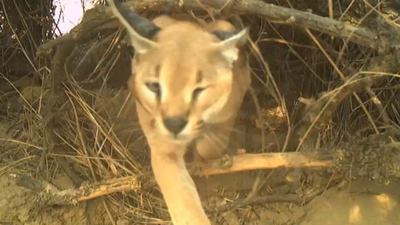
JAISALMER: Studies have been initiated in the border region of Shahgarh in Jaisalmer to gather information on the habitat, food habits, movement and behaviour of the endangered Caracal, a Schedule I species. The Wildlife Institute of India is conducting research, while the Wildlife Trust of India has launched a pilot project to encourage local communities to support conservation efforts. As part of the initiative, a “goat bank” is being set up to reduce conflict between villagers and the animal. A WTI team recently visited the area and held discussions with forest department officials. The forest department has installed motion-sensing camera traps at selected locations to monitor the animal’s movement. Though only a limited number of cameras have been deployed so far, they have confirmed the presence of two new caracals — one male and one female — taking the total number recorded in the Shahgarh region to three. However, one caracal was killed by villagers, who allegedly burned it alive. In addition, a radio-collared caracal is being closely monitored to study its movement and behaviour. According to forest officials, more camera traps have been installed in the Ghotaru area of the Thar Desert following signs of the species’ presence. Including the radio-collared animal, three caracals have been confirmed, while one was earlier killed in the Bachhiya area in an attempt to destroy evidence after hunting. Officials said a larger number of cameras will be required to survey the species across its habitat range, particularly in the Thar Desert. A comprehensive plan will be prepared after the ongoing study is completed. Forest authorities said the caracal, locally known as “Padang”, sometimes preys on sheep and goats, leading villagers to view it as a threat. Efforts are being made to raise awareness and involve communities in conservation to prevent such incidents. Under the WTI pilot project, measures such as the goat bank aim to reduce conflict and promote coexistence. Villagers are being encouraged to report sightings, and authorities have assured livestock owners that problematic animals will be safely captured and relocated if necessary. Officials believe the Shahgarh region may support a larger population due to favourable ecological conditions, and continuous monitoring is underway. Experts said the caracal population in Jaisalmer is among the last remaining groups of this rare wild cat in India. Regular evidence, including pugmarks, has been recorded in the Ramgarh–Shahgarh region since last year. They added that the region consists of arid grasslands with sparse human settlements, though nomadic pastoralists frequently pass through. The caracal is a medium-sized wild cat that usually lives alone, coming together with others only during the breeding season.