




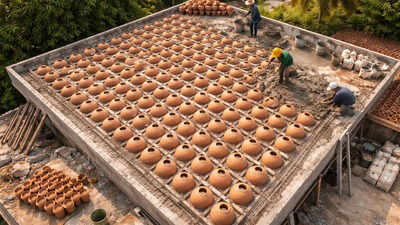
By the time summer reaches its peak, almost all homes become heat-trapping places. In most cases, the roof of a home absorbs heat from the sun during the day and then slowly lets out the heat inside the house, causing discomfort despite the functioning of fans in each room.Though air conditioners can bring a sense of relief from such discomfort, their use comes with a huge electric bill and an impact on the environment. However, there exists a very simple and traditional way of addressing such problems that does not work against nature but alongside it.
Clay pot roofing explained: A lightweight and strong alternative to concrete slabs
The clay pot roofing system constitutes one of the methods used under the filling slab construction process. In the process of using this method, clay pots are inverted into the roof and covered with concrete.Unlike in other methods where there is a full slab of concrete, this process creates holes in the roof to make it lightweight but strong at the same time. The holes also improve the efficiency of insulation.How clay pot roofs slow down heat transfer and keep interiors coolThe coolness is based on a very simple principle: air cannot be a good conductor of heat.The air chambers formed within the clay pots delay the heat conductivity from the roof surface to inside the building. Simultaneously, clay materials do not absorb heat the way concrete does.It is due to this that the indoor temperature is significantly lowered as compared to regular roofs.
Clay pot roofs: Why are they cost-effective
Not only is it an economical way of doing things, but it also happens to be financially viable. Clay pots happen to be inexpensive and readily available materials. Due to the partial replacement of concrete with clay pots, there will be a reduction in the overall demand for building materials.As stated in a paper published on ResearchGate titled “Design and Analysis of Filler Slab Using Terracotta Fillers,” this method of constructing walls ensures that the structure is strong, while the overall cost of construction is reduced.Labour costs, in addition to energy costs, are minimised.
Environmental benefits of the clay pot roof system
The use of the clay pot roof system is also environmentally friendly. By minimising the use of air conditioning systems, there will be a reduction in energy usage and greenhouse gas emissions.Moreover, by decreasing the amount of concrete needed, there is also a decrease in environmental pollution, since cement production has been one of the primary sources of pollution.
Works across seasons
Although it is highly efficient in the summer months, this method has its advantages in cold months too. The air spaces that prevent heat entry in summer assist in maintaining the heat indoors in winter. This makes the interior temperature more stable, thus lessening the need for air conditioners and heaters.
Why is this method returning
Concrete is commonly used in contemporary buildings, and because it retains heat, it leads to a rise in indoor temperature. However, the traditional architectural design considered climatic conditions.With rising temperatures and growing demand for sustainability, the use of sustainable solutions such as the clay pot roof is once again gaining popularity.Clay pot roofs demonstrate that there is no need for intricate technology in order for solutions to be successful. The combination of indigenous knowledge and sound engineering produces an easy solution to reduce the temperature in houses while simultaneously increasing their efficiency. In today’s world, where energy prices and heat levels are climbing, solutions like this become necessary.