






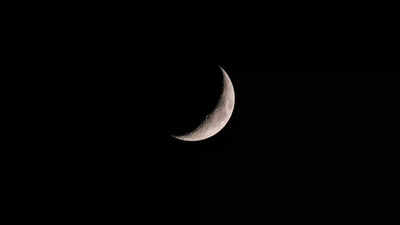
The crescent moon is one of the most recognisable things in the night sky. At dusk or dawn, a lot of people have seen a thin, curved line of light in the sky. This shape is caused by the positions of the Earth, Moon, and Sun. The Moon doesn’t make its own light; it reflects light from the Sun. The Moon moves around the Earth every 29.5 days, which is why the phases of the Moon, like the thin crescent, happen. This makes it so we can see less sunlight.NASA Science says that the crescent moon happens when only a small part of the Moon’s sunlit surface is facing Earth and the rest is in the dark. These phases happen in a set order and are part of a lunar cycle that happens over and over again.
What is the crescent moon
The crescent moon is when the Sun only shines on a small, curved part of the Moon’s surface. It looks like this:
- Waxing crescent: The part of the moon that is lit up gets bigger every night after a new moon.
- Waning crescent: The lit part gets smaller just before the new moon.
According to NASA Moon Phases, this occurs because only part of the Moon’s sunlight-facing side is visible from Earth.
Why crescent moon appear thin in the sky
The crescent looks thin because, while half the Moon is always sunlit, we see only a small section.NASA Science says that when the Moon is close to the Sun in the sky, the part that is lit up is just a thin arc. The rest of the lit side is hidden from view, which gives it the thin crescent shape.The Moon looks thinnest right after sunset or right before sunrise, when it is close to the horizon near the Sun’s position.
How lunar phases work
The Moon’s phases follow a predictable sequence as it orbits Earth:
- New moon (invisible)
- Waxing crescent
- First quarter
- Waxing gibbous
- Full moon
- Waning gibbous
- Last quarter
- Waning crescent
This full cycle takes about 29.5 days, according to NASA Science.
Why the crescent moon appears where it does
The crescent moon is close to where the Sun is in the sky
- Waxing crescent: The western sky after the sun goes down
- Waning crescent: The sky in the east before the sun rises
NASA APOD says that this position is why the crescent is often only visible for a short time each day, low on the horizon.
Moonlight is reflected sunlight
The Moon does not emit light. The bright glow we see is sunlight reflected off the Moon’s surface. NASA Science confirms this explanation.
A subtle glow called Earthshine
Sometimes the dark part of a crescent moon appears faintly illuminated. This happens due to Earthshine, sunlight reflected from Earth onto the Moon.NASA Earth Observatory notes that Earthshine is measurable and depends on Earth’s reflectivity (albedo).
Observing the crescent moon
You can see the crescent moon with the naked eye. Look near the horizon just after the sun goes down or just before it comes up. You can see details along the terminator, which is the line between light and dark, with binoculars or a small telescope.