




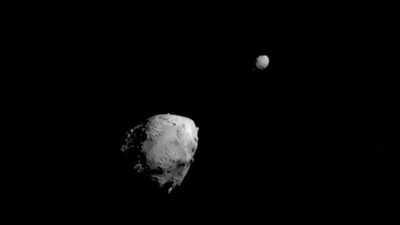
When NASA deliberately crashed a spacecraft into an asteroid in 2022, the event sounded like something out of a science fiction film. The mission, called the Double Asteroid Redirection Test or DART, was designed to answer a serious question: could humanity push an asteroid off course if one ever threatened Earth? At the time, scientists mainly focused on how the collision changed the orbit of the small asteroid Dimorphos around its larger companion, Didymos. Now, researchers say the impact may have done something even more surprising. New observations suggest the crash slightly altered the entire asteroid system’s orbit around the Sun. The change is extremely small, almost difficult to imagine, but experts say it represents the first time a human-made spacecraft has measurably shifted the solar orbit of a natural celestial body.
How NASA’s DART impact changed the motion of a binary asteroid system
The DART spacecraft intentionally collided with Dimorphos in September 2022 at a speed of about 22,500 kilometres per hour. The target asteroid was relatively small, measuring roughly 170 metres across. It circles a much larger asteroid named Didymos, which is about 805 metres wide. Together, these two rocky bodies form what astronomers call a binary asteroid system.Dimorphos orbits Didymos while both objects travel together around the Sun. Because they are gravitationally connected, any change to one of them can affect the movement of the entire system.When the spacecraft struck Dimorphos, the collision blasted a huge cloud of rock and dust into space. The impact also reshaped part of the asteroid’s surface. Scientists had expected some debris, but the amount that erupted surprised many observers. Researchers explain that when material was thrown away from the asteroid, it carried momentum with it. This created an additional push on Dimorphos. The effect is known as the “momentum enhancement factor.” In simple terms, the debris acted like a natural rocket exhaust that strengthened the impact delivered by the spacecraft.
When the asteroid’s 12-hour orbit suddenly got shorter
Earlier studies confirmed that the impact dramatically changed Dimorphos’ orbit around Didymos. Before the collision, the smaller asteroid took roughly 12 hours to complete a single orbit. After the crash, that orbital period became about 33 minutes shorter.Scientists were pleased with that result because it showed that a spacecraft could successfully alter the motion of an asteroid.New research now indicates that the event had a second, much subtler effect. Observations show that the Didymos–Dimorphos system’s orbit around the Sun changed by about 0.15 seconds. In astronomy, even the smallest shift can be meaningful. Researchers estimate the binary system’s speed changed by roughly 11.7 microns per second, which equals about 1.7 inches per hour. It is an almost unbelievably slow adjustment, but scientists say that over long periods such changes could grow into substantial orbital deflections.
Future of asteroid defence
The DART mission was only the first practical test of asteroid-deflection technology. Scientists are already preparing the next steps in planetary defence.NASA is currently developing the Near-Earth Object Surveyor mission, a specialised space telescope designed to detect difficult-to-see asteroids. Many potentially hazardous objects are dark and reflect very little sunlight, which makes them hard to identify using traditional telescopes.