



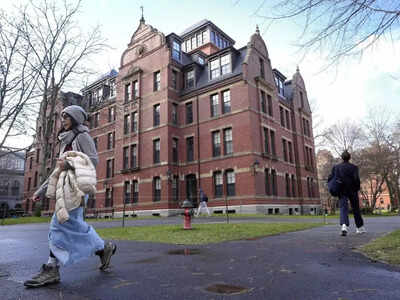
In the overcrowded space of imagination for American higher education, there is a name that has continued to emerge from the noise. It is a name that is greater than a university; it is a cultural ideal, a generational synonym for excellence, and for many, the ultimate academic experience.The latest 2026 College Hopes & Worries Survey by The Princeton Review, based on responses from 9,446 applicants and parents, places Harvard firmly at the top of students’ dream colleges, an enduring testament to its symbolic power in an increasingly competitive admissions landscape.Even as the abode of higher education evolved, Harvard breathes and gets nurtured as the ultimate dreams Americans have not revised.
A surge in applications, a surge in anxiety
This year’s admissions cycle has unfolded against a backdrop of intensifying competition. According to Common App data cited in The Princeton Review’s 2026 survey report, more than 1.4 million students submitted over 9.2 million applications for the 2026–27 academic year, a 5% rise from February 2025, with applications to public colleges up 6% and private institutions up 5%. But as application numbers climb, so too does the emotional cost.The Princeton Review survey finds that 73% of respondents reported high levels of stress related to the application process, including 28% who described their stress as “very high.” This marks a sharp increase from 56% in 2003, when the survey was first conducted. The modern college application, it appears, has become less a gateway and more a gauntlet.
The price tag that haunts the dream
If Harvard represents aspiration, affordability represents its most formidable barrier. The survey reveals that 93% of respondents said they would need financial aid, with 52% describing it as “extremely necessary,” according to The Princeton Review’s 2026 findings. The numbers point to a near-universal dependence on financial support, an indication of how deeply cost considerations now shape college decision-making.More strikingly, 35% of respondents identified student debt as their biggest concern, far exceeding the 28% who feared not gaining admission to their first-choice college, the report notes.This marks a profound shift. In 2003, rejection dominated anxieties; in 2026, it is the financial aftermath of acceptance that weighs heavier.Further highlighting this concern, 38% of respondents estimated the total cost of college at over $150,000, with half of all parents selecting this figure, according to The Princeton Review.
Parents vs students: A subtle divide
While Harvard remains the top choice among students, parents are charting a slightly different path. The survey identifies the Massachusetts Institute of Technology (MIT) as the number one dream college among parents, followed by Princeton and Stanford.This difference, as revealed in The Princeton Review report, points to a complex change in student and parent values. While students may be attracted by the notion of legacy and prestige, parents are increasingly concerned with outcomes, especially in areas that are relevant to technological advancement.
Testing endures, despite the debate
In a landscape marked by test-optional policies and ongoing debate, standardised exams continue to hold their ground.According to The Princeton Review’s 2026 survey, 93% of respondents reported taking the SAT, ACT, or both, with 48% opting for the SAT compared to 13% for the ACT.When asked why, 45% said test scores help distinguish applications, while 36% pointed to their role in securing scholarships and financial aid, the report notes. Far from fading, standardised testing remains embedded in the strategic calculus of admissions.
Distance, decisions, and the meaning of “Fit”
While prestige dominates headlines, proximity continues to shape preferences. The survey reports that 39% of respondents preferred colleges within 250 miles of home, with 47% of parents favouring closer institutions compared to 33% of students. Yet when it comes to final decisions, a more personal metric prevails.According to The Princeton Review, 48% of respondents said they would choose a college based on overall “fit,” compared to 32% prioritising specific academic programmes, 12% affordability, and 8% reputation. In an ecosystem obsessed with rankings, the idea of “fit” emerges as a quiet counterweight.
The value question: Still worth it?
Despite rising costs and mounting stress, faith in higher education remains remarkably resilient. The survey records that 98% of respondents believe college is “worth it,” marking a slight dip from the near-unanimous 99% recorded in previous years.When asked about the primary benefit of a degree, 43% cited better job prospects and higher income, while 31% pointed to exposure to new ideas and experiences, and 26% emphasised education itself, according to The Princeton Review. The promise of college, it seems, is increasingly measured in outcomes.
Voices from the frontlines
Beyond the statistics, the survey captures a more intimate layer of the admissions experience, advice from those navigating it.Students urged future applicants to “focus on finding a college you’re excited about rather than the name,” while parents emphasised that “college is a match to be made, not a prize to be won,” as quoted in The Princeton Review report.And yet, even amid such grounded wisdom, the pull of Harvard endures, powerful, persistent, and deeply embedded in the American psyche.
A dream reimagined, not replaced
But the survey does not demolish the American College Dream, it complicates it. Harvard may still reign supreme at the top, a shining beacon of hope for dreams yet to be fulfilled for generations of Americans yet to come. But the road to that dream is no longer defined by the same factors, and the values by which it is defined have changed.And in that, you’ll find the story of American higher education in 2026: a system still built on dreams, but one increasingly defined by the price of those dreams.