






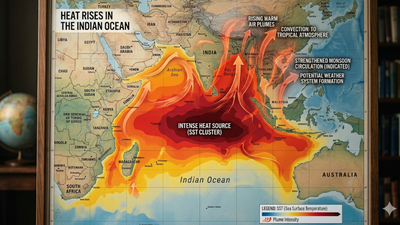
The overheating of the Indian Ocean to potentially lethal levels due to marine heat waves and sea surface temperature increase poses severe challenges for the fish population, coral reefs, marine ecosystems, and coastal communities, as climate monitoring alarms have revealed. According to scientists studying this region, the warming of the Indian Ocean, including the Arabian Sea and Bay of Bengal, has reached an ecologically unsustainable level. The dangers include the bleaching of corals, reduction in fish stocks, deoxygenation of waters, and disruption of marine food chains. At the same time, millions of people relying on fishing and other sources from the coastlines face grave risks.
Indian Ocean warming intensifies as marine ecosystems face escalating stress
An episode of abnormal heating is taking place in the Indian Ocean, which has been detected by monitoring systems that have found a recurrence and spread of marine heatwaves in crucial parts of the world’s waters. “Marine Heat Waves in the Indian Ocean: A Major Climate Impact on Marine Microalgae” shows that large areas of the Arabian Sea and Bay of Bengal have had prolonged periods when the sea surface temperatures were significantly above what was safe for marine life.However, experts caution that this unusual warming phenomenon is not merely a deviation that will correct itself. On the contrary, it is part of a long-term trend caused by global climate change. Increasing the temperature of the waters is leading to the disruption of an equilibrium, and there is a shortage of oxygen in warmer waters. This means that marine life faces significant stress, resulting in reduced biodiversity and altered food chains in oceans.
Coral reefs in the indian ocean face bleaching and long-term degradation
Perhaps one of the most apparent effects of rising sea temperatures is the impact on the delicate ecosystems of coral reefs, organisms that rely heavily on maintaining specific temperature levels. Any fluctuation in temperature will result in coral bleaching, during which time the coral expels algae that give it sustenance and colour.When coral bleaching happens continuously, the reefs are unable to recover, thus resulting in massive coral deaths that have already been witnessed in various locations within the larger Indo-Pacific area. As mentioned by scientists in their studies on the climate, there is currently an increase in global bleaching cases caused by high levels of ocean heat.One scientific review stated that the corals have experienced “severe stress due to continued ocean warming as a result of climate change.” This problem, however, does not only affect the ecosystem in general but also humans since the reefs serve as natural protection along the coastline.
Fisheries are disrupted as fish move, decline, and coastal incomes weaken
Warming of the Indian Ocean will also affect the behaviour and distribution of fish, which will ultimately impact the coastal people directly. Fishes are very sensitive to any variations in water temperature, and they start shifting towards cooler or deeper areas in order to survive.This shift will create problems for the fishing community due to decreased fish density in fishing areas, making it necessary for the fishermen to go far away from the coast. Many studies and observations have shown that the warming of the ocean has led to increased travel distances for fishing, making it dangerous and expensive as well.Such fishermen have to spend their entire day in deep-sea fishing and suffer from a lot of physical exhaustion due to difficult circumstances.This can be very troublesome for them economically, as well as physically.
Wider ecological imbalance signals a shifting ocean system
In addition to the coral reefs and fish population, the wider Indian Ocean ecosystem seems to be experiencing structural changes. The rising surface temperatures result in less mixing of nutrients between different depths of water and, therefore, less production of phytoplankton that forms the base of the marine food chain.Scientists studying the Indian Ocean have observed an increase in the frequency and duration of marine heat waves globally. According to findings from research on the global climate, the warming of the upper layers of the ocean increases owing to greenhouse gas emissions. Reversing such effects poses great challenges in the short run.
Monitoring systems highlight urgency for climate response
As per the Ministry of Environment, Forest and Climate Change, services like the Indian National Centre for Ocean Information Services (INCOIS) are continually observing the condition of oceanic waters and are sending out early warnings about the possible coral bleaching danger and marine heat stress for preparation purposes.However, according to specialists, ocean monitoring alone will not solve the problem. Without any measures taken to decrease emissions or improve the state of marine environments, global warming will continue.The case with the Indian Ocean can be regarded as a reflection of the global trend towards excessive heat being trapped in the water of oceans. It becomes clear why the ocean can be considered a buffer and an early-warning system of climate change.The ocean in India heats up to critical temperatures, causing changes in marine organisms, bleaching coral reefs, and posing a threat to millions of people who live on the shores of the ocean. With growing marine heatwaves and the ecosystems being stressed all the time, the Indian Ocean finds itself at a turning point in its environmental destiny.