






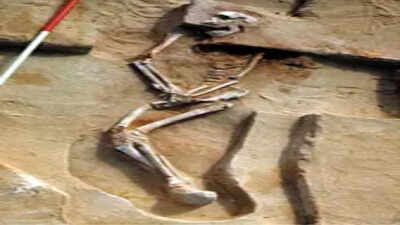
There is a sombre ambience about the Willandra Lakes of New South Wales. The landscape is dotted with dried-up lake beds, and it has the impressive formations known as the Walls of China. However, 42,000 years ago, this was an entirely different landscape, one teeming with life. The contrast between then and now hit home hard in 1968 when geologist Jim Bowler made a discovery in the field. At the time, he was studying soil layers and climate history, not looking for evidence of past human life. Yet as he was walking atop a sand dune, the wind blew off some charcoal remains from a human skeleton.This wasn’t just another archaeological find. Bowler had stumbled upon Mungo Lady, and her remains would eventually flip our understanding of human culture upside down. The bones weren’t just old; they were clearly burnt. This meant her people didn’t simply leave her behind. They had performed a deliberate, multi-stage ritual. The discovery proved that tens of thousands of years before the famous civilisations of Egypt or Mesopotamia even existed, people in Australia were already practising the world’s earliest known cremation.According to an article on Nature titled New ages for human occupation and climatic change at Lake Mungo, Australia, this discovery brings into focus just how important this find really is. The date placed on the cremation is estimated at around 40,000 to 42,000 years old. However, the authors of this paper move even further from simply establishing dates to highlighting the ability of early humans to thrive during times of climatic change.A ritual that turned our understanding of human history on its headIt used to be widely accepted that sophisticated religious beliefs and burial rituals appeared only much later in human evolution. But Mungo Lady made the assumption obsolete. The process included three steps: burning the body, crushing the skeleton, and placing it next to a nearby dune. The practice could not have happened without fire and a sense of collective belief in an afterlife. It reveals that ancient humans developed emotional ties within the community and funeral traditions.Another pivotal piece of research published in Nature titled Pleistocene Man in Australia: Age and Significance of the Mungo Skeleton broke down the initial findings at the site. The researchers noted that the remains were tucked into the shoreline dunes of an ancient Pleistocene lake. This was a massive deal because it proved Australia had been occupied much longer than anyone had previously thought. It showed that these early inhabitants weren’t just surviving day-to-day; they were developing a complex culture filled with symbolic behaviour.

This find fundamentally altered our understanding of early human culture, demonstrating sophisticated beliefs and emotional ties. The site, also yielding Mungo Man, highlights ancient Australians’ complex symbolic behaviour and enduring connection to their land.
This story was not limited to the discovery of Mungo Lady alone. Not long after, another discovery came in the form of Mungo Man. The burial site was distinct, but equally fascinating – an elaborate grave design with red ochre covering the body. In their collective discoveries of Mungo Lady and Mungo Man, what we can learn is a view into the culture of people who were unheard for forty thousand years. The one had the power of fire, while the other had the skill of using ochre.A permanent mark on a changing worldThe story of Mungo Lady is the story of the landscape as well. The sand dunes surrounding Lake Mungo became a natural vault, protecting the skeletons with layers of silt and sand known to Jim Bowler. Were Bowler to arrive even five minutes too early or too late, the remains would either be buried even deeper or completely weathered away by the harsh elements of Australia. It was the perfect time, the right combination of archaeology and geology.Today, the Mungo Lady is not only an artefact for study; she is our ancestress. The find gave way to global debates on the intelligence of the indigenous peoples of Australia, proving that there is not only a centuries-old connection between them and the country, but a primal, spiritual one, dating back to the dawn of rituals. The Lake Mungo site itself was declared World Heritage territory.Considering the leisurely pace with which Bowler ambled over the sand dunes in 1968, history does not necessarily have to be recorded in books. History can also be eroding a hillside, waiting to be rediscovered and thus immortalised as part of a rock. The Mungo Lady becomes a powerful symbol for the eternal human need to pay respects to the departed, a ritual that has survived for more than 42,000 years.