




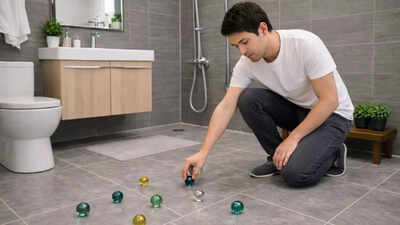
A curious trend circulating online has left many people puzzled. Videos show residents in Japan placing or dropping small marble balls on their bathroom floors and watching how they move. At first, the act seems random or even playful. But the idea behind it has a practical explanation linked to home safety.The practice, often called the “marble ball test,” is connected to Japan’s long experience with earthquakes. Since the country frequently experiences seismic activity, people are always looking for simple ways to check whether their homes might have shifted after a tremor. Dropping a marble on the floor is seen by some as a quick way to notice small changes in the level of the floor.While the test is informal and not used by engineers, it has sparked curiosity around the world.
What the marble ball test in Japan’s bathrooms means
The marble ball test is extremely simple. A small glass marble or metal ball is placed on the bathroom floor. Once it is set down, the person watches whether it stays still or starts rolling.If the floor is level, the marble should remain mostly in the same spot. If it begins rolling steadily in one direction, it may indicate that the floor is slightly slanted.The idea works because round objects naturally move toward the lowest point on a surface. Even a slight tilt that is difficult for the human eye to detect can sometimes become visible when a marble begins rolling.Many people use the test casually at home after an earthquake or when they suspect their house might not be perfectly level.
Why are bathrooms used for this test
The bathrooms are usually the best places to conduct this experiment. One reason is that the floors in bathrooms are normally smooth and flat. The tiles on the floors enable the marble to roll without getting stuck.Another reason is that bathrooms are normally designed in such a way that the water drains to the drain hole when you open the tap. As a result, it is normally assumed that the floor is evenly balanced.If the marble rolls strongly in one direction, it may raise some doubts about the floor’s balance.However, it is essential to understand that the floors in the bathrooms are normally designed with a slight slope to enable the draining of the water.
The connection with earthquakes in Japan
Japan sits on several tectonic plates, which makes earthquakes a regular part of life. Thousands of tremors occur each year, though most are small and cause little damage.Even minor earthquakes can sometimes cause subtle structural movement over time. Buildings may shift slightly, and floors can develop a gentle tilt that people may not notice immediately.Because of this possibility, some residents look for quick ways to check whether their home might have moved. The marble ball test is one of those simple observations people can do without tools.If the marble suddenly rolls in a direction where it never rolled before, it might prompt someone to look more closely at their home.Still, professionals stress that a marble alone cannot determine whether a building is safe.
Why the idea became popular on social media
The marble ball test became popular mainly because of social media, where users post pictures and short videos showing how the test is performed by rolling marbles on the bathroom floor.For viewers unfamiliar with the idea, the videos looked surprising. Many assumed it was a strange Japanese habit or a cultural practice.In reality, it is more of a curiosity experiment than a nationwide routine. Some people try it out of interest, while others use it as a rough way to observe their surroundings.The simplicity of the test made it perfect for viral content, which helped spread the idea far beyond Japan.
Can this test really reveal structural problems
The underlying principle for this marble test is based on physics principles, but it is not entirely reliable.Floors in buildings are not perfectly flat surfaces. Even in new buildings, tiny slopes can be detected due to the construction techniques used. As mentioned earlier, bathroom floors are designed with a slope so that water can flow towards the drain.Therefore, when a marble is rolled on a floor in a building, it does not necessarily indicate that the building has shifted or is no longer safe.Structural engineers make use of precise instruments to determine whether a building is leaning or settling. These instruments can detect minute changes in buildings that cannot be accurately measured by objects found at home.The marble test may spark interest, but it should never be used when there is a genuine concern about a building’s structure.
A small trick that reflects everyday caution
The method of the marble ball test demonstrates the way in which people living in areas where earthquakes are common develop small habits in order to be more aware. Although this method is not based on science, it does illustrate the way in which the human mind is aware.Sometimes, simple observations can encourage people to be more aware of the things going on in the area in which they are living. In areas where earthquakes are common, this is especially the case.Watching a marble roll across the floor might seem trivial. Yet behind the idea lies a reminder of how people adapt to the natural risks around them and look for easy ways to check whether their homes remain stable.