




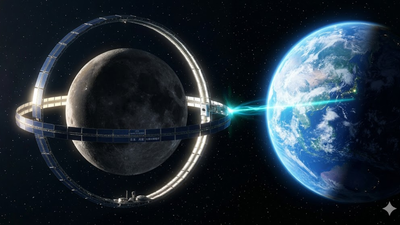
What would a future look like with no darkness because people learned how to produce limitless amounts of power instead of saving electricity? It seems like this scenario was considered by the engineers from Japan in a project called the “Lunar Solar Ring.” The idea offered by Shimizu Corporation is a solar ring made of solar panels encircling the whole surface of the Moon and producing endless electricity for the benefit of Earth. This solution seems quite impossible, but its design is thoroughly studied. Considering the environmental changes caused by the excessive production of electric power, this idea can become one of the solutions.
What is Japan’s lunar ‘solar ring’ project
Lunar Solar Power (or the Luna Ring) is a massive infrastructure project that would surround the Moon with solar power cells along its equatorial belt. As Shimizu Corporation says on its official concept page, it “will harness solar energy by placing solar panels in a belt around the Moon’s equator.”Measuring about 11,000 kilometres in length and hundreds of kilometres in width, this would be one of the biggest man-made constructions ever conceived by humankind. The proposal emerged due to Japan’s exploration of new sources of power after the Fukushima incident.Unlike terrestrial solar farms, the Luna Ring project enjoys many advantages because of the Moon’s unique nature. There is no atmosphere or weather phenomena there, which means sunlight can hit solar panels virtually all day long.
How would the Moon generate and send energy to Earth
And yet the procedure sounds rather neat. The solar cells placed on the Moon’s surface will receive sunlight and transform it into electrical energy, which is then transferred to Earth via laser beams or microwaves.When the energy reaches Earth, there are devices called “rectennas,” whose function is to convert the received energy into electricity and distribute it.Since there is at least one side of the Moon that is constantly illuminated by sunlight, the system can operate around the clock, potentially producing 13,000 terawatts of energy per hour, far more than the total requirement on Earth today.Tetsuji Yoshida, president of Shimizu’s space consulting group CSP Japan, in a conversation with ABC News, said if all the energy from the lunar panels reached Earth, there would be no need to burn coal, oil, or biomass ever again.To put it succinctly, as the Shimizu Corporation does, one should move from “limited resources on earth to nearly limitless clean energy.”
Current state of the Lunar solar ring project
In spite of its ambitious and futuristic nature, the Lunar Solar Ring is at the theoretical stage only. As reported by Keep Track, currently, there is no definite construction schedule, government support, or development program from space organisations like NASA or JAXA. The concept still exists more in theory than in practice as a promising but distant mission of Shimizu Corporation.Nevertheless, associated technologies are gradually evolving. Already, some competitors have started to develop space solar power plants on a much smaller scale than the Lunar Solar Ring. A research on ‘Technical challenges of space solar power stations:Ultra-large-scale space solar array systems and space environmental effects,’ successfully demonstrated that it was possible to transmit some solar power from space to Earth through microwaves.
Challenges and the future of space-based solar power
However, there are several challenges that prevent the realisation of this great vision. First, the construction of necessary infrastructure in space would require the application of cutting-edge robotics technology that could be used to mine the moon’s soil and construct buildings on it.Logistical issues, the costs of space transportation and delivery, collaboration with other countries, as well as safely transmitting energy over a distance of 384,000 kilometres, are all serious complications in the project.Even the creators of the Lunar Solar Ring recognise that this is a long-term project, and initial plans have suggested a timeframe of 2035.But what makes this proposal especially interesting is its very concept; moving our focus away from scarcity and towards abundance. We must think outside the box if we wish to find solutions for the problems we face on Earth.