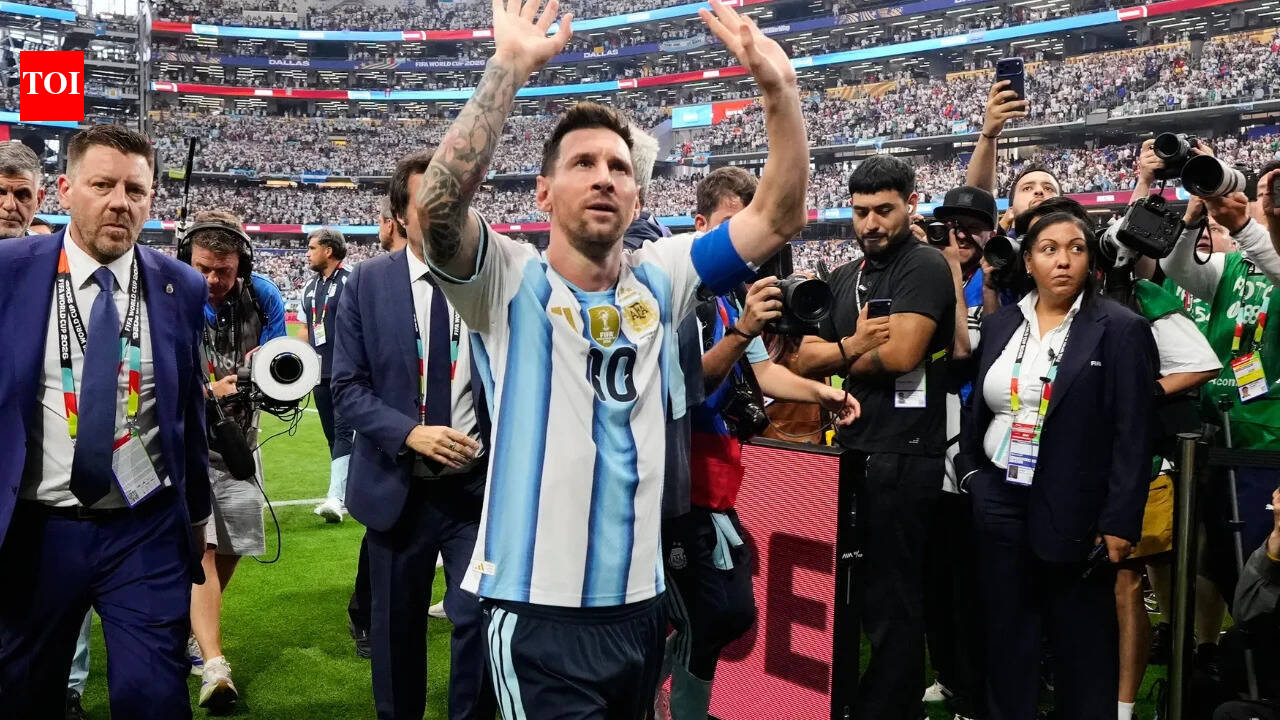
Lionel Messi just keeps writing new pages in football’s history book and at 38, he shows absolutely no signs of stopping.When Messi swept home Argentina’s opening goal against Austria at Dallas Stadium in Arlington, Texas on Monday, he became only the third player in history to score in six successive World Cup appearances, joining France’s Just Fontaine, who achieved the feat in 1958, and Brazil’s Jairzinho, who did it in 1970. The goal, coming in the 38th minute, sent the crowd into deafening roars and sent the record books into a spin. Messi’s six consecutive World Cup games with a goal span across two different World Cup tournaments, starting from 2022 and continuing into 2026.Messi scored seven goals in as many matches during Argentina’s 2022 World Cup title run in Qatar, scoring in each of the four knockout rounds, previously unprecedented in FIFA World Cup history. He then carried that momentum straight into the 2026 edition. He scored a hat-trick against Algeria in Argentina’s 2026 opener to tie Miroslav Klose’s all-time record, and then went on to break it against Austria on Monday, recording his 17th and 18th World Cup goals.The journey to this point has been nothing short of extraordinary. Just days earlier, against Algeria in Kansas City, Messi had scored a hat-trick, his first ever at a World Cup to equal Klose’s mark of 16 goals and stake his claim as the greatest scorer in the tournament’s history. That night in Kansas City was also his 200th international appearance, coming exactly 20 years to the day since he made his World Cup debut against Serbia and Montenegro in 2006.The numbers around Messi at this 2026 World Cup are simply staggering. He is the first player to appear in six different World Cups, has scored against 11 different nations, more than any other player in tournament history and holds the record as both the youngest and now the oldest goalscorer for Argentina at the World Cup.Fontaine scored all his nine goals at a single tournament in 1958. Jairzinho scored in every match of Brazil’s triumphant 1970 campaign. Now Messi joins them but across six World Cups spanning two full decades of football.