






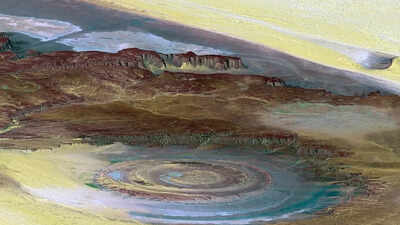
Looking down from space, astronauts on board the International Space Station spotted a fascinating landform in the Sahara Desert. This resembles a huge eye looking back up into space. The eye of the Sahara has been officially named the Richat Structure, which lies within Mauritania.The NASA Earth Observatory site has shown numerous pictures of this formation. From above, it looks like concentric rings with almost perfect proportions. It covers an area of about 25 to 30 miles in diameter, making it one of the most remarkable landforms visible from space.The eye of the Sahara is not a crater of any kindDue to this particular appearance, can it be taken as the result of a large meteor impact? In reality, it has nothing to do with space. Its creation is more geological in nature. For many years, people were convinced that the Eye of the Sahara was a result of some meteor impact. Impacts usually leave their marks in the form of a crater.However, both NASA and geologists have dismissed this hypothesis. There is no evidence of any shock waves or ejecta that usually appear during impacts.The feature is described as a dome, also referred to as a domed anticline. Simply put, layers of rock rose up from the bottom layers through a series of events. Then, erosion gradually removed the upper layers, revealing the underlying layers and thus forming rings.As NASA says, in such formations, older layers are often observed closer to the centre, while younger rocks form concentric circles farther from the central point. This fact allows scientists to distinguish an impact crater from this formation.How erosion formed rings in the SaharaAfter the dome had formed, the erosion process began. Natural forces began eroding the dome over millions of years. Different types of rocks eroded differently fast. This phenomenon is referred to as differential erosion.Differential erosion led to the formation of ridges that resemble concentric circles around the centre of the dome. Rock layers resistant to erosion form elevated areas, while less solid layers erode faster.According to NASA, different colours observed on satellite photos are the result of diverse types of rocks – sedimentary and igneous formations, in particular.
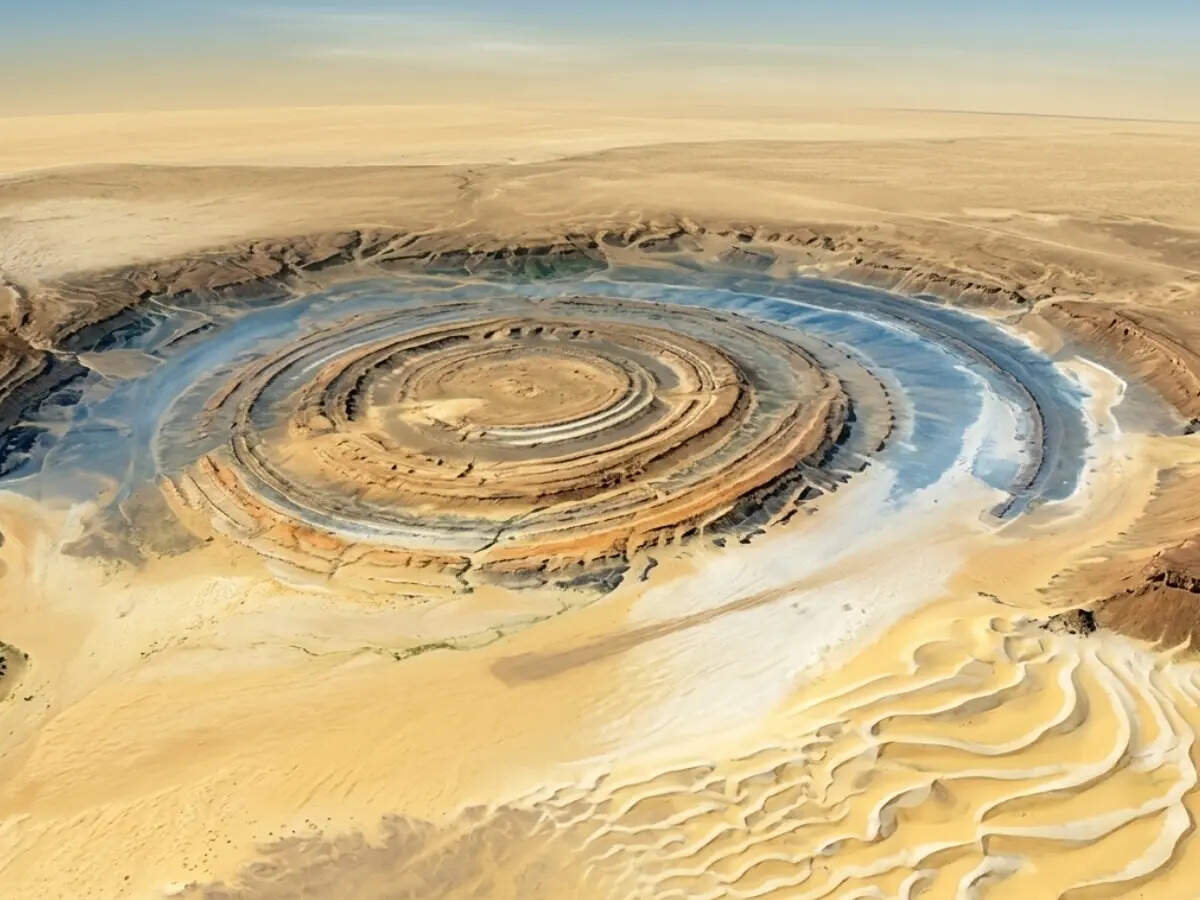
The eye of the Sahara has been officially named the Richat Structure. Image credit – Gemini
Astronauts claim the Richat Structure is a landmark developmentThe Sahara Desert may seem rather flat and dull in satellite images. It poses problems in terms of orientation for astronauts. However, the Richat Structure serves as a helpful marker to navigate.According to NASA, the Eye of the Sahara became an important landmark for astronauts during early space missions. This structure is large and distinct enough for astronauts to easily recognise its location.The most popular photo shows the Richat Structure taken from the International Space Station on July 10, 2020, using a high-end camera. Afterwards, NASA edited the picture, which made it more visible to researchers.What the dunes tell us about the areaSurrounding the Richat Structure are endless sand dunes. They were formed as a result of particular weather phenomena and therefore are predictable. For instance, according to NASA, longitudinal dunes develop in the direction that coincides with prevailing winds, while transverse dunes form at right angles to these winds when sand accumulates in certain locations.Sometimes, dunes end abruptly near cliffs due to changes in wind patterns near obstacles. Thus, dunes accumulate in one zone while another is left bare.These patterns help us learn more about how winds behave and desert dynamics.The Sahara Desert holds a key factor in the climate dynamics of the planetIt is not only because the Sahara is a desert. It is one of the greatest ecosystems on Earth, and the dust from there blows over continents.According to a study by NASA, an estimated 182 million tons of dust are released by the Sahara each year into the atmosphere. Of these, about 27.7 million are transported to the Amazon Basin. There, they provide vital nutrients, such as phosphorus, necessary for the development of the forest.According to the National Oceanic and Atmospheric Administration, the Saharan Air Layer travels many kilometers around the globe, even reaching the United States.The Saharan dust affects air quality, creates haziness, and influences weather dynamics. Scientific research reveals that the deposition of dust impacts oceanic ecosystems. They contribute 4.5 percent of ocean productivity and up to 60 percent in certain areas.Richat Structure – demonstration of Earth’s subtle complexitiesOne prime example of the deceptive nature of science is the Richat Structure. What appears to be a mark left by a meteor collision is actually the outcome of the workings of geology through time.This also demonstrates the dynamism of desert landscapes. The dunes surrounding the structure constantly move, thanks to the wind. Meanwhile, the dust carried by the Sahara is dispersed all over the world.Through NASA’s observations, scientists are able to have a deeper understanding of the aforementioned concepts. The combination of photographs taken by astronauts and data from satellites allows researchers to study the evolution of structures.