




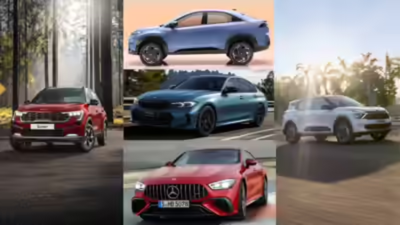
NEW DELHI: The long-discussed India-EU Free Trade Agreement (FTA) has finally been formalized on Tuesday, but don’t expect the prices of top European brands such as Mercedes-Benz, BMW, Audi, Renault, Citroen, Volkswagen, and Skoda to come down anytime soon. Rather, the prices may only go up as the continued devaluation of the rupee against the Euro (it fell by 19% in 2025 itself) is putting a severe pressure on the profitability of companies, which has even prompted some of the brands to take a price hike at the beginning of the year itself.The FTA, which paves the way for a massive cut in import duty on vehicles coming in from Europe from the peak 110% currently to 10% over a period of five years (on a quota of 2.5 lakh cars per annum), in any case is likely to come into force only over the next 18-24 months. “The agreement will be discussed within the various EU constituents and thus will not come into effect anytime soon,” top sources said.Also, the import of electric cars will not see any change in duty for at least a period of five years. Thus, the prices of European EVs coming in through the import route will also likely stay unchanged for now.And while the agreement will surely see a significant cut in prices of super-luxury European brands such as Lamborghini, Porsche, and Ferrari – which have no reason to make in India considering their limited sales volumes — even these will have to wait till the time the FTA gets a final approval and gets implemented on the ground.Players in the Indian car industry such as Maruti Suzuki, Tata Motors, and Mahindra & Mahindra are also in a “wait and watch mode” as they try to assess the competitive impact from low-duty imports of European cars. The FTA is looking to give the concession to vehicles priced upwards of 15,000 Euros (around Rs 16.4 lakh).EUROPEAN MAKERS EXPECT NEWER MODELS, TECHNOLOGIES TO FLOW INCommenting on the agreement, the European automakers hoped that it will see the entry of newer vehicle categories and technologies to India. “I heartily welcome the forward-looking India–EU Free Trade Agreement (FTA), which will further strengthen cooperation between the two regions. As a global company, we strongly support free-trade agreements across markets and geographies,” said Piyush Arora, MD & CEO of Skoda Auto Volkswagen India (SAVW).Arora said greater tariff certainty and a more predictable trade framework will “allow us to evaluate the introduction of a wider range of European models” for Indian customers. “Over time, this can support deeper technology transfer, capability building, and long-term investment in the Indian automotive ecosystem. As more details emerge, we will be able to assess the medium- and long-term implications of this agreement.”Balbir Singh Dhillon, Brand Director of Audi in India, said the agreement recognises the potential to deepen economic ties between two of the world’s largest trading blocs. “This constructive approach to trade could support the broader automotive ecosystem, including innovation, supply-chain efficiency, and technology collaboration.”However, Dhillon said any implications for pricing and market can only be assessed once the final terms are available and carefully reviewed, including the timeframe of implementation. “Until then, it would be premature to draw conclusions on specific commercial or product strategies.”Santosh Iyer, MD & CEO Mercedes-Benz in India, said the company welcomes the FTA as it will have a “positive cascading effect on customer sentiments” for the luxury segment, with a boost in overall economic growth.“A gradual tariff reduction on vehicles and fully liberalized automotive parts are strategically important decisions in the FTA for the automotive industry. The FTA opens up new avenues for customers with improved vehicle allocations, better availability of top-end global models for the Indian market, faster access to latest technology and creating a stronger luxury car ecosystem. Mercedes-Benz will however continue to value add to customers with local production of world-class models from our manufacturing plant,” Iyer said.Hardeep Singh Brar, president and CEO of BMW Group India, said the FTA is a “historic and ambitious milestone”, reflecting the growing strategic and economic relevance of India on the global stage.“We have always advocated free trade as it enhances fair market access, strengthens economic collaboration, leverages mutual strengths, and builds more resilient supply chains especially at a time when such cooperation is more critical than ever. The proposed phased reduction of tariffs on cars and auto components has the potential to positively impact consumer confidence, enable greater product choice, and foster technological innovation and sustainable growth within the Indian automotive sector, particularly in future mobility.”Brar, however, added that the company “does not foresee any immediate price changes in the near term”. “… the FTA could create opportunities to introduce new and niche products and, if demand scales, support deeper localization over time. We will closely evaluate the detailed implementation roadmap, timelines and qualification criteria once the fine print of the agreement is available.”Shailesh Hazela, CEO and MD of Stellantis India, said the company sees the agreement as a significant accelerator for its long-term commitment to ‘Make in India for the World’. “Reduced trade barriers will help enhance manufacturing competitiveness, expand export potential, and support the seamless integration of our India operations into global supply chains. For our customers in India, this development enables greater access to advanced technologies and the latest offerings from the Stellantis line-up.”INDIAN CARMAKERS SAYS FTA TO NOT CHANGE COMPETITIVE DYNAMICSOn the Indian makers side, Anish Shah, Group CEO and MD of Mahindra Group, said the FTA is a significant milestone as it provides the next wave of economic impetus for India, building on the strong foundation laid by a number of policy reforms.“We see a huge positive for the auto sector as it provides duty-free access to European markets and will attract European OEMs to invest further in India. This agreement is very well designed, as it lowers in-quota duties only at higher priced segments which will enhance scale in the core segments relevant to Make in India for the world. We feel this will not change any competitive dynamics in the industry,” Shah said.Shailesh Chandra, president of local industry body SIAM and MD & CEO of Tata Motors Passenger Vehicles Division, said the FTA with EU will play a key role as India marches on towards ‘Viksit Bharat’.“While we look forward to specific details of the India-EU FTA with respect to the auto industry, the calibrated approach to balance market access and domestic manufacturing should give us a win-win between increased global participation on one hand and growth of the domestic auto industry with investments and employment on the other hand. This will also enable increased choice for consumers in both regions,” Chandra said.Saurabh Agarwal, Partner & Automotive Tax Leader at EY India, said the overall impact on the Indian auto industry is expected to remain limited. “Vehicles imported in CKD form continue to attract a significantly lower duty of around 15%, and this route is also widely used by European, Japanese and Korean manufacturers. This model is likely to continue, helping maintain price stability for consumers while supporting local manufacturing, investment and employment in India.”