




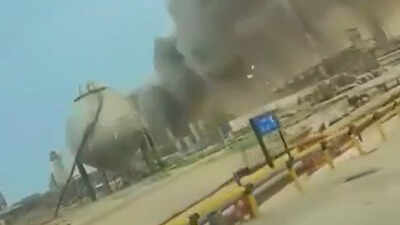
Iran’s recent retaliatory drone and missile strikes on Saudi Arabia and key oil refinery sites amid joint US-Israel attacks and Ayatollah Khamenei’s killing, has sparked a strong reaction from Pakistan, which has condemned Tehran’s “dangerous escalation” and pledged “full solidarity” with Riyadh and Gulf states.As the situation continues to escalate with Iran continuing its missile and drone barrage, questions are being raised whether Islamabad’s reaction will go beyond verbal admonishment given its 2025 Strategic Mutual Defence Agreement with Riyadh .
Saudi cities, Aramaco oil refinery attacked
- Riyadh: Capital hit by intercepted missiles, prompting air raid sirens and government condemnation of “blatant Iranian aggression” on the kingdom’s heartland.
- Dammam/Eastern Province: Broader barrages struck this industrial hub near oil fields, with debris and direct impacts reported.
- Ras Tanura Refinery: Primary target, one of the world’s largest with 550,000 barrels/day capacity on the Persian Gulf. A drone strike caused a small fire and black smoke, leading to temporary shutdown for damage assessment; no injuries, blaze contained quickly.
The strikes were part of a wider Iranian wave hitting UAE (Abu Dhabi, Dubai), Qatar (Doha), Bahrain (Manama), and Oman (Duqm port), spiking oil prices 10-15%. Saudi Patriots intercepted most threats.
Pakistan’s reaction
Pakistan Prime Minister Shehbaz Sharif said he had spoken with Saudi Crown Prince Mohammed bin Salman to convey Islamabad’s position on the escalating situation.Posting on X, Sharif said, “This evening, I spoke with my dear brother, His Royal Highness the Crown Prince Mohammed bin Salman, to express Pakistan’s strong condemnation of the dangerous regional escalation that followed the Israeli attack on Iran and the subsequent strikes in the Gulf region.”He added that Pakistan stands “in full solidarity with the Kingdom of Saudi Arabia and the sisterly Gulf states during this difficult time”.Sharif further said that Pakistan is fully prepared to play a constructive role for peace and expressed hope that the holy month of Ramadan would bring tranquillity and stability to the region.But will Islamabad dispatch jets, troops, or nukes?
What the defence pact says
Pakistan and Saudi Arabia formalised the Strategic Mutual Defence Agreement (SMDA) in September 2025, a pact treating aggression against one as an attack on both.Core provisions
- Collective defense clause: Any attack on either nation triggers mutual response, rooted in decades of military training, joint exercises, and Pakistan’s support for Saudi security.
- Enhanced cooperation: Covers joint mechanisms, intelligence sharing, defense industry collaboration (e.g., drones, cybersecurity), and potential co-production of equipment, without explicit nuclear guarantees despite speculation.
- No nuclear umbrella: Pakistan’s doctrine remains India-focused; the pact institutionalizes conventional ties rather than extending deterrence.
Will Pakistan step up?
The pact’s collective defense clause treats aggression against one as an attack on both, building on decades of military ties. Yet, core provisions emphasise conventional cooperation — joint exercises, intelligence sharing, drones — without nuclear commitments. PM Sharif’s call with Crown Prince Mohammed bin Salman pledged “full solidarity” and peace mediation, not jets or troops. Experts say dispatching forces could drag Pakistan into a multi-front war, straining its economy and exposing vulnerabilities amid domestic woes.“The Saudi-Pakistan defence pact is more of a political and strategic partnership rather than a classical defence pact akin to NATO. Pakistan has publicly condemned the Iranian attack on the Saudis and expressed solidarity and nothing beyond that. Pakistan in no way will get into any kind of military involvement as it has enough on its hand both externally with Afghanistan and internally with TTP and BLA. This once again exposes the double standards which Pakistani leadership has been exhibiting from time to time,” said Major General Rajan Kochar (Retd).Experts add that Islamabad will likely stick to diplomacy, logistics aid, or overflight rights — bolstering Riyadh without boots on ground.