




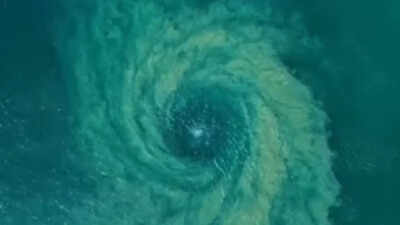
Drone footage captured at Manly Beach in Sydney has documented a rare and potentially dangerous rip current forming close to the shoreline. The footage shows a strong circular motion in the water, where sand and seawater are drawn into a spinning vortex beyond the breaking waves. The event occurred on Monday shortly before midday and was recorded by surf photographer Jamen Percy.The visual material has drawn attention due to the clear structure of the rip current, which is typically difficult to identify from the beach level. From above, the movement of water appears as a distinct swirling formation moving seaward, contrasting with the surrounding wave patterns.
Mysterious underwater tornado vortex forms in Australia amid strong ocean waves
The documented occurrence formed as a result of natural ocean wave action. The formation of rip currents occurs when water carried towards the shore from waves is discharged back into the ocean through a channel. In this instance, the water discharged formed a vortex that sucked the sand and surface water into a spiral path.The video was shot on days when there was high wave action on the New South Wales coast. During the days before the documentation, there were unusual wave actions in the area, characterised by large waves hitting various beaches in Sydney.
Role of drone imagery in identifying hazards
The rip current featured in the video clip was not easy to spot when viewed from the beach. When observed on the ground, the rip current tends to look like the rest of the water conditions prevailing there, hence making it dangerous. The video footage gave clear pictures of the movements of the water. Jamen Percy, a surf photographer, gave his account regarding how rip currents tend to stay concealed even as they pose serious threats when seen from ground level. Using an unmanned aerial vehicle gave him a chance to observe the formation process of the rip current.
Safety concerns associated with Rip currents
Rip currents are recognised as a major hazard along Australian beaches. Coastal safety organisations, including Surf Life Saving Australia, classify them among the most common causes of beach-related drowning incidents. These currents can move swimmers away from shore quickly, particularly when they are not identified early.Statistical data from recent years indicates that rip currents contribute to multiple drowning incidents annually across the country. Beach safety warnings continue to emphasise the importance of recognising flagged swimming zones and understanding ocean conditions before entering the water.
Beach safety awareness and public response
The recording of the rip current through visuals has helped reinforce messages for ocean safety that have been sent out by the coast guards in the past. There are beach flags and areas demarcated within the beach for safer swimming to avoid areas where there is a higher probability of rip currents occurring.Safety agencies continue to emphasize that rip currents are an ever-present natural phenomenon at surf beaches. The campaign emphasizes locating areas for safer swimming and what to do in case one gets caught up in a current.