




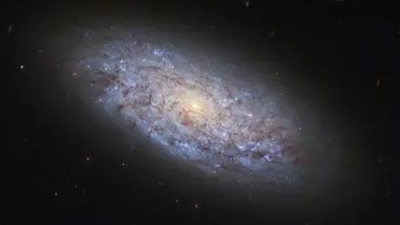
BENGALURU: In the vast hierarchy of the universe, the smallest galaxies are often overlooked. But a new study now suggests they may hold clues to one of astronomy’s most persistent questions: how black holes first formed and evolved.Researchers at the Indian Institute of Astrophysics (IIA) in Bengaluru have examined whether dwarf spheroidal galaxies, the tiny, faint companions orbiting the Milky Way, could host black holes at their centres. These galaxies are among the most difficult to study: they contain very little gas, emit weak light, and are dominated by dark matter. Black holes are routinely found in large galaxies, including supermassive ones weighing millions or even billions of times the mass of the Sun. But whether such objects exist in much smaller galaxies has remained uncertain. The answer could help scientists trace the origins of the earliest black holes and understand how they grew over cosmic time. The team, led by K Aditya and Arun Mangalam, built detailed models of these dwarf galaxies by accounting for three components: stars, dark matter, and a possible central black hole. By studying how stars move within these galaxies, using high-quality kinematic data, they were able to place limits on the mass of any hidden black hole. Their findings suggest that if black holes exist in these systems, they are relatively small. In most cases, their masses are likely below one million times that of the Sun, and often much less. The data do not require the presence of large black holes but remain consistent with smaller, intermediate-mass ones. Importantly, the study connects these small galaxies to their larger counterparts through a known relationship between a galaxy’s stellar motion and the mass of its central black hole. By combining their results with existing data, the researchers show that this relation appears to extend smoothly across a wide range of galaxy sizes, though with greater uncertainty at the low-mass end. The work also explores how such black holes might form and grow. Models based on gas accretion suggest masses of around 1,000 Suns, while processes involving stars being captured could push this to about 10,000 Suns or more. Another possibility is that these dwarf galaxies were once larger systems that lost much of their mass through interactions with the Milky Way. The findings come at a time when new telescopes are on the horizon. Instruments such as the proposed National Large Optical Telescope (NLOT) and the Extremely Large Telescope (ELT) are expected to provide sharper observations of faint galaxies. These could help confirm whether such small galaxies do, in fact, harbour the seeds of black holes.