




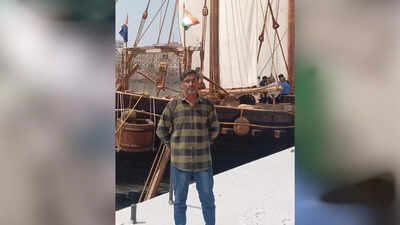
PUNE: When INSV ‘Kaundinya’ docked safely at Mumbai Port, ending its demanding voyage across challenging waters, there was visible relief among Indian Navy sailors and their families. Amid the celebrations and camera flashes at the Naval Dockyard, one man stood quietly in the background, absorbing the moment with moist eyes and folded arms — 50-year-old shipwright Rajeesh. He had travelled all the way from Goa to Mumbai, not for applause, but to see with his own eyes that the vessel he had painstakingly stitched together had returned intact. Standing away from the media glare, Rajeesh appeared calm yet deeply emotional. “I can’t express my happiness in words today, seeing the safe voyage of the ship through all the challenges posed by the demanding sea during this journey,” he said softly. A second-generation craftsman originally from Kerala’s Konnur district, Rajeesh has spent over two decades mastering a niche and fading art — traditional wooden shipbuilding. He learned the craft as a boy from his father, watching and assisting him in shaping timber and stitching hulls using natural fibres. Today, he works with the Hodi Association of Goa and was among the key artisans involved in reconstructing the ancient-style sailing vessel for the Navy. Rajeesh was entrusted with one of the most critical tasks — stitching the vessel’s hull using coconut fibres and coir, securing the wooden planks that form the ship’s base. In traditional shipbuilding, this method replaces modern metal fastenings, relying instead on tightly bound organic materials that expand when wet, creating a watertight seal. “I had done the stitching of coconut fibres, coir, and other materials, especially the main bed of the vessel,” he explained. “The main body of the ship is its base. If water had entered through it, it would have been disastrous for the entire crew. The mission would have failed.” Though he never sailed on the voyage, Rajeesh says he endured his own emotional journey over the past 39 days. He followed updates daily, anxiously tracking the vessel’s progress through rough seas and unpredictable weather. “Along with the sailors, though I was not in the water, it was a test of my craftsmanship that I have learned over the years from my father. The last 39 days, like the crew members, I too had a tough time,” he recalled. Once the ship docked, Rajeesh quietly stepped aboard. He ran his hands over the wooden planks, inspected the seams, and checked the condition of the hull — almost like a father examining a child after a long journey. “I felt really relaxed and satisfied after inspecting the ship. It looks sturdy, reliable, and gentle to be on. Each and every part of it we checked thoroughly before handing it over to the Navy in May 2025. It was our baby,” he said. Rajeesh worked under veteran shipbuilder Babu Sankaran, who headed the ambitious reconstruction project. Over the years, Rajeesh has contributed to various shipbuilding projects, including assignments for private firms and foreign companies in Dubai. Yet, he insists this mission stood apart. “This project was something special because it was for the Navy and for the country. For us, it is more than a project. Its success is the work of our entire team back in Goa,” he said with quiet pride. “For me, it was also the credibility of my father’s skills that I have carried forward.” As celebrations continued around him, Rajeesh slipped back into the crowd — the silent stitcher whose work stitched history silently into the demanding sea.