





India’s skilling challenge is becoming more urgent as the country tries to prepare a large young workforce for an economy being reshaped by technology, shifting labour-market needs and global uncertainty. At a roundtable organised by The Times of India and JPMorgan Chase , policymakers, educators, employers and researchers examined why the transition from education to employment remains so difficult for many young people.The discussion showed that the problem runs deeper than a shortage of training seats. Panelists pointed to weak career guidance, outdated curricula, limited work exposure, social stigma around vocational careers, low job creation, and the structural barriers faced by women and rural youth. They also outlined a broad set of solutions, from earlier career awareness and hyperlocal demand-mapping to stronger apprenticeships, employer-led training and better support systems that can help young people move into work more smoothly.
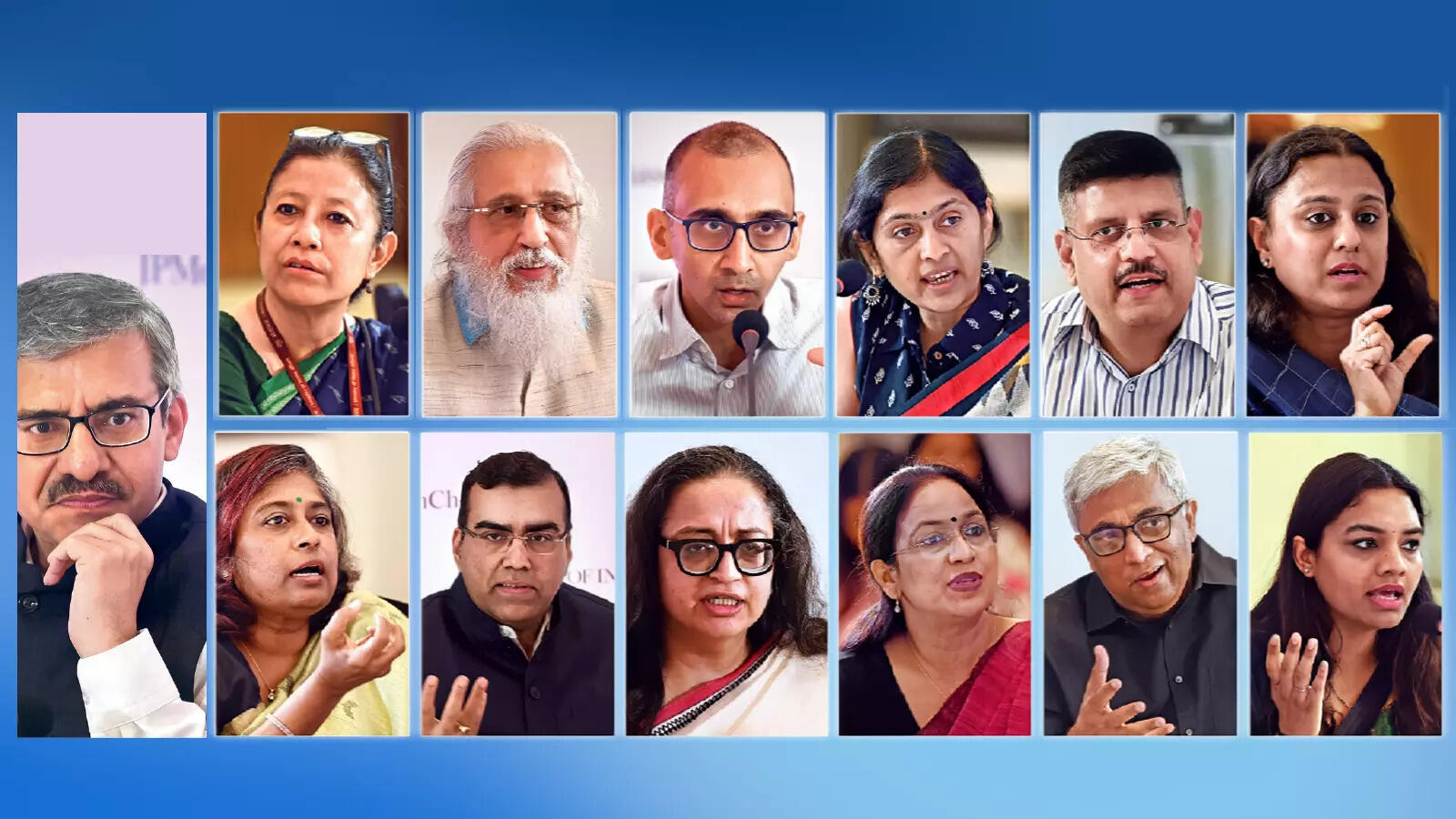
A cross-section of policymakers, educators, researchers and employers who took part in the TOI-JPMorganChase skilling roundtable
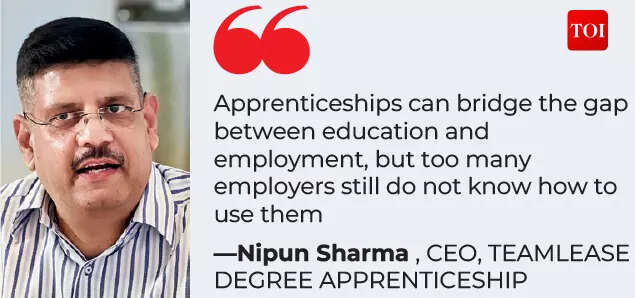
1. Students are choosing in the darkOne of the concerns was that students often make educational choices without understanding what jobs exist, what qualifications they require, or which pathways are actually viable. Isha Gupta, research lead at JustJobs, identified this as a central “information gap” in the transition from education to employment. Shriya Lall Sethi, operating partner at The Convergence Foundation, said this problem is complicated by the lack of reliable district and state-level data on job demand.Solutions: Priya Agrawal, founder director of Antarang Foundation, said career education needs to start in school, with teachers, parents, principals and local employers helping students understand real options. Sethi called for hyperlocal demand-mapping so institutions and families can make better decisions. Nipun Sharma, CEO of TeamLease Degree Apprenticeship, said awareness of existing skilling and apprenticeship pathways also needs to improve among employers themselves.
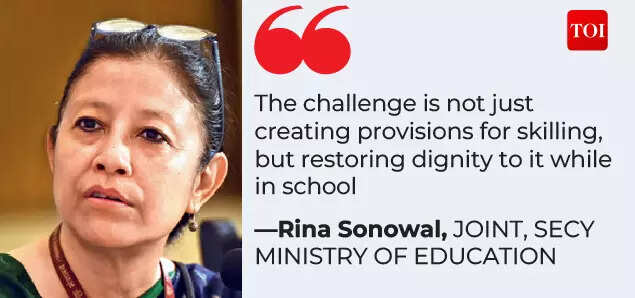
Rina Sonowal
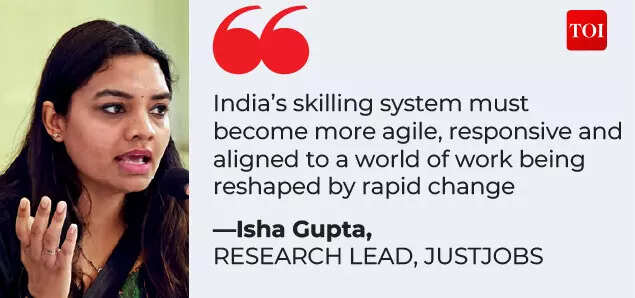
Isha Gupta
2. What colleges teach, jobs don’t needSeveral speakers said India continues to produce graduates and trainees whose education is poorly aligned with the changing demands of the workplace. Prof Anil Sahasrabuddhe, chairman, National Assessment and Accreditation Council (NAAC), said outdated curricula had long been a complaint from industry and that institutions had been forced to move towards more frequent revision and closer consultation with employers.Solutions: Sahasrabuddhe called for continuous curriculum reform and lifelong learning. Guhaprasath Rajagopal, India head of payments, JPMorgan Chase, said employers must stop behaving like passive recruiters and instead become active skill-builders. Neha Mathur, chief human resources officer of Urban Company, said companies also need to shorten the gap between training and jobs by building in-house training systems that respond quickly to changing demand.
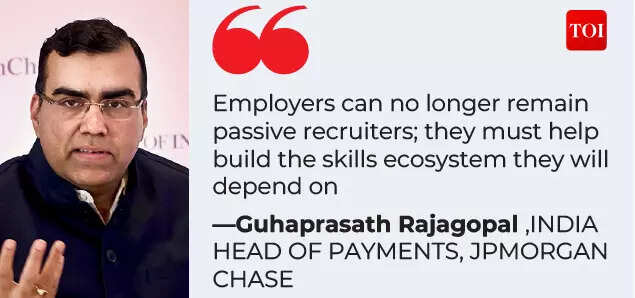
Guhaprasath Rajagopal
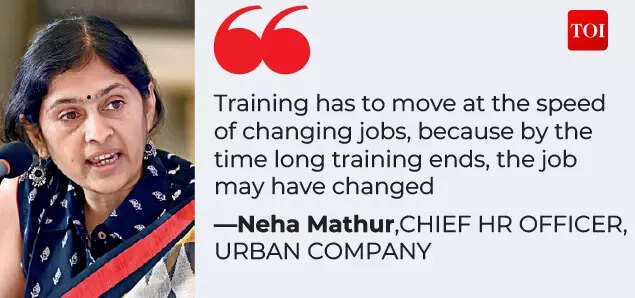
Neha Mathur
3. No one is job-ready without work exposureThe panel repeatedly returned to the problem of an “experience gap” — the lack of real exposure to the world of work before job entry. Gupta said many young people struggle because the reality of employment does not match what they imagined.Solutions : Sahasrabuddhe and Amit Basole, professor at Azim Premji University, both pointed to internships as an effective bridge between education and work. Teamlease’s Sharma made a strong case for apprenticeships, saying they allow students to learn while they earn and ease the transition into stable employment. Sethi highlighted work-integrated degree programmes, while Raj Gilda of Lend A Hand India, an NGO working in the jobs and skilling space, said vocational exposure should begin much earlier in school and deepen over time through local internships. His NGO supports students in grades 11 and 12 for 80hour internship with local businesses-grocery stores, healthcare units,cafes, garages, workshops, small manufacturers.
Nipun Sharma
Amit Basole
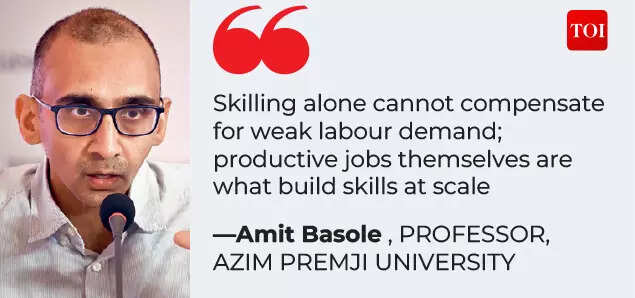
4. Skilling cannot replace job creationAmit Basole said that the skilling debate, too, often treats the problem as one of supply alone. India, he said, has expanded education and skilling infrastructure, but labour demand has not grown fast enough, especially for workers without college degrees.Solutions: Basole said that skilling policy must be linked to broader job creation, especially in manufacturing and other sectors that can absorb large numbers of non-graduate workers. He also said employers’ reluctance to invest in workers cannot be separated from wider business constraints such as energy costs, logistics and regulation. His larger point was that productive jobs themselves create skills, and skilling cannot be treated as a substitute for employment-generation.
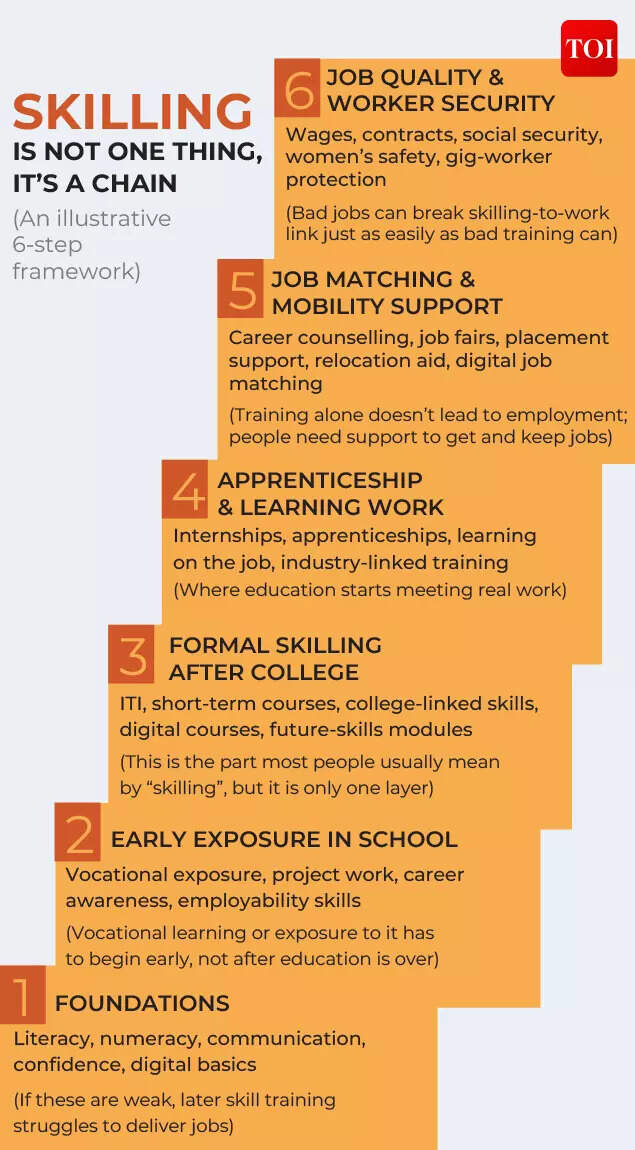
Skilling is not one thing, it’s a chain
5. Why vocational work still lacks respectAnother recurring theme was that skillbased and manual work still does not enjoy the same social legitimacy as white-collar careers. Rina Sonowal, joint secretary in the ministry of education, said one of the sector’s continuing challenges was that skilling remains less aspirational than conventional education. Basole linked this to deeper social attitudes, including caste-based ideas about manual labour.Solutions : Sonowal said that dignity of labour has to be built into schooling. Priya Agrawal said career pathways need to be normalised through trusted institutions like schools. Her foundation works with govt schools to integrate career education into public educational systems. Urban Company’s Mathur suggested that vocational work gains dignity when it offers visible progression in income and status. Nipun Sharma said success stories of people who learn while they earn could help shift social perceptions.
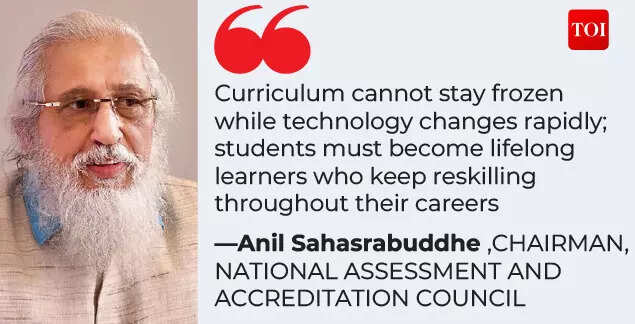
Anil Sahasrabuddhe
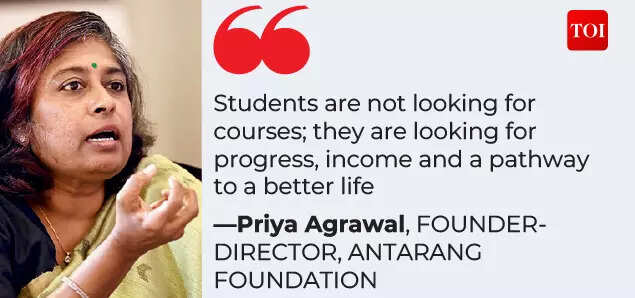
Priya Agarwal
6. For women, the obstacle is often outside the classroomThe discussion made clear that women’s participation in skilling and employment is shaped by barriers beyond the classroom. Devinder Kaur, assistant director at the Noida-based National Vocational Training Institute for Women, said several women, particularly from rural areas, struggle with transport costs, living expenses, social restrictions, marriage-related interruptions and weak local placement options even when training is subsidised.Solutions: Neha Mathur said employers need to think beyond training and address practical mobility constraints, citing efforts to help women access vehicles and improved movement for work. Sharma said safe accommodation remains a major concern. The broader solution suggested by the panel was that skilling policy must include support for transport, housing, safety and family acceptance if women are to stay in jobs.
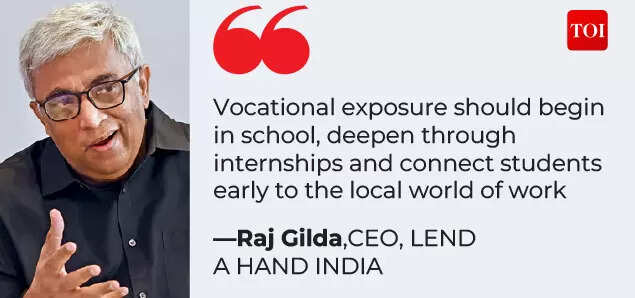
Raj Gilda
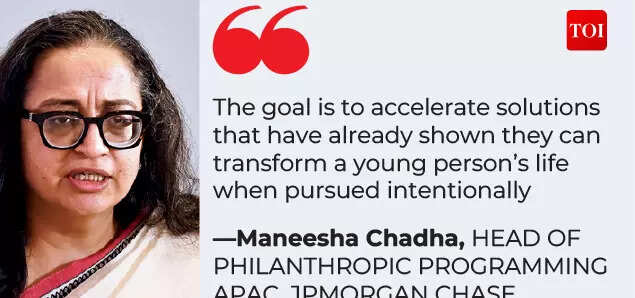
Maneesha Chadha
7. Should skilling follow local Jobs?The panel also debated whether skilling should be tailored mainly to local jobs or to broader labour-market mobility. Sethi argued for local demand mapping so institutions can align training with nearby opportunities. Raj Gilda stressed that small local businesses — from garages and salons to retail shops and cafes — are an underused source of internships and early work exposure.Solutions: The view that emerged was that both approaches matter. Local opportunities can ease entry into work, especially for school students, women and first-generation learners. But Nipun Sharma cautioned against restricting skilling to local labour markets, asserting that mobility to cities or even overseas often transforms incomes. The answer is local grounding, combined with pathways for wider mobility.
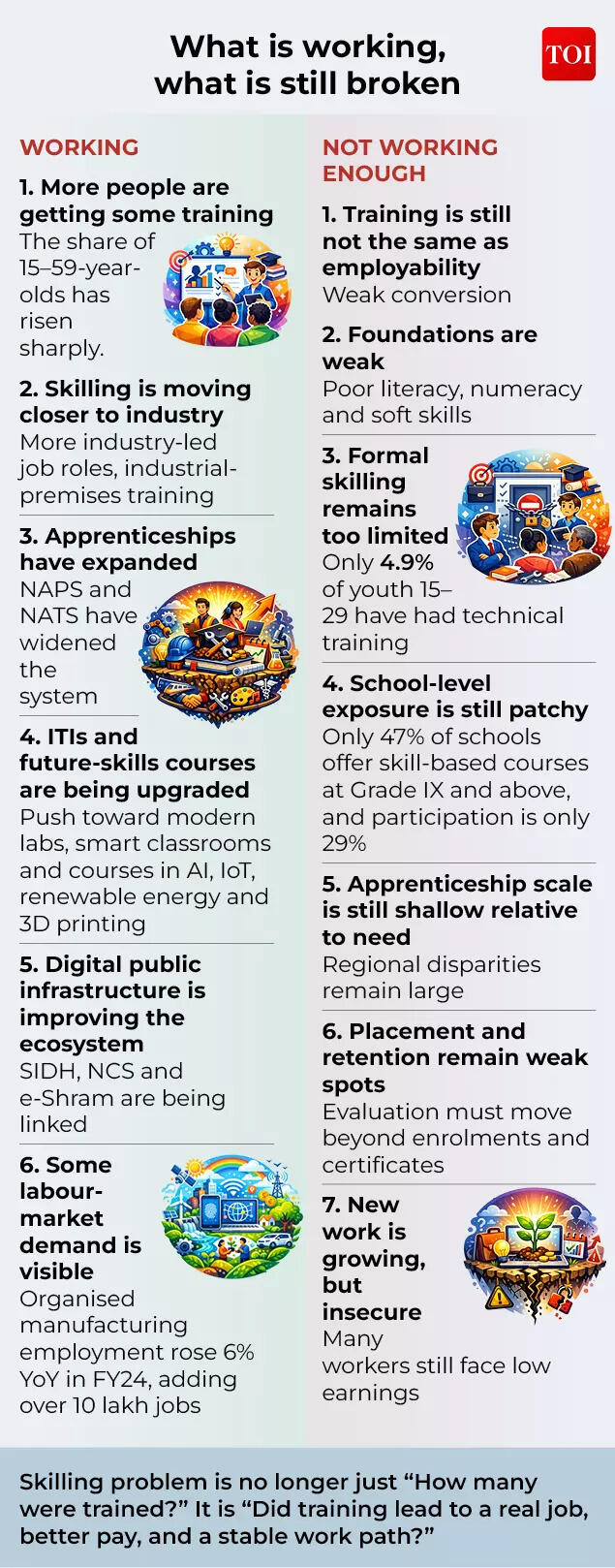
.
8. Why good skilling ideas stall on the groundA repeated theme in the discussion was that the country does not necessarily lack policy frameworks or platforms; the bigger issue is patchy uptake and weak execution. Sahasrabuddhe listed several existing initiatives, including curriculum reform measures, digital learning platforms, and credit systems. He talked about UGC and AICTE — the two regulator in higher education sector — coming together to create model curriculum in association with industry leaders an alumni.Solutions: Speakers suggested the need to focus less on launching new schemes and more on making existing ones work better. That would mean stronger quality tracking, better coordination with institutions and employers, and greater awareness within industry of tools such as apprenticeships and modular credentials. Sharma said apprenticeship budgets and provisions remain underused largely because employers do not know enough about them.Maneesha Chadha, head of philanthropic programming APAC, JPMC, highlighted the range of solutions that are being tried out at the ground level and said the idea is to accelerate the adoption of all these models that have successfully demonstrated that one can transform the life of a young person if efforts are made proactively and intentionally.
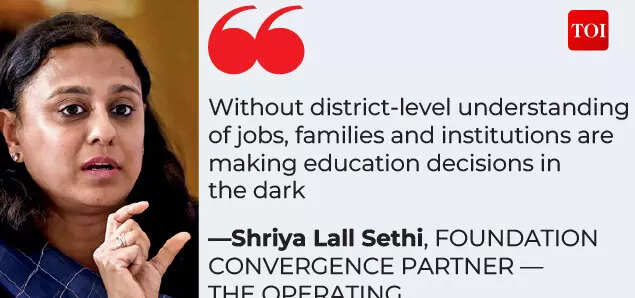
Shriya Lall Sethi
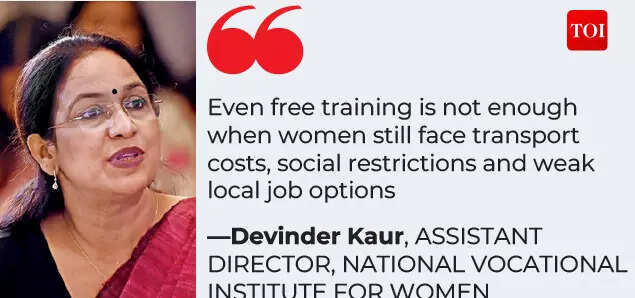
Devinder Kaur
9. AI will change jobs. Can skilling keep up?The panel also touched on AI, both as a disruptor and as an opportunity. There was recognition that technology is reshaping entry-level roles and may reduce demand for some conventional tasks.Solutions: Nipun Sharma said AI could be used for counselling, personalised learning, fitment, and matching workers with employers. Guhaprasath Rajagopal said AI should not be seen only as a threat, but also as something that complements skilling systems to make them more efficient. The broader suggestion was that skilling systems will need to adapt faster, both in what they teach and in how they teach it.JUSTJOBS’ 6-point plan:Drawing on field evidence from seven nonprofit partners, a report by JustJobs Network, a global research organisation, recommends six connected reforms: map local job demand, provide continuous career guidance, teach employability skills, build industry links, strengthen trainers, and engage families.