






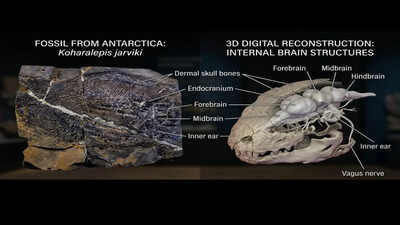
Fish fossils from the Antarctic have been revealing a key stage in early animal evolution. Scientists are scanning the fossil for clues about life before the land animals. They claim that the discovery of Koharalepis jarviki can give insight into the fauna preceding the colonisation of the land by animals some 370 to 380 million years ago.The discovery presented in a study by the Frontiers in Ecology and Evolution reveals that the fossil belongs to the Devonian period, also known as the “Age of Fishes.” It is characterised by the evolution of various structures in primitive vertebrates that would later prove helpful for living on land.Skull of a fish brings hidden secrets to lightWhat makes this particular specimen stand out is the well-preserved skull structure, which is rare for this species of fish. This is a three-dimensional structure, unlike other fossils that lack internal structures.Conducted by Corinne L. Mensforth, a PhD candidate at Flinders University, the study mainly analysed the braincase of this fish, as it contained valuable information about sensory capabilities. Mensforth stated that Koharalepis became the sole focus in the research because it is the only fossil in the whole group that has retained the internal bones of the skull.Some of the fossil’s characteristics relate to its senses of smell, vision, and respiration. Scientists can learn about how early vertebrates evolved to adapt to shallow aquatic environments through such characteristics.How advanced imaging techniques uncover the fossilRather than dissecting the specimen, the experts employed neutron tomography and synchrotron radiography to examine the fossilised head. This allows researchers to visualise internal structures within dense rocks without damaging them.Neutron tomography is based on the utilisation of neutral particles to penetrate hard rock layers, whereas synchrotron scanning uses high-energy X-rays to examine dense specimens.As a 2021 study published in Science News indicates, neutron imaging enables the visualisation of structures not visible in X-ray scans of dense materials and fossils. This technique helped uncover the braincase, teeth, and internal channels previously unknown in the fish’s skull.
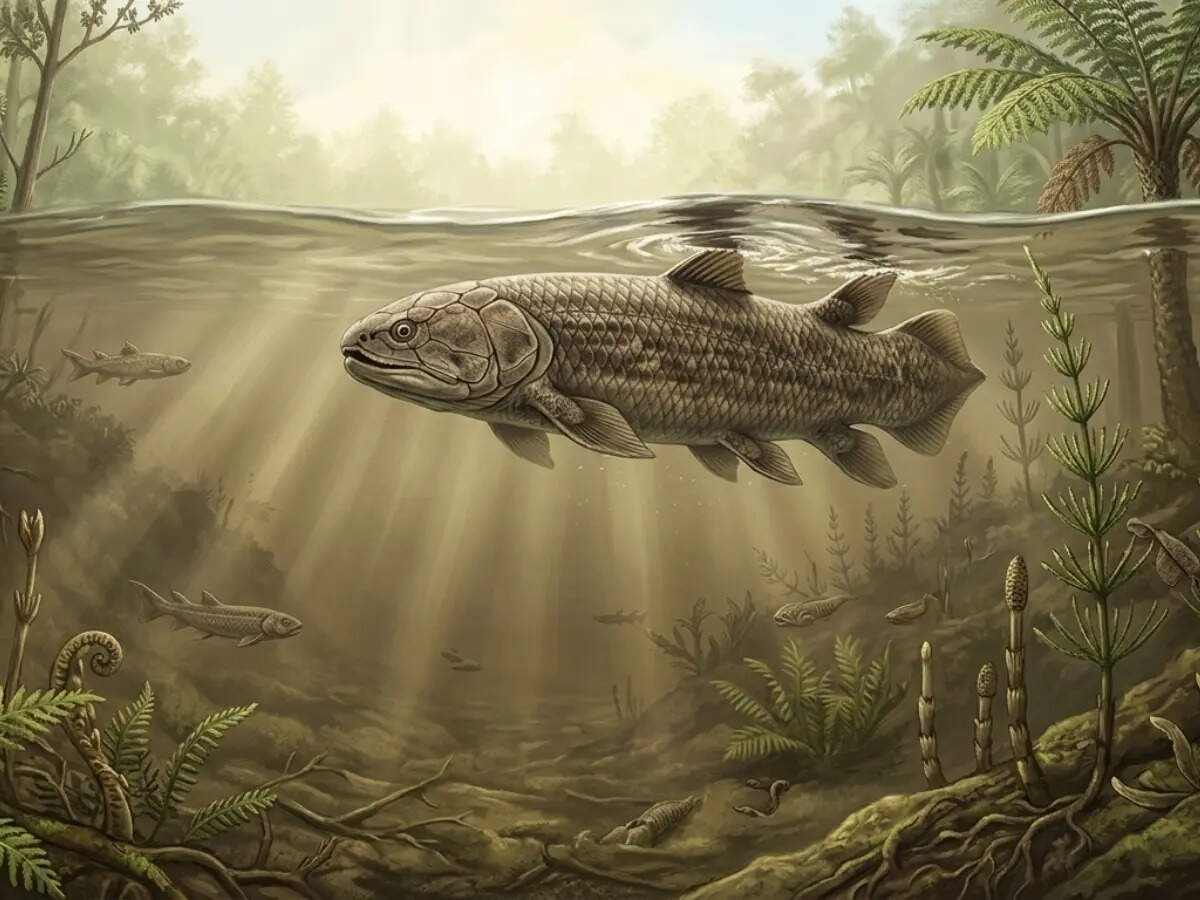
A rare Antarctic fish fossil just revealed what happened before animals left water. Image credit – Gemini
Built for life close to the surfaceBased on the fossil, Koharalepis jarviki could be found near the surface of freshwater habitats. Several anatomical attributes supported this notion. The fish has a highly developed pineal gland, which is sensitive to light and regulates circadian rhythms. It implies the use of light, which is available in abundance closer to the surface.Besides, the fish had small openings located on its head referred to as spiracles. They are considered to allow for the inhalation of air, thus marking the beginning of respiration out of the water.In addition, the researchers noted highly developed olfactory pathways, which implies that the fish had a highly developed sense of smell. It is useful when one needs to hunt in murky water.According to several studies, small-eyed vertebrates living long ago tended to be highly reliant on smell and short-range senses in areas of poor visibility.Ambush predator in ancient riversBeing 3.3 feet long, the fish possessed sharp cone-like teeth, implying that it was an ambush predator hunting for prey in close proximity. Small eyes and a broad skull imply that it was not built for active hunting. Therefore, the study concluded that it was an ambush predator waiting near the surface.Like many modern-day predators, including crocodiles, the timing and stealth are more crucial than sheer speed.Connections between continents and evolutionIn addition, the fossil provides further information about the connections between prehistoric ecosystems. At the time of the Devonian period, Antarctica and Australia belonged to a supercontinent known as Gondwana.According to Dr Alice Clement, a research fellow at Flinders University, Koharalepis is part of a family of fish known as Canowindridae, which indicates an ancient connection between Australia and Antarctica.Fossils belonging to the Canowindridae family have been unearthed in both regions. Therefore, similar species have existed throughout the southern hemisphere.Why is this discovery of an ancient fish skull significantAmong all events in evolution, the shift from aquatic to terrestrial life was among the most significant. It led to the emergence of amphibians, reptiles, mammals, and eventually humans.Therefore, fossils like the one mentioned above are vital since they offer insights into the development of early vertebrates’ ability to detect light, breathe air, and hunt in shallow waters.Despite the fact that a single specimen cannot provide all the answers, it offers valuable information from an area that is usually underrepresented in evolution studies.