




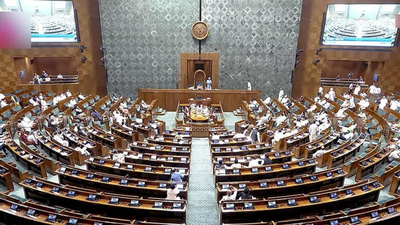
NEW DELHI: On a day Parliament put its stamp of approval on the Transgender Persons (Protection of Rights) Bill 2026 amid demands from opposition MPs that the bill be referred to a standing committee for wider consultation, two National Council for Transgender Persons members from the community sent their resignation to the social justice minister Virendra Kumar to register their strong protest against the bill and lack of consultation. The bill lays out a more precise definition of “transgender persons” making it clear that it will not include persons with “different sexual orientations and self-perceived sexual identities”.“From NCTP, some of us tried to reach out to you as the voice of the community and we felt that we were not heard,” said Rituparna Neog, a member of the council from the northeast region stated in her letter of resignation addressed to Kumar who is the chairperson of the statutory body. The body is supposed to have around 10 members representing the transgender community.The other member to resign, Kalaki Subramaniam, who is the southern region representative, registered a strong protest over lack of consultation with the community that views the bill as “regressive” and as a “step backward for their fundamental rights to self identification and dignity”. “I cannot continue to hold a seat at a table where our collective voice has been silenced,” she added.Transgender Persons (Protection of Rights) Bill, which was passed in Lok Sabha on Tuesday was passed by a voice vote in Rajya Sabha on Wednesday. Congress party’s Renuka Chowdhury opened the discussion putting forth a stirring question – “If no one asks us – men and women to prove our gender before a medical board, then who are we to question the identity of trans people?”At the end of the discussion, minister Virendra Kumar reiterated that the bill aims to provide protection to only those who face severe social discrimination due to their biological condition. He also tried to counter the opposition to the removal of the clause on self – perceived identity and introduction of a medical board by saying that this was aimed at securing the rights of TG persons by removing scope for any ambiguity and enabling benefits reach genuine persons through administrative clarity. BJP members joined the chorus in support.The amendments, which will now become law after the President of India gives her assent, marks a significant departure from the existing law as it omits the clause that allowed “self-perceived gender identity” to be the basis for self-determination and identification for approval for transgender certificate by the district magistrate.A medical board headed by chief medical officer has been introduced, and the district magistrate will going forward issue a certificate of transgender identity, after examining the recommendation of the medical board cited as “authority” to be constituted by the central or state govts.The bill proposes to create specific offences with graded punishments that reflect the gravity of the harm, the irreversibility of the injury, and the particular vulnerability of child victims.DMK’s Tiruchi Siva who had brought a private member bill “The Rights of Transgender Persons Bill, 2014” reflected on the struggles of the community to get their rights and demanded consultation from stakeholders, legal experts, civil society, transgender community as well as a review by the select committee. Manoj Kumar Jha (RJD), Saket Gokhale (TMC), CPI (M) MP John Brittas, NCP-SCP’s leader Fauzia Khan, Jaya Bachchan (SP), Shiv Sena-UBT’s Priyanka Chaturvedi, Sanjay Singh and Sandeep Pathak form AAP, IUML’s Abdul Wahab among others strongly opposed the bill.Even Golla Babu Rao from YSR Congress Party and Subhasish Khuntia from BJD joined the chorus with other opposition members and demanded that the bill be sent to a parliamentary committee for stakeholders consultation.The first signs of a backlash from the community emerged soon after the Bill was passed in Rajya Sabha as the two NCTP members resigned. Also the community members who have been agitating through press conferences and outreach campaigns since the Bill was introduced, now plan to hit the streets through demonstrations across states. In her resignation letter addressed to the social justice and empowerment minister, Kalki Subramaniam said, “until February 2026, my experience working alongside the ministry officials was one of mutual respect and a shared vision for an inclusive India. However, the recent introduction and passage of the Transgender Persons (Protection of Rights) Bill 2026 has created an untenable position for me.”“As a statutory representative, my primary mandate is to advise the govt on legislation affecting our lives. The decision to move this Bill forward without any formal consultation with myself or other community representatives of the NCTP undermines the very purpose for which this Council was established,” she added. Registering her opposition to the Bill passed by Parliament, in her resignation, Rituparna Neog states, “while I understand my responsibility as an NCTP member to represent the voice of my community to the competent authority, however, looking at the current circumstances, I wish not to continue as a member.”On Saturday, four NCTP members Abhina Aher, Vidya Rajput, Raveena Bareeha and Subramaiam, in a meeting hurriedly called by senior officials of the ministry on Saturday, had strongly reiterated that “self-affirmation of transgender identity, as upheld in the NALSA judgment, must remain the foundation of transgender identification”.After the meeting the members had highlighted the absence of the social justice minister Virendra Kumar who they were told would be chairing the meeting. “We were told that the minister was unable to attend due to ill health and a reported family emergency,” Aher said.According to Aher, at the meeting led by joint secretary Yogita Swaroop, Senior Economic Advisor in the ministry, govt officials raised concerns about identifying “genuine” transgender persons and referred to biological markers such as chromosomal combinations (XX/XY). “NCTP members clarified the concept of gender incongruence/dysphoria, mental health aspects, and the impact of stigma, though they felt that a gap in understanding of transgender issues was observed among the officials,” she added.The TG Council members also emphasised at the meeting that the definition of transgender person in the Bill was not inclusive and must explicitly include transgender men and transgender women; use respectful terminology and recognise diverse regional identities like Nupi Manabi and Nupi Manba (Manipur).On the provision in the Bill introducing screening by a medical board, NCTP members initially called for the removal of the provision. “However, considering the govt’s position, members proposed that any assessment should be limited to mental health support, it must not involve invasive physical examinations, and it should uphold dignity and remain aligned with the NALSA judgment,” Aher said. The need for gender-neutral laws to address violence against transgender persons was also raised vociferously.Now with the Bill having been passed in Parliament without paying heed to any of the suggestions made by the NCTP member representatives, the community has announced protests and demonstrations starting from Thursday.