




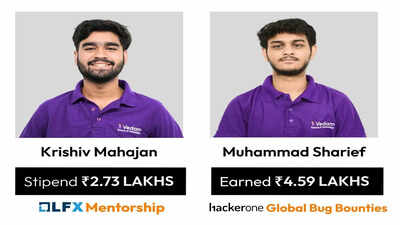
What most top engineering college students aim to achieve by their third or fourth year is already happening in the first-year at Vedam School of Technology. Within just months of starting their journey, two first-year students have made their mark in global technology ecosystems; one through open-source development and the other through real-world cybersecurity research, pointing to how early engineering outcomes are evolving.Krishiv Mahajan, a first-year student at Vedam School of Technology, has been selected for the LFX Mentorship Program (2026 · Term I)1, a global initiative by The Linux Foundation, earning a stipend of ₹2.43 Lakhs, as reported by the institute. The program connects developers with some of the most active open-source projects in the world and is known for its highly competitive selection process.Vedam School of Technology confirms that he will be working with the Karmada project, part of the cloud-native ecosystem under the Cloud Native Computing Foundation (CNCF), contributing alongside experienced maintainers from across the globe. These are not isolated student projects or academic simulations, but real contributions to systems used in production environments. Subhesh Kumar, Head of Academics at Vedam, notes that selection into LFX typically requires demonstrated ability, consistency, and proof of work, something most students take years to build. He further adds that achieving this in the very first year places Krishiv Mahajan in an exceptionally rare league of early-stage developers breaking into global open-source ecosystems.Since its inception in 2019, the LFX Mentorship Program has selected over 190 mentees worldwide participating in 96 mentorship programs2, making this a selective global milestone.At the same time, as reported by the institute, another first-year student, Muhammad Sharief, has achieved a breakthrough in cybersecurity3—earning $5,000 (₹4.5 lakh+) in global bug bounties on HackerOne; the world’s largest ethical hacking platform used by companies like Google, PayPal and the U.S. Department of Defense.
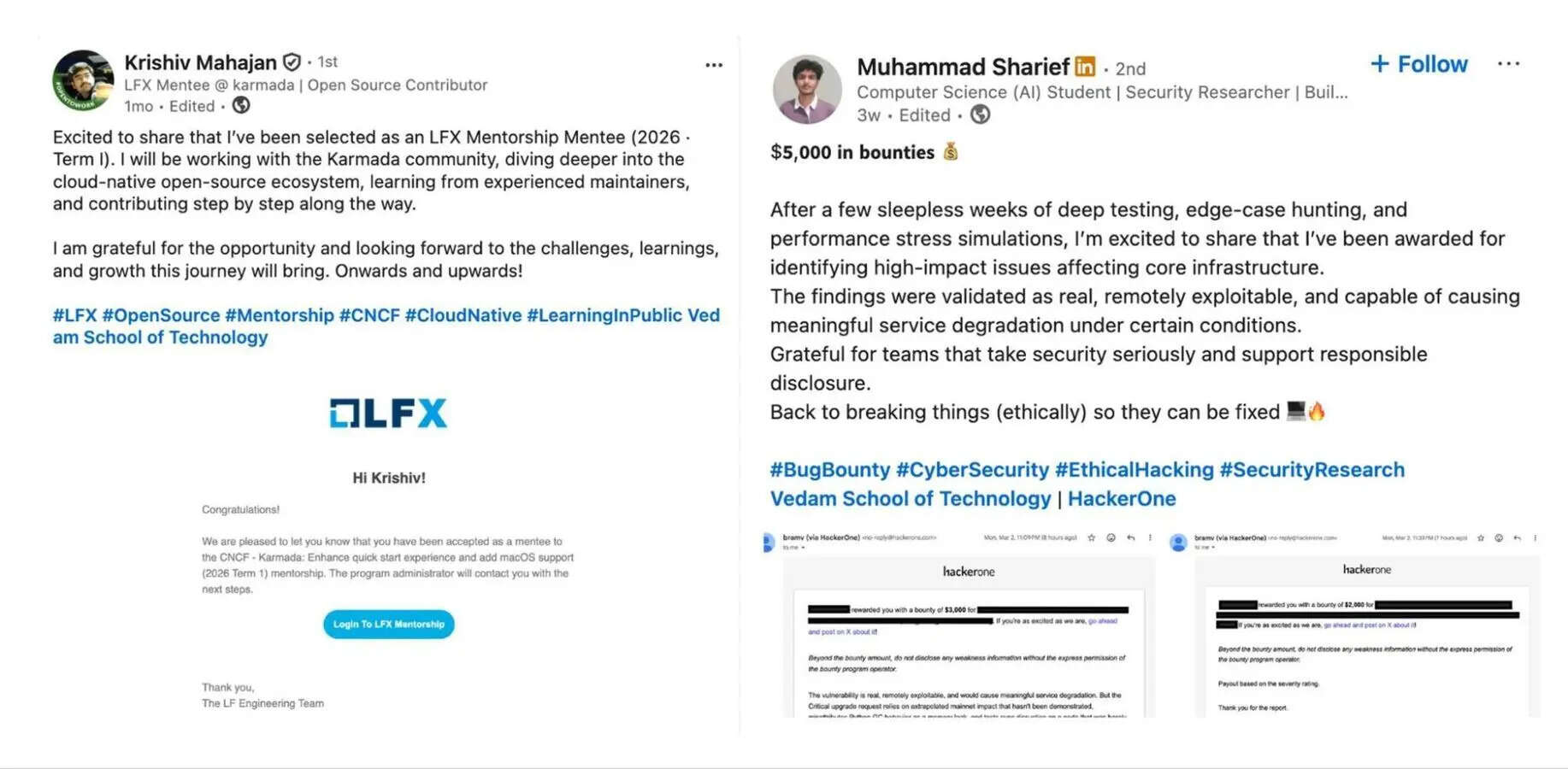
Muhammad Sharief, in his LinkedIn post, shared that he identified two real vulnerabilities in live systems while working on Chia Network, a blockchain-based platform. These were not sandbox environments or practice exercises. The vulnerabilities existed in real infrastructure, meaning his work directly contributed to securing live systems.His performance has also been formally recognised. He is among the top 10 hackers & currently ranked #3 on the Chia Network leaderboard, with a program reputation score of 137 and an overall HackerOne reputation of 36, as per Sharief’s HackerOne profile4.His approach involved:
- Python scripting for automation and proof-of-concept development
- Blockchain protocol analysis to understand node behaviour
- Peer-to-peer network testing to analyse communication between distributed systems
- Exploit development to demonstrate real-world impact
Pankaj Kumar, Director and Faculty member at Vedam, states that this work is typically associated with experienced security researchers. Yet, it was carried out alongside regular academic coursework. Sharief spent 3–5 hours daily over several weeks, continuously testing, analysing, and refining his approach. Much of this learning came from independent experimentation, working on real systems rather than in controlled environments. The institute cites similar examples among other first-year students at Vedam. For instance, Shubham Barik works as a Python and AI Engineering Intern, earning ₹50,000 per month, and Shivansh Ojha, who works as a Technical Program Intern at Finzie, earns ₹30,000 per month —before even completing their first year. These are early milestones, and the institute shares that many are yet to receive offer letters from big tech firms, suggesting that students are gaining industry exposure earlier in their academic journey.Piyush Nangru, Founder at Vedam School of Technology, notes, “If you start coding from day one, achieving these outcomes in the 1st year itself becomes very practical.”What’s enabling this shift, according to the institute, is its approach to how the 4-year Computer Science & AI Undergrad program is being incubated.At Vedam, the focus is simple: build strong fundamentals early and apply them in real-world contexts. Core areas like programming, data structures, algorithms, and problem-solving are not taught in isolation—they are used to build, break, and understand real systems.The advanced tech ecosystem is supported by a mentorship-led model under Subhesh Kumar, Head of Academic Delivery (ex-Google SDE, DTU 5-star coder). According to him, learning extends beyond lectures, with continuous feedback through project reviews, one-on-one mentorship, and execution-focused problem-solving. At Vedam, this acceleration is supported by a modern tech infrastructure designed for hands-on learning—innovation lab, modern tech classrooms, and an ecosystem that encourages building, experimenting, and shipping real projects from day one. The environment goes beyond classrooms, enabling students to immerse themselves in real-world problem-solving early in their journey.Subhesh Kumar emphasises that this approach becomes especially important in deeply applied domains. Students are consistently supported in preparing for global opportunities—whether it’s contributing to open-source projects like GSoC (Google Summer of Code), or sharpening their problem-solving skills through competitive coding platforms like ICPC (International Collegiate Programming Contest), SIH (Smart India Hackathon), and Imagine Cup- Microsoft. This ecosystem allows students to explore and build across critical domains such as systems engineering, blockchain, cybersecurity, NLP, robotics, and DevOps—areas where practical understanding, depth, and early exposure make all the difference.For students interested in hands-on learning, early industry exposure, and becoming future-ready for the Jobs of 2030 and beyond, admissions are now open for Vedam School of Technology’s 4-year Computer Science and AI program (Batch 2026–2030). Explore more at vedam.org.Disclaimer – The above content is non-editorial, and TIL hereby disclaims any and all warranties, expressed or implied, relating to it, and does not guarantee, vouch for or necessarily endorse any of the content.Sources: