
The Art of the Ask: Why Your Questions Matter More Than AI’s Answers
The conversation around Artificial Intelligence has shifted. For the past few years, the world was obsessed with one question: “What can AI do?” We watched in awe as it generated images, wrote poems, and debugged code. But as the novelty wears off, a more sophisticated question has emerged for the modern professional: “What should I ask AI?”.
This evolution represents a move from viewing AI as a simple gadget to treating it as a “co-intelligence” or a thought partner. In this new era, the quality of the output you receive is no longer limited by the AI’s capabilities, but by your own ability to frame the problem. Whether you are a small business owner, a marketer, or a student, mastering the “art of the ask” is the single most important skill of 2026.
From Keywords to Conversations: The New SEO
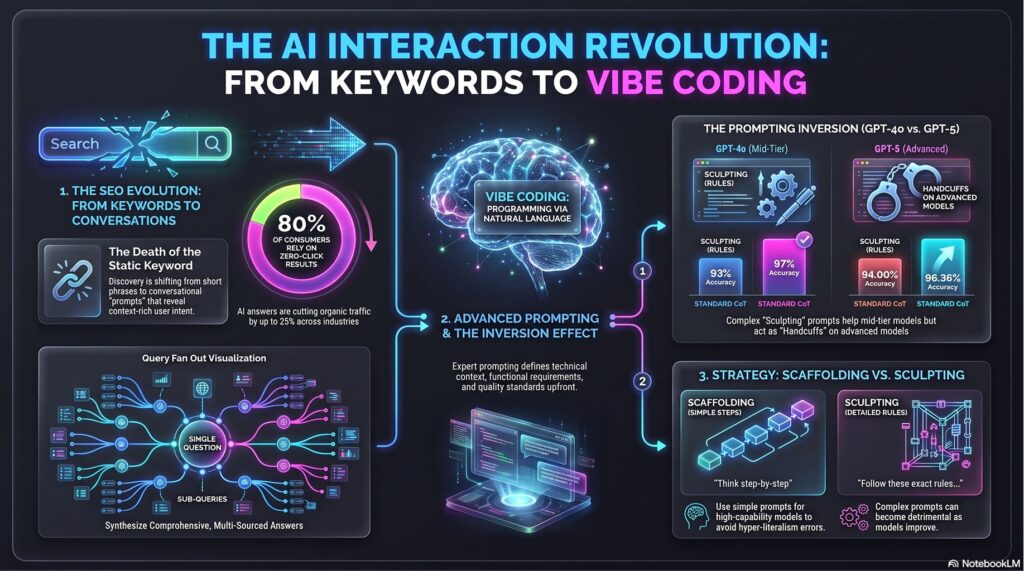
If you’ve ever managed a website, you know the old rules of Search Engine Optimization (SEO): guess the short phrases people type into Google (like “plumber near me”) and sprinkle them throughout your content. But AI is killing the static keyword.
Today, customers don’t just type keywords; they ask real, complex questions. Instead of “email marketing tips,” they type: “How can I get more people to open my weekend specials without spamming them?”. AI models like ChatGPT and Gemini interpret these as context-rich messages that reveal who the user is and what they truly want.
The Rise of Zero-Click Search
The data is startling: nearly 80% of consumers now rely on “zero-click” results—answers that appear instantly in an AI window without requiring the user to click a single link. This has cut organic traffic to some websites by up to 25%. To survive, your content must join these conversations. You need to stop optimizing for words and start optimizing for prompts—the real language customers use when talking to AI.
“Vibe Coding” and the Art of Natural Language
We are entering an era of “vibe coding,” where the syntax of programming isn’t Python or C++, but natural human language. The difference between a beginner and an expert in this field often comes down to one thing: prompt quality.
A novice might ask an AI to “make a login form”. The result will likely be a basic, non-functional HTML box. An expert, however, provides Technical Context and Functional Requirements.
The Expert Prompt Example:
“Create a React login form component with email and password fields, client-side validation for email format and password length (minimum 8 characters), submit handling that calls an API endpoint, loading states during submission, and error display for failed authentication attempts.”
This prompt provides the AI with a “map” to follow, ensuring the code is production-ready in seconds rather than requiring hours of debugging.
The Foundation: System vs. User Prompts
To understand how to ask better questions, you must understand the two layers of an AI conversation: System Prompts and User Prompts.
- System Prompts: These are the foundational instructions that define the AI’s foundational behavior and constraints. Think of this as the “personality” or “role” of the AI.
- User Prompts: These are the task-specific inputs designed to solve a particular query.
Research shows that optimizing the system prompt—telling the AI it is a “knowledgeable and analytical assistant specializing in medical topics”—can significantly boost performance across every subsequent user question. By setting the “vibe” at the system level, you create a synergistic relationship where the AI better understands your intent.
The Prompting Inversion: Why “Less” is Sometimes “More”
As AI models become more powerful, a strange phenomenon has occurred: The Prompting Inversion.
In mid-tier models (like GPT-4), complex, rule-based prompts act as “guardrails,” preventing the AI from making common-sense errors. However, in more advanced models (like the upcoming GPT-5), those same detailed rules can become “handcuffs”.
Recent Example: The Guardrail-to-Handcuff Transition
In a math problem involving “gift bags per invited guest,” a mid-tier model might get distracted by real-world common sense (adjusting for guest no-shows) and provide a wrong answer. A detailed prompt that says “Use ONLY the numbers provided” acts as a guardrail to keep it on track.
But in a more advanced model, that same rule might cause “hyper-literalism”. If you tell a highly intelligent model to “never use outside common sense,” it might fail to understand basic English idioms like “two times older than,” leading it to reject perfectly reasonable inferences and give an incorrect, overly pedantic response.
The takeaway for beginners: As models get smarter, your instructions should trend toward simplicity and clarity rather than elaborate procedural constraints.
AI as Your Thought Partner: Mental Models
Shifting from “what can it do” to “what should I ask” requires new mental models. Here are three books and concepts that revolutionize how we interact with AI:
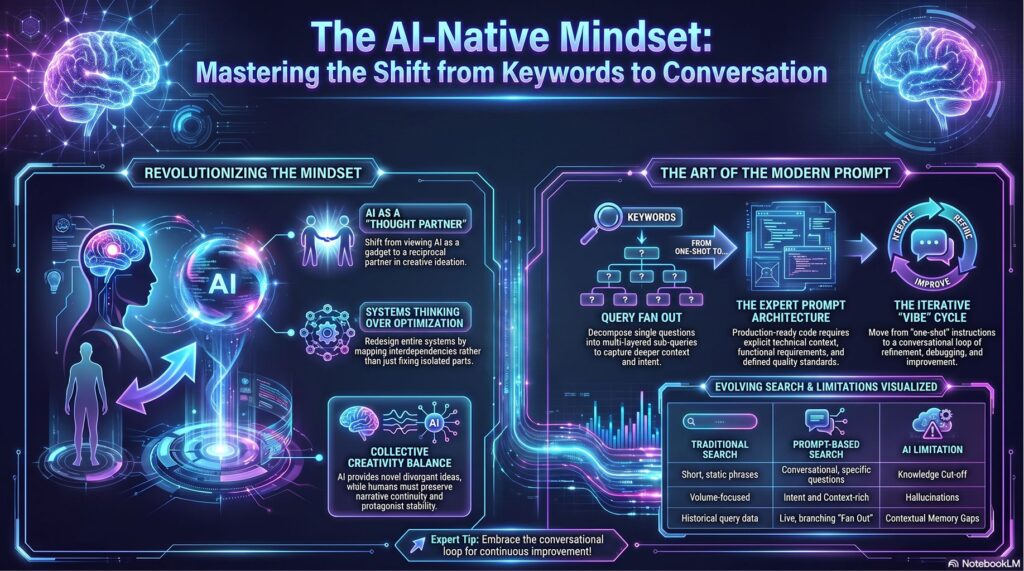
- Co-Intelligence (Ethan Mollick): Treat AI as a partner in thought, not a gadget. Strategy becomes about asking better questions, not hoarding answers.
- Systems Thinking (Donella Meadows): Large efforts fail when we ignore how things are connected. Use AI to map feedback loops and second-order effects rather than just reacting to outcomes.
- Think Slow, Act Fast (Bent Flyvbjerg): Success depends on planning. Use AI to test your assumptions through “reference-class forecasting” before you execute.
The Triple Illusion: Understanding AI Limitations
Beginners must remain skeptical. Generative AI tools have three core limitations that can lead to “The Triple Illusion”—systematic knowledge gaps in interactions:
- Short-Term Contextual Memory: In long conversations, AI can “forget” earlier details, leading to incoherent conclusions.
- Knowledge Cut-Off: If an AI was trained on data up to 2024, it will confidently make up (hallucinate) facts about events in 2025.
- Hallucinations: AI is a “predictive engine.” It creates outputs that appear intelligent by mimicking patterns, but it lacks an internal understanding of the “why”.
Recent Example of Failure: Major consulting firms have been caught using AI in high-priced reports that included fake citations and research that didn’t exist. Always validate AI results with credible sources like market research or government data.
Collective Creativity: Why You Are Still Necessary
You might wonder: if AI can do so much, is human creativity still valuable? A recent study on “Human-AI Social Networks” found that while AI-only groups were initially more creative, hybrid human-AI networks became more diverse over time.
AI agents tend to “thematic converge”—they eventually settle on similar ideas (like space-related themes). Humans, however, provide stability and continuity, retaining core character identities and objects that AI might discard in favor of “novelty”. The richest creative outcomes come from a balance: human stability plus AI novelty.
Practical Actions: How to Start Asking Better Questions
To move from an AI novice to an expert “asker,” take these immediate steps:
1. Adopt the “Iterative Mindset”
Never expect the perfect answer on the first try. Vibe coding is conversational. If the AI-generated code or text has issues, provide specific feedback (e.g., “The sorting function works alphabetically, but I need it to handle negative numbers correctly”).
2. Use the “Context-Role-Goal” Framework
When crafting a prompt, always include:
- Role: “You are a senior project manager”.
- Context: “We are scaling a small bakery in Austin without a social media budget”.
- Goal: “Identify three ways to get local foot traffic through Google Maps”.
3. “Decompose” Your Tasks
Don’t ask one big, complex question. Break it down into discrete steps. Ask the AI to:
- Summarize what it has learned so far.
- Recap your previous instructions to ensure it hasn’t “forgotten” them.
- Refine results by subtopics (e.g., “Now take the financial analysis and break it down by month”).
4. Conduct Prompt-Based Keyword Research
If you are a marketer, stop looking at what people searched. Start looking at what they meant.
- Enter your seed topics into an AI like ChatGPT.
- Observe the autocomplete and “related questions” it suggests.
- Extract “entities”—tools, brands, or products that repeat in these conversations (like “Canva” or “Instagram Reels”) and build content around those clusters.
5. Build “Guardrails” for Mid-Tier Models
If you are using a standard model, explicitly state your quality standards. Tell the AI to:
- “Provide a rationale for your reasoning”.
- “Check for contradictions in the provided clues”.
- “Prioritize accuracy and logical coherence”.
6. Verify, Verify, Verify
Treat AI results as a draft, never the final word. Use Google Search to validate citations and ensure sources are real and credible. Translate your AI prompt into an “Advanced Google Search” query to find the actual whitepapers or data the AI is trying to summarize.
By shifting your mindset from “what can AI do” to “what should I ask,” you unlock a new level of productivity. The future doesn’t belong to the people with the best answers, but to the people with the best questions.