







Large parts of north, northwest and central India are set to experience a prolonged spell of challenging winter weather from January 30 onwards, marked by cold wave conditions, dense to very dense fog, gusty winds and the impact of a fresh western disturbance. According to the India Meteorological Department (IMD), these conditions are likely to affect daily life and transport services over the coming days, even as some regions begin to see gradual temperature fluctuations.One of the most immediate concerns remains the persistence of cold wave conditions across key parts of northwest India. Isolated pockets of Punjab, Haryana, Chandigarh and Delhi are expected to remain under cold wave influence, with night temperatures dipping sharply. In the Himalayan foothills, isolated ground frost conditions are likely in Uttarakhand.As per the IMD bulletin, dense fog is very likely at isolated locations over Bihar, Chhattisgarh, Himachal Pradesh, Odisha, Rajasthan, sub-Himalayan West Bengal and Sikkim, Uttarakhand and western Madhya Pradesh. More concerning, however, is the forecast of dense to very dense fog over Punjab, Haryana, Chandigarh, Delhi and Uttar Pradesh. These conditions are expected to prevail mainly during night and early morning hours. Authorities are advising commuters to exercise caution and stay updated on travel advisories during peak fog hours.Meanwhile, weather activity is set to intensify with the arrival of a fresh western disturbance, which is likely to affect northwest India from the night of January 30. Western Disturbances are one of the major factors responsible for rainfall and snowfall during winter months in the region, and this system is likely to cause scattered to fairly widespread rainfall in the Western Himalayan region. The regions in Jammu and Kashmir, and Ladakh are also likely to experience rainfall and snowfall along with thunderstorms, lightning, and gusty winds.
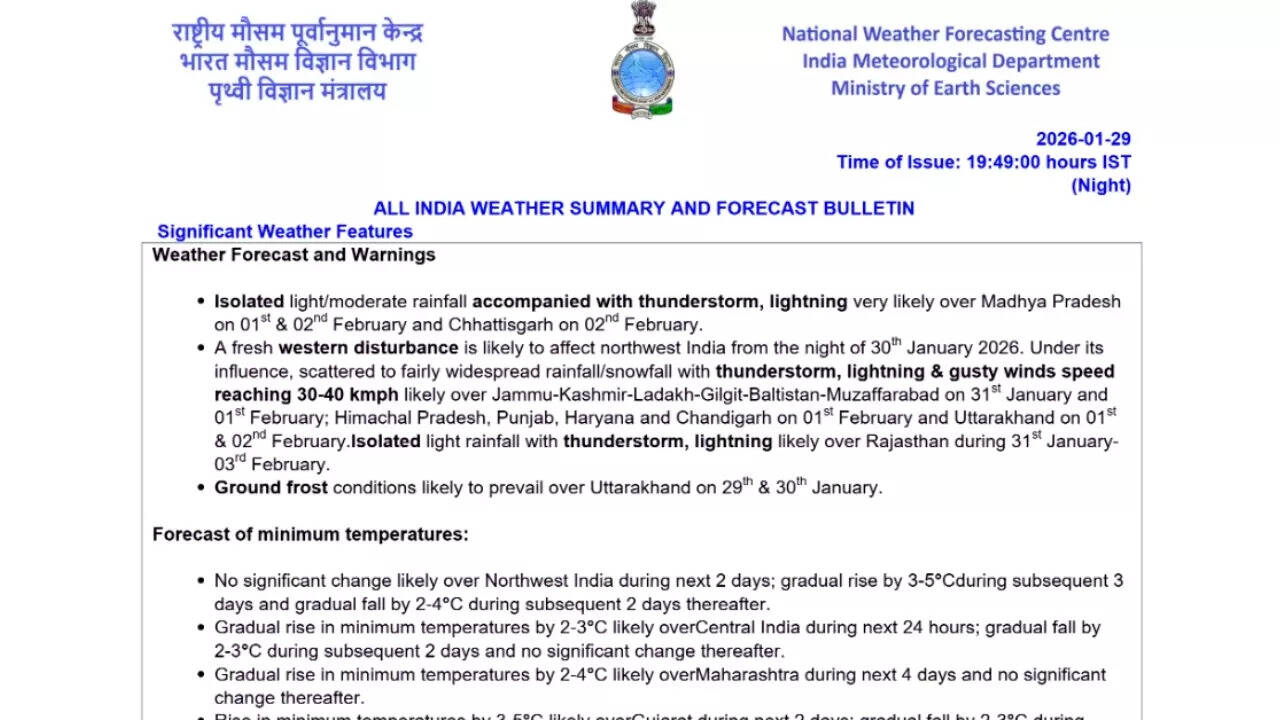
IMD weather update
This weather system is also likely to affect the regions of Himachal Pradesh and Uttarakhand, where there are chances of thunderstorms, lightning, and gusty winds. The neighboring plains, including Punjab, Haryana, Chandigarh, and Delhi, are also likely to experience thunderstorm activity along with strong winds. Isolated thunderstorm activity is expected over Rajasthan, Madhya Pradesh and Chhattisgarh as the system moves eastwards.The IMD has also pointed out the concerns regarding strong winds and rough sea conditions in the southern coastal regions. The effects of such conditions are a threat to fishing activities, and warnings have been issued to fishermen to not enter the affected area during the period.Temperature trends after January 30 show mixed indications in different regions. Northwest India will experience no significant change in temperatures at first, followed by a gradual increase of 3 to 5 degrees Celsius. This may be a temporary effect, as another drop of 2 to 4 degrees Celsius is expected. Central India may witness a slight drop in temperatures after a rise, while Maharashtra is likely to witness a gradual rise in minimum temperatures in the coming days. Gujarat is also likely to witness fluctuating trends, with a rise followed by a drop and then another rise. There are no significant changes in temperatures expected in the rest of the country.For the hill states and tourist spots in the western Himalayas, the approaching western disturbance is likely to bring fresh snowfall, which may have a positive impact on winter tourism in the long run but may also cause disruptions in the short run. The road connectivity to the tourist spots may get impacted due to the accumulation of snow, and one should check local advisories before embarking on a journey.