




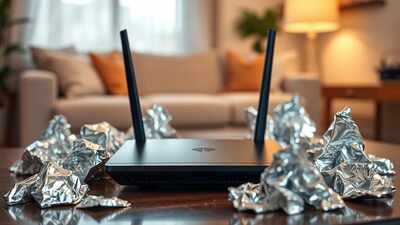
It happens to us all at one time or another. We find ourselves in the midst of a stressful meeting on video or right before the climax in a streamed movie, and then suddenly see the hated loading symbol appear. Then, automatically, we turn on our ISPs or begin thinking about the price of a mesh network costing hundreds.An emerging group of individuals dedicated to both do-it-yourselfers and scientists seems to suggest that the solution to all those “dead zones” could well lie under your very fingertips, sandwiched between the sheets of plastic wrap and parchment paper. The logic of such a kitchen trick is straightforward: an appropriately placed piece of aluminium foil can help reflect wireless signals the right way.The logic behind this particular trick is connected with the propagation of wireless signals within a household. Routers tend to rely on omnidirectional antennas, which send signals in all directions. In other words, 360 degrees of coverage means that many signals become redundant, reflecting from outer walls, unused corridors, or even being sent out onto the streets.Adding a mirror-like metal sheet behind your router is almost the same thing as capturing the extra energy and reflecting it back into the room. This technology may sound like one of those strange tips from forums, yet scientific evidence proves that there is more truth to the tip than just an old wives’ tale.The Ivy League discovery that makes kitchen implements more credibleIf you have doubts about applying a piece of aluminium to help a troublesome high-speed router work better, you may want to take a closer look at some scientific evidence. One study conducted at Dartmouth College, named A Virtual Wall Improves Wireless Security and Performance, proves that reflections from certain surfaces have the ability to alter wireless signals indoors for the better. According to the results achieved by the scientific group, specially designed and shaped metal reflectors, covered in aluminium foil, were able to increase the power of the wireless signal indoors by as much as six decibels.
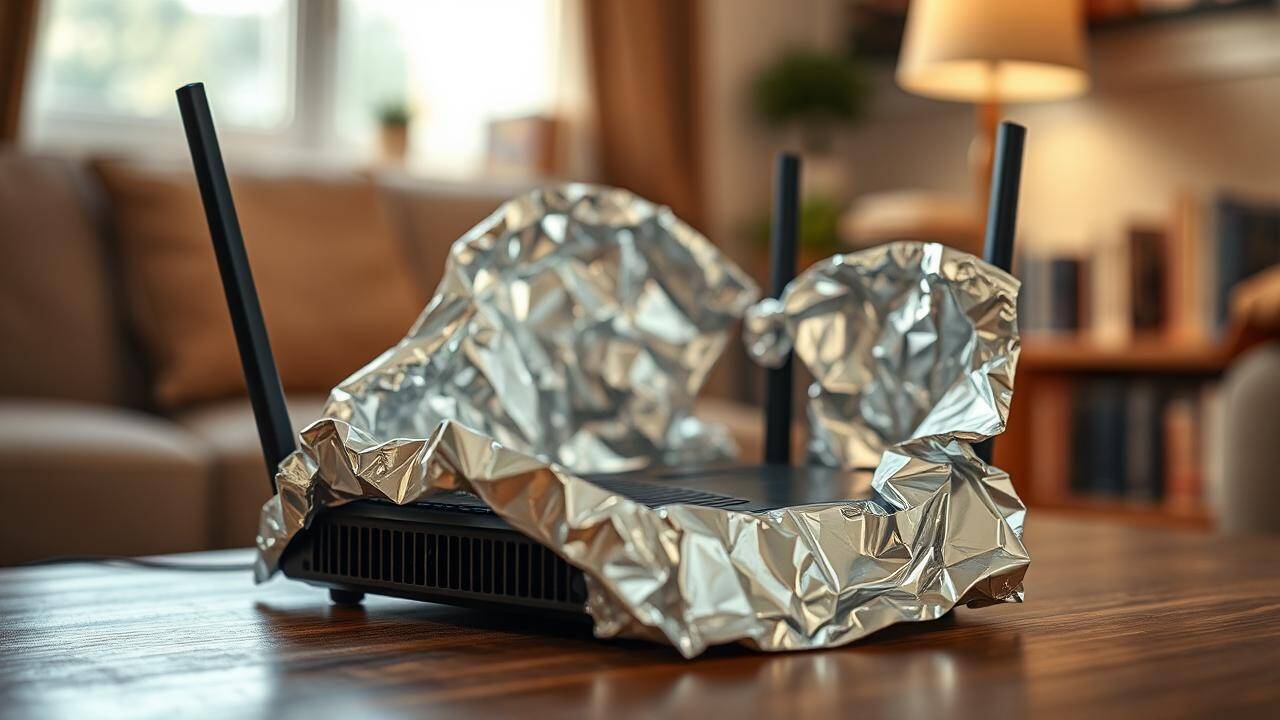
Scientific studies support this method. It can improve performance and even add security. This inexpensive trick offers a better Wi-Fi experience.
The thing about these results is not only their speed. The scientists have proved that with the help of this technique, using those metal barriers, it is possible to prevent the wave from entering unwanted areas. This can be considered an inbuilt shield, which provides additional security so that no one from outside can access your data.This “virtual wall,” as researchers refer to it, not only keeps your information within your network but also makes your connection better when you use it. And it doesn’t cost any more than your morning coffee.Constructing your own reflectorAn engineer isn’t required to construct this at home. Instead, start with the easy-to-follow instructions provided by Reader’s Digest on how to build a signal reflector out of tinfoil. You begin by cutting out a piece of cardboard into a curving shape, making it in the form of a capital letter “C”. The curvature plays an important role here because if the surface were flat, it would merely reflect the signal but not direct it in any way, whereas a curved surface would be able to direct the signal in one particular direction. Cover the curved cardboard with aluminium foil.The placement is just as important as the construction. You should slide the reflector behind your router’s antennas so that the open end of the curve points directly toward your “dead zone,” such as a home office or a distant bedroom.Asianet Broadband says this hack works only by diverting the signal, but not amplifying it. While doing so, you can experience a slight reduction in the signal strength around the rear of the aluminium foil. However, for homes where rooms do not align traditionally or when the home consists of thick walls, the minor cost becomes justified in exchange for reliability at the point of work.Once the aluminium foil is placed, some minor tinkering will be required to perfect the homemade installation. Adjusting the angle of the bend or elevating the reflector is essential to avoid objects such as large pieces of furniture that may interfere with the radio waves.Think of your Wi-Fi as a beam of light, and use the foil as a mirror. This simple and free experiment offers you an opportunity to create a better Wi-Fi environment for your house, converting a bad connection to a highly optimised one. At times, some of the best inventions can be found inside your pantry.