





There’s a certain kind of cold that sneaks up on you. Not the kind of biting freeze that has you pulling every blanket in the house; it’s that mid-season chill when your apartment feels a little too stark, a little too uninviting, and your first instinct is to bump the thermostat up and watch your energy bill quietly spiral.Here’s the thing: sometimes your room is cold, not because it is actually cold. It feels cold because of how it looks. Lighting is one of the most underrated tools in your home. Swapping out a few bulbs and rethinking where your lamps sit can honestly change how warm a space feels, no HVAC required.Start with the bulbs you’re already usingYour first problem is if those bright, bluish-white bulbs light your apartment. Lights with a colour temperature above 4000 K are clinical and flat. They are good for a kitchen or bathroom, but very unfriendly in a living room or bedroom. Instead, you want bulbs that are in the 2200K to 2700K range; the warm, amber-toned end of the spectrum that mimics golden hour or candlelight. This warmth enhances textures, encourages relaxation and is perfect for spaces where you want to unwind.There’s real science behind why it works. Warm lighting doesn’t actually change how sensitive you are to temperature, but we have a deep-seated automatic association between warm-toned light and thermal comfort, according to a study published in Building and Environment. Changing your lighting doesn’t just change the look of a room; it also makes your brain perceive it as warmer. Replacing the bulbs is a five-minute fix that costs next to nothing, and makes a genuinely noticeable difference the second you switch it on.Layer your lighting like you layer your outfitsThe interior design equivalent of dressing in just one thin layer in November is one overhead light doing all the heavy lifting. It’s technically working, but it’s not doing you any favours.One overhead fixture cannot begin to fill a room with the depth and warmth that comes from placing several small, low-wattage lamps at varying heights, on tables, shelves, and the floor, creating pools of soft, amber light. Imagine the difference between harsh fluorescent lights in an office and a cosy corner coffee shop with bulbs everywhere. Same room temperature, yet a completely different feel.
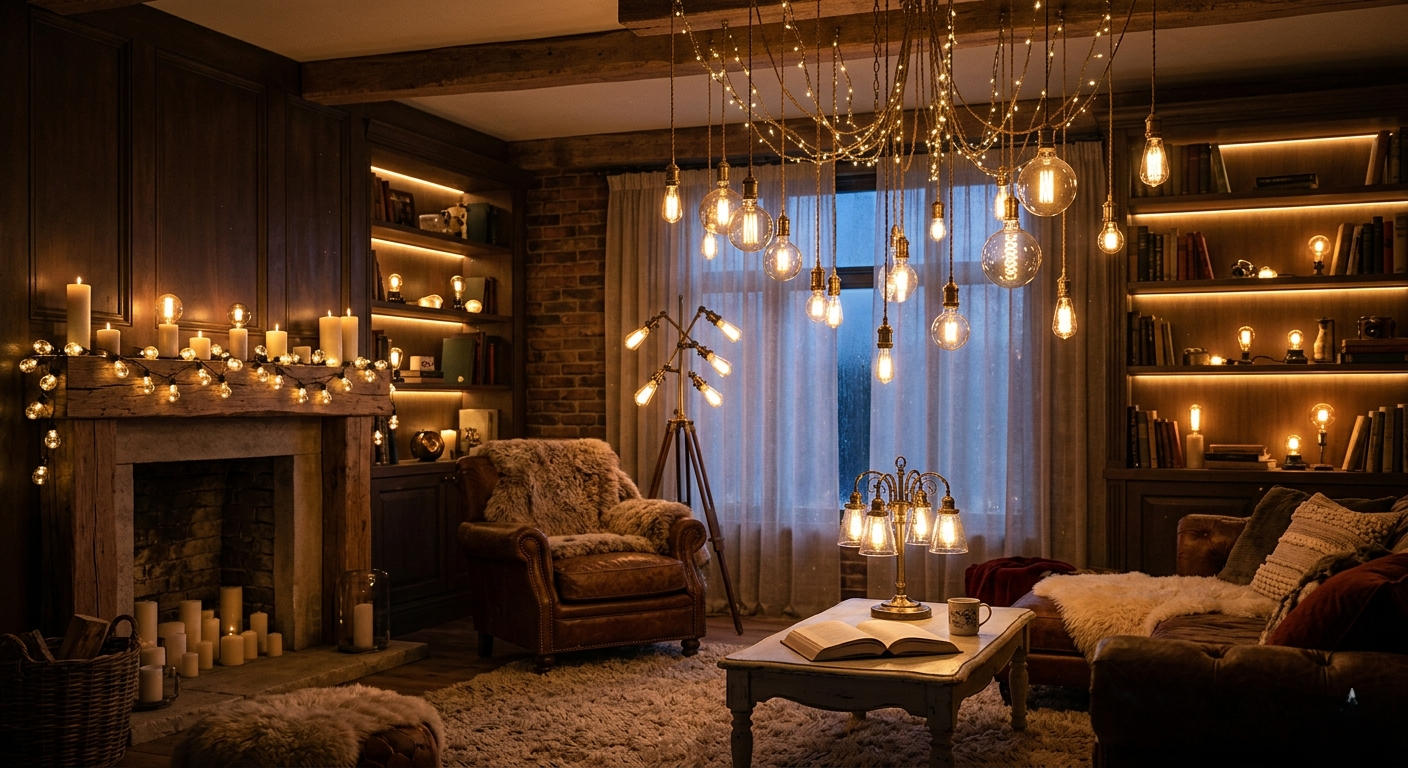
A few warm-toned bulbs and some strategic lamp placement can completely transform how a room feels on a cold evening. Image Credits: Google Gemini
The bonus? This way of distributing light will make you feel warmer without actually using more energy. Even when the thermostat has not moved, the body takes all those soft, overlapping sources of light for warmth.Use mirrors as a secret weaponChances are, you have at least one mirror in your home just hanging there doing nothing. Get it working.Put a big mirror next to the window or another light source, and it will spread warmth and light to the darker corners of a room, without the need for extra lamps or heat. It really takes whatever warm lighting you have and makes it better, opening up the space and bringing it to life. You know how restaurants lit with candles have mirrors all over the place? Well, this is why.Don’t forget the walls and surfacesLight is reflected better by pale wall colours, polished wood, and glossy decor, thus making your space seem warmer and brighter. If you are renting and can’t paint, even swapping dark hues for lighter, more reflective ones, such as a cream-colored throw blanket, a light wood side table, will help move the room in the right direction.Bring in the texturesLighting does a lot, but it does even more when your room is on its side. Thick fabrics such as velvet and wool on cushions, throws, and curtains physically trap warmth and add a layer of tactile comfort that transforms the feel of a room the moment you walk in.This isn’t mere conventional wisdom. Research published in Developments in the Built Environment highlights the growing use of textiles as functional architectural elements. Interior design is increasingly integrating high-performance fabrics to provide thermal insulation and improve indoor quality of life. By choosing heavy, high-pile textures for your home, you are, in a sense, adding a functional layer to the way your space performs against the cold. A chunky knit throw draped over your couch is insulation, not just a style choice.None of this involves a renovation or a big spend. It’s about being intentional with what you already have and realising that the way your home looks directly affects how it feels. Start with the bulbs, add a lamp or two, move that mirror and see how different your space feels before you ever touch the thermostat.