
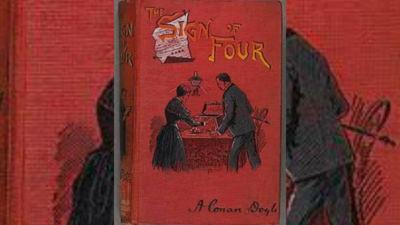
A rare first-edition copy of The Sign of Four, one of Sir Arthur Conan Doyle’s Sherlock Holmes novels, sold for £11,520 after being discovered among book donations at an Oxfam charity shop in Shrewsbury, England. According to Oxfam’s official press release, the 1890 book was identified by staff who recognised its potential significance and sought help to establish its value. The volume was subsequently sold at Bonhams auction house in March 2026. The unexpected sale turned an ordinary donation into a substantial contribution to Oxfam’s humanitarian work.
How an ordinary donation became a rare find
The book arrived at the Oxfam bookshop in Shrewsbury as part of a donation from a regular supporter. It initially appeared to be an old novel among the many second-hand books received by the charity, but shop manager Tom Cotton recognised that it was an early Sherlock Holmes story. Identifying an old book as a first edition requires more than recognising its title. Publication details, binding, condition and other distinguishing features can help establish whether a copy is an early printing and whether it has particular value to collectors.Cotton sought assistance from colleagues and people with specialist knowledge to investigate the book further. Oxfam’s book development team and other contacts helped assess the volume before it was referred for specialist evaluation and auction. The discovery illustrates the role charity-shop staff can play in identifying valuable donated items. Books that might otherwise be priced as ordinary second-hand stock can sometimes turn out to be sought-after collectibles, particularly when they retain features associated with their original publication.
Why the 1890 edition matters
The Sign of Four was written by Arthur Conan Doyle and first published in 1890. It is the second Sherlock Holmes novel, following A Study in Scarlet, which introduced the celebrated detective and his companion, Dr John Watson. The story follows Holmes and Watson as they investigate a mystery involving a missing man, a valuable treasure and a complicated chain of events connected to India. Its combination of deduction, adventure and mystery helped establish the fictional detective’s place in popular literature.The particular copy found at Oxfam was identified as a first edition, first issue. It retained its original red cloth binding, with gilt lettering on the cover and spine. These features helped distinguish it from later editions and contributed to its interest for collectors. The book also contained a provenance clue: an ownership bookplate identified a previous owner as James Burgess Boote of Gwernaffel, Knighton, who served as High Sheriff of Radnorshire. Such details can add historical interest by connecting a book to a previous owner and its journey through time.
From the charity shop to an £11,520 auction sale
After the book was assessed, it was consigned to Bonhams, where it sold for £11,520 on March 26, 2026. The sale was reported on March 27, and Oxfam published its official press release on March 30. For the charity, the outcome meant that an unexpected donation could generate significant funds for its work. Oxfam said proceeds from donated books and other items support its wider humanitarian activities, including life-saving assistance in conflict zones and efforts to improve access to clean water.Cotton described the valuation as a collective effort, joking that he lacked Sherlock Holmes’s powers of deduction and likening himself to Mrs Hudson, the character associated with Holmes’s Baker Street home. His comments reflected how the discovery depended on staff recognising the book’s potential and seeking help rather than relying on a single appraisal. The result also shows why the history and physical condition of a book matter in the antiquarian market. A familiar title alone does not guarantee a high price; edition, printing, binding, provenance and demand all contribute to a collectible’s appeal.
What the discovery means for charity shops
The sale offers a reminder that donations can have value beyond their immediate use. Charity shops depend on donated goods to raise money for their causes, and specialist items can sometimes generate far more than their ordinary resale price. However, not every old book is rare or valuable. First editions can vary significantly in price depending on their condition, printing details, completeness and historical associations. In this case, the original binding and ownership bookplate helped make the volume particularly interesting.The discovery also highlights the continuing appeal of Sherlock Holmes, whose adventures have remained popular since the late 19th century. The character has inspired countless books, films, television adaptations and stage productions, sustaining interest in early editions of Conan Doyle’s work.For Oxfam, the £11,520 sale was more than an unusual auction result. It demonstrated how an ordinary donation could support charitable work around the world. The book’s journey from a Shrewsbury shop to an auction room shows the importance of looking closely at donated items and recognising their potential.