
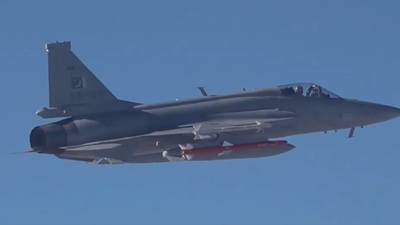
Pakistan has announced the successful flight test of its first indigenously developed air-to-air missile, the Fa’az. The Inter-Services Public Relations (ISPR) said the test was witnessed by senior military officers, scientists and engineers involved in its development. Equipped with a terminal guidance system, the missile is designed to engage aerial targets at longer ranges and, according to the military, will add to the Pakistan Air Force‘s operational flexibility. The announcement gave no details of the missile’s range, speed or performance.The test comes as Pakistan expands indigenous weapons production and modernises its air force after the military confrontation with India in May 2025. Islamabad is also working with Turkey on beyond-visual-range missile technology. Pakistan’s Global Industrial and Defence Solutions (GIDS) is developing the Fa’az-2, while Turkey’s Tubitak Sage is working on the Gokdogan, and reports suggest the two sides could combine elements of their designs. Nothing in the available information shows that the Fa’az tested now is the FAAZ-2, so the two should be treated as separate systems for now.
India’s answer: the Astra family
India, meanwhile, is building its own family of air-to-air beyond visual range missiles, known as the Astra family of weapons. The indigenously developed Astra Mk-2 is expected to enter service either this year or in 2027, offering a range of 200 kilometres, with the Indian Air Force planning to induct as many as 700 units across its Sukhoi-30 and Tejas fleets, as per reports.Work is simultaneously underway on the more ambitious Astra Mk-3 air-to-air missile, which is also being called the Gandiva. This missile will extend the reach of the air force and navy’s fighters further out to 350 kilometres using solid fuel ducted ramjet propulsion, a technology comparable to that powering Europe’s Meteor missile, which is also used by the IAF’s Rafale fighter aircraft. Together, the Astra series is expected to progressively replace the Russian, French and European air-to-air missiles that currently equip Indian fighter squadrons, marking a significant step toward self-reliance in one of the most technologically demanding categories of modern weaponry.This family rests on the Astra Mk-1, developed by DRDO and built by Bharat Dynamics Limited. It has a range of about 110 kilometres and is already in service on the Su-30MKI. In March 2025, a Mk-1 fired from a Tejas Mk1 prototype hit a target drone at over 100 kilometres, showing it can work with India’s domestically developed light fighter. The Mk-2 missile adds range through a dual-pulse rocket motor, while the Mk-3 would take the family into the class of the longest-range air-to-air missiles in the world.