
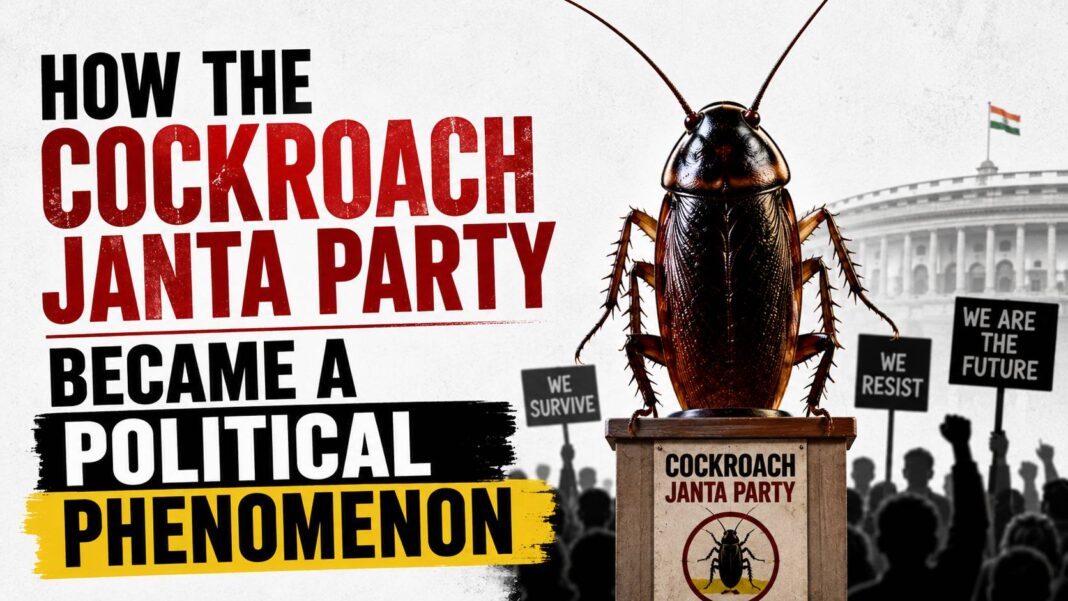
In just a few weeks, a satirical social media movement has transformed from a digital joke into a significant irritant for the Indian political establishment. The Cockroach Janta Party (CJP), founded in May 2026, has captured the attention of millions by turning a derogatory remark from the highest levels of the judiciary into a badge of honor for frustrated Gen Z youth.
The Spark: A Judicial Jibe
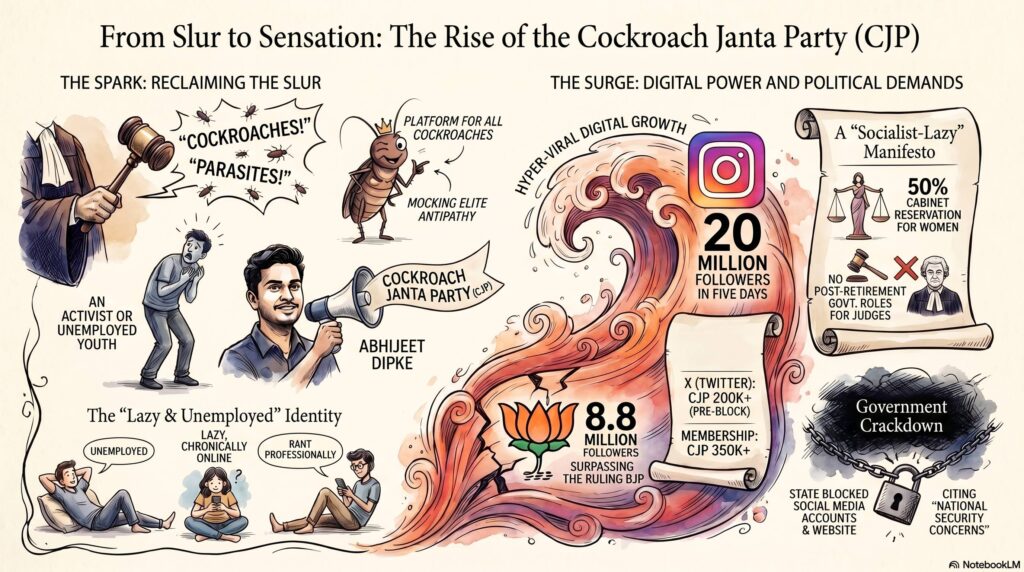
The movement was born on May 16, 2026, following controversial remarks by the Chief Justice of India, Surya Kant. During a court hearing on May 15, Justice Kant compared unemployed youth and activists who “attack the system” through social media and RTI requests to “cockroaches” and “parasites”.
While the Chief Justice later clarified that his comments were aimed at those practicing with fraudulent degrees rather than India’s youth in general, the damage was done. Abhijeet Dipke, a 30-year-old communications strategist and Boston University graduate, decided to use the insult as a tool for protest, launching the CJP online within 24 hours.
A Viral Phenomenon
The CJP’s growth was unprecedented, fueled by Gen Z’s frustrations over large-scale unemployment, inflation, and recent education scandals. Within five days of its launch, the party’s Instagram account surpassed 10 million followers, eventually reaching over 22 million—effectively overtaking the official handle of the ruling Bharatiya Janata Party (BJP).
The party defines itself through a satirical four-point eligibility criteria: members must be unemployed, lazy (physically), chronically online (at least 11 hours daily), and capable of “ranting professionally”. Its motto—“Secular – Socialist – Democratic – Lazy”—is a direct play on the traditional values of the Indian Republic.
From Online Rants to Offline Protests
The CJP quickly proved it was more than just “meme politics”. On June 6, 2026, Dipke led a youth protest at Jantar Mantar in New Delhi. The demonstration focused on the NEET 2026 paper leak controversy, with protesters demanding the resignation of Education Minister Dharmendra Pradhan.
The party’s edgy five-point manifesto targets systemic issues, including:
- Banning post-retirement government rewards for judges.
- Arresting election officials if legitimate votes are deleted.
- Mandating 50% reservation for women in Parliament and the Cabinet.
- Investigating the bank accounts of “Godi media” (pro-government) anchors and canceling licenses for media houses owned by major conglomerates like Adani and Reliance.
The Government’s Crackdown
The rapid rise of the CJP has been met with significant digital resistance from the Indian government. On May 21, the party’s X (formerly Twitter) account was withheld in India following a legal demand from the Ministry of Electronics and Information Technology (MeitY), which cited “national security concerns”. Government representatives and BJP politicians have labeled the movement a “foreign influence operation” designed to destabilize the country.
Despite these hurdles—including hacked Instagram accounts and blocked websites—the movement persists. Founder Abhijeet Dipke maintains that the CJP is a necessary “pressure group” to hold the government accountable in a country where more than a quarter of the population is Gen Z.
As the movement continues to navigate legal battles in the Delhi High Court, it serves as a giant commentary on the state of Indian political representation and the power of digital satire to mobilize an entire generation.
FAQ (Frequently Asked Questions)
The Cockroach Janta Party (CJP) manifesto is described as an “edgy” take on contemporary Indian issues, including allegations of voter manipulation, media bias, and the independence of the judiciary. Designed using artificial intelligence tools like Claude and ChatGPT, the manifesto consists of five core points and several additional principles accepted by the movement.
The Formal Five-Point Manifesto
- Judicial Independence: No Chief Justice of India shall be granted a seat in the Rajya Sabha as a post-retirement reward.
- Electoral Accountability: The Chief Election Commissioner shall be arrested under the Unlawful Activities (Prevention) Act (UAPA) if any legitimate vote is deleted, characterizing the loss of voting rights as an act of “terrorism”.
- Gender Representation: Women shall receive 50% reservation in Parliament (increased from the current 33%) and 50% of all Cabinet positions shall be reserved for women.
- Media Reform: Licenses for all media houses owned by Reliance Industries (“Ambani”) and the Adani Group shall be cancelled to promote independent media, and the bank accounts of “Godi media” anchors shall be investigated.
- Anti-Defection: Any Member of Parliament (MP) or Member of the Legislative Assembly (MLA) who defects from one party to another shall be barred from contesting elections or holding public office for 20 years.
Additional Accepted Principles
The party also incorporated points suggested by activist Anjali Bhardwaj, which include:
- Transparency: The party commits to being fully answerable under the Right to Information (RTI) Act.
- Financial parodies: The party vows not to establish a “secret Cockroach CARES Fund,” a satirical reference to the controversial PM CARES Fund.
Mission and Vision
The CJP’s mission is to build a platform for young people who have been labeled “lazy, chronically online, and, most recently, cockroaches”. Its vision is not to rebrand corruption or holiday on taxpayer money, but to loudly and repeatedly demand accountability by asking “where the money went”. The party operates under the satirical motto: “Secular, Socialist, Democratic, and Lazy”.
The Cockroach Janta Party (CJP) has released a formal five-point manifesto that addresses issues of judicial independence, electoral accountability, gender representation, and media reform. The points are as follows:
- Judicial Independence: The manifesto mandates that no Chief Justice shall be granted a seat in the Rajya Sabha as a reward following their retirement.
- Electoral Accountability: If any legitimate vote is deleted, the Chief Election Commissioner must be arrested under the Unlawful Activities (Prevention) Act (UAPA). The party characterizes the removal of voting rights as being “no less than terrorism”.
- Gender Representation: The party calls for a 50% reservation for women in Parliament (an increase from the current 33%) without increasing the overall strength of the body. Additionally, 50% of all Cabinet positions must be reserved for women.
- Media Reform: The manifesto demands the cancellation of licenses for all media houses owned by the Adani Group and Reliance Industries (“Ambani”) to facilitate independent media. It also calls for investigations into the bank accounts of “Godi media anchors”.
- Anti-Defection Measures: Any Member of the Legislative Assembly (MLA) or Member of Parliament (MP) who defects from one political party to another would be barred from contesting elections or holding any public office for 20 years.
Beyond these five primary points, the party has accepted additional principles suggested by activist Anjali Bhardwaj, including a commitment to be answerable under the Right to Information (RTI) Act and a pledge not to establish a secret “Cockroach CARES Fund” (a satirical reference to the PM CARES Fund). The manifesto was designed using artificial intelligence tools like Claude and ChatGPT to synthesize societal grievances into a digital insurgency.
The Cockroach Janta Party’s (CJP) manifesto defines “judicial independence” primarily through a specific restriction on the post-retirement activities of top judges. Specifically, it mandates that no Chief Justice of India shall be granted a seat in the Rajya Sabha as a reward following their retirement.
The party frames this point as an “edgy” take on the systemic issue of judges being appointed to government positions after they leave the bench. In addition to this formal manifesto point, the CJP has accepted principles regarding transparency and accountability, such as being fully answerable under the Right to Information (RTI) Act.