
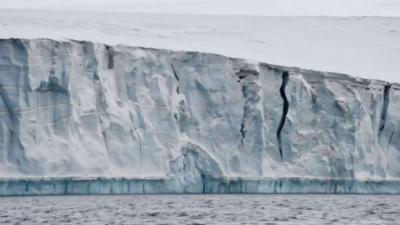
Scientists studying Antarctica’s towering ice cliffs have found that glaciers can retreat faster than existing models predict without triggering the catastrophic, self-sustaining collapse some researchers have feared. The findings, reported by MIT News and the Woods Hole Oceanographic Institution (WHOI), offer new observational evidence that could help refine projections of future sea-level rise. Published in the journal Science in October 2026, the study examined 15,330 satellite observations of ice cliffs along the margins of Earth’s ice sheets. Led by Caroline Needell, a doctoral researcher in the MIT-WHOI Joint Program, the research investigated whether exceptionally tall ice cliffs are as vulnerable to runaway collapse as a long-standing scientific theory suggests. The results present a more complicated picture: some cliffs retreated rapidly, but the retreat was often temporary, with glaciers subsequently stabilising rather than continuing to collapse inland.
Testing the theory of runaway ice loss
The research focuses on marine ice-cliff instability (MICI), a theory that has influenced scientific discussions about how Antarctica could contribute to rising seas as the planet warms. The theory proposes that when an ice shelf breaks away, it can expose a tall, unsupported cliff at the edge of a glacier. If the cliff rises more than approximately 100 metres above sea level, the immense pressure exerted by the ice could cause it to fracture and collapse. This process could expose another tall cliff farther inland, potentially triggering a chain reaction of retreat.Such a scenario could accelerate ice loss and raise sea levels more rapidly than conventional projections suggest. However, the process has remained difficult to verify because scientists have lacked comprehensive observations of how exceptionally tall cliffs behave over time. To investigate, the team analysed measurements collected by NASA’s Ice, Cloud, and Land Elevation Satellite-2 (ICESat-2) between 2019 and 2023. The satellite uses laser altimetry to measure changes in the elevation of ice sheets and glaciers, allowing researchers to monitor cliff heights and their evolution.The observations revealed that the average ice cliff was approximately 30 metres tall, considerably below the height traditionally associated with potential instability. A smaller number of cliffs exceeded the 100-metre threshold, providing an opportunity to examine how the tallest formations behaved.
What helps glaciers stabilise?
The researchers found that cliff height alone cannot explain whether a glacier will continue retreating. Other physical features, including the depth of the surrounding water, the amount of broken ice accumulating at the glacier’s front and the shape of the land beneath the ice, also influence stability.The broken ice and sea ice that collect in front of a glacier form a mixture known as mélange. The study found an association between thicker mélange and cliffs that remained relatively stable. Water depth also appeared to matter, with deeper water providing greater buoyant support to the ice.The team then examined four Antarctic regions containing some of the tallest observed cliffs, including one that reached approximately 127 metres. Satellite measurements showed that these cliffs collapsed and retreated faster than existing models predicted. However, the rapid retreat did not continue indefinitely.One important explanation emerged from the landscape beneath the ice. Raised sections of the underlying bedrock can reduce the thickness of the ice above them, creating conditions that make further collapse less likely. As tall cliffs lose height through calving and thinning, they may also become less vulnerable to continued rapid retreat.
What the findings mean for sea-level projections
The findings offer a more detailed understanding of a process that could influence future sea-level rise. If current models underestimate how quickly tall cliffs can break apart, they may also underestimate the speed of ice loss over short periods. At the same time, assuming that every collapse triggers an unstoppable chain reaction could exaggerate the extent of long-term retreat.The research does not establish that Antarctica’s ice sheets are safe from accelerated melting, nor does it rule out future episodes of sustained instability. The scientists emphasise that the outcome will depend on changing climatic conditions and the physical characteristics of individual glaciers.The next challenge is to incorporate factors such as bedrock topography, ice thinning and the surrounding water conditions into ice-sheet models. Better representation of these processes could help researchers narrow uncertainties in projections used to assess flooding risks and prepare coastal communities for rising seas.