
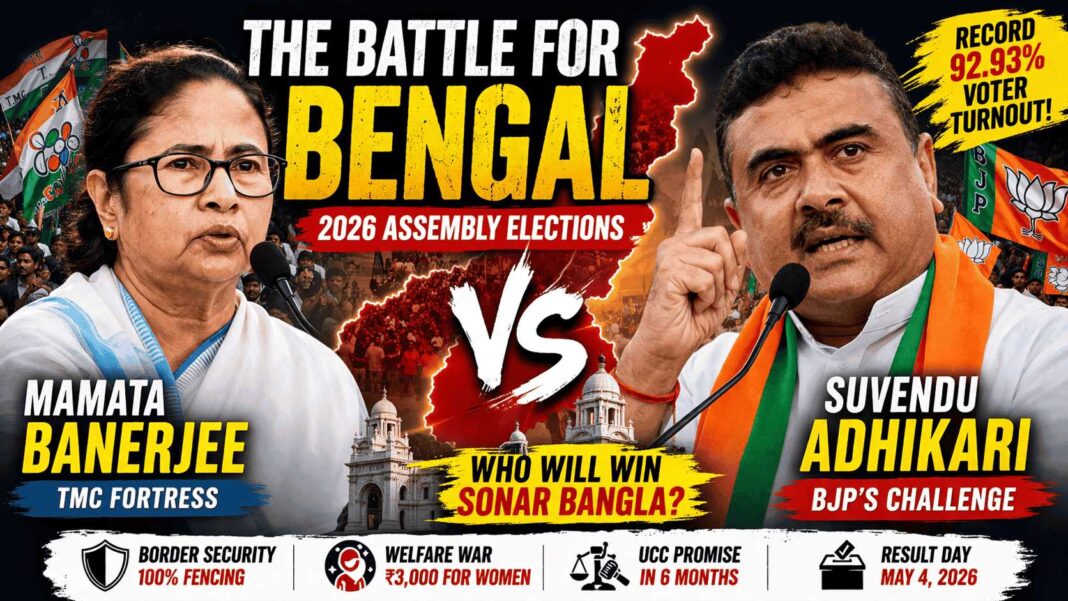
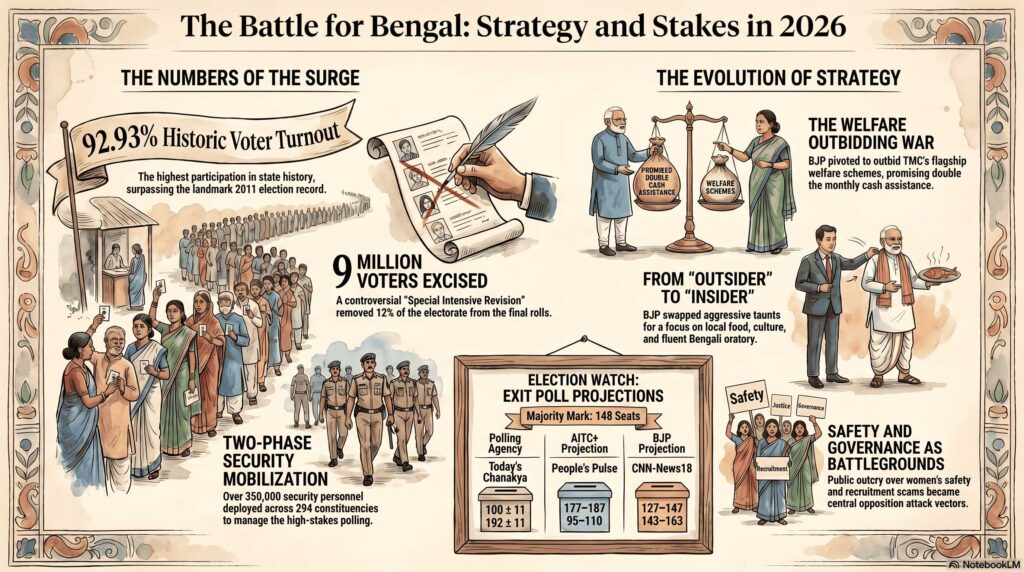
The 2026 West Bengal Legislative Assembly election has emerged as one of the most significant and closely watched political contests in recent Indian history. Following a high-decibel campaign, the state participated in a two-phase polling process on April 23 and April 29, 2026, to elect members for 294 seats. This election has been defined by a historic and record-breaking preliminary voter turnout of 92.93%, surpassing the landmark 2011 election that saw the end of the Left Front’s 34-year rule.
The Rematch: Mamata vs. Suvendu in Bhabanipur
At the heart of this electoral storm is the high-profile contest in Bhabanipur, where Chief Minister Mamata Banerjee faces her former protégé turned arch-rival, Suvendu Adhikari. This battle is a symbolic rematch of their 2021 encounter in Nandigram, where Adhikari defeated Banerjee by a narrow margin. By bringing the fight to Banerjee’s home turf-which includes her Kalighat residence-Adhikari and the BJP are attempting to shatter the Trinamool Congress (TMC) fortress in South Bengal.
BJP’s Strategic Pivot: “Paribartan” of Tactics
Learning from its 2021 defeat, the BJP has radically altered its campaign strategy. The party has largely ceased personal attacks on Mamata Banerjee, shifting its focus to the “nephew,” TMC National General Secretary Abhishek Banerjee, to avoid generating public sympathy for the Chief Minister.
Furthermore, the BJP has moved to shed its “outsider” tag by leaning into Bengali soft power. Instead of relying solely on the “Jai Shri Ram” slogan, candidates have been seen publicly consuming Bengali staples like fish and invoking local deities such as Kali and Durga. The party also utilized leaders like Smriti Irani to address crowds in fluent Bengali, emphasizing her maternal Bengali roots.
Welfare Wars and Security Pledges
The campaign saw a fierce “bidding war” over welfare schemes. To counter the TMC’s popular Lakshmir Bhandar initiative, the BJP’s “Sankalp Patra” promised to double the monthly assistance for women to Rs 3,000. Other key BJP pledges included:
- 100% border fencing within 45 days of coming to power.
- The implementation of the Uniform Civil Code (UCC) within six months.
- Direct cash benefits for youth and farmers, including an unemployment allowance.
The TMC, meanwhile, has campaigned on its record of continuity and welfare delivery, emphasizing state autonomy and defending Bengali identity against what it labels as politically motivated attacks from the center.
The SIR Controversy and Key Issues
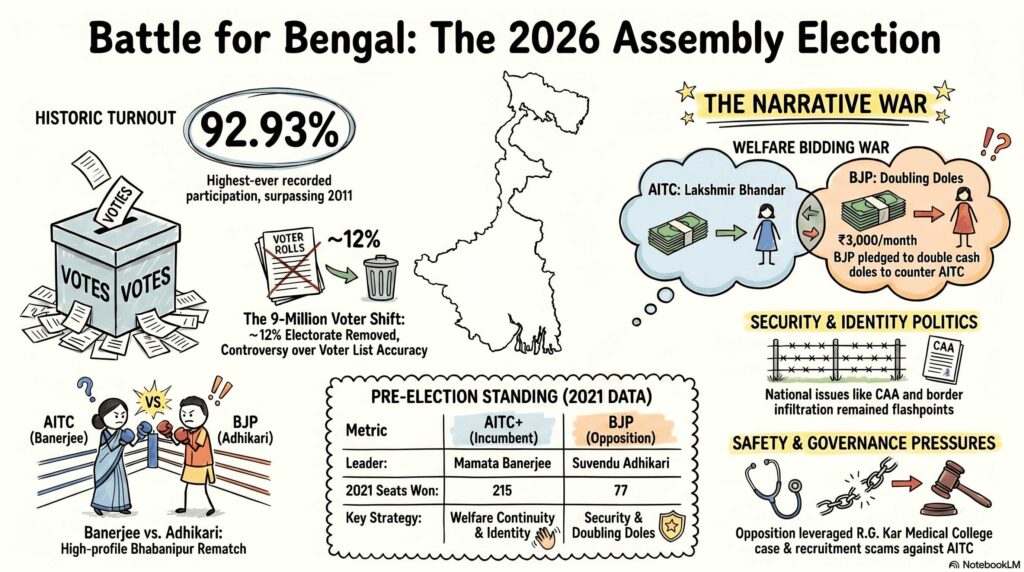
A central controversy of the 2026 cycle was the Special Intensive Revision (SIR) of electoral rolls, which resulted in the deletion of approximately 9 million voters. While the BJP defended the move as necessary to remove “illegal migrants” and “bogus entries,” the TMC argued it was an attempt to disenfranchise genuine voters, particularly among minority and Dalit communities.
Other dominant issues included:
- Women’s Safety: The 2024 R.G. Kar Medical College case became a major flashpoint, with the BJP even fielding the victim’s mother as a candidate.
- Corruption: Ongoing investigations into the school recruitment scam fueled opposition attacks on the TMC’s governance record.
- Economy: Frustration over delayed recruitment exams and a lack of industrial investment remained a priority for younger, urban voters.
The Verdict Awaited
As the state braces for the results on May 4, 2026, exit polls suggest a deeply polarized electorate. While agencies like Today’s Chanakya project a massive BJP surge of 192 seats, others like People’s Pulse predict a decisive TMC victory with 185 seats. Whether Mamata Banerjee secures a fourth term or the BJP achieves its dream of “Sonar Bangla,” the outcome will hinge on which party better captured the pulse of a state that turned out in unprecedented numbers to cast its vote.