

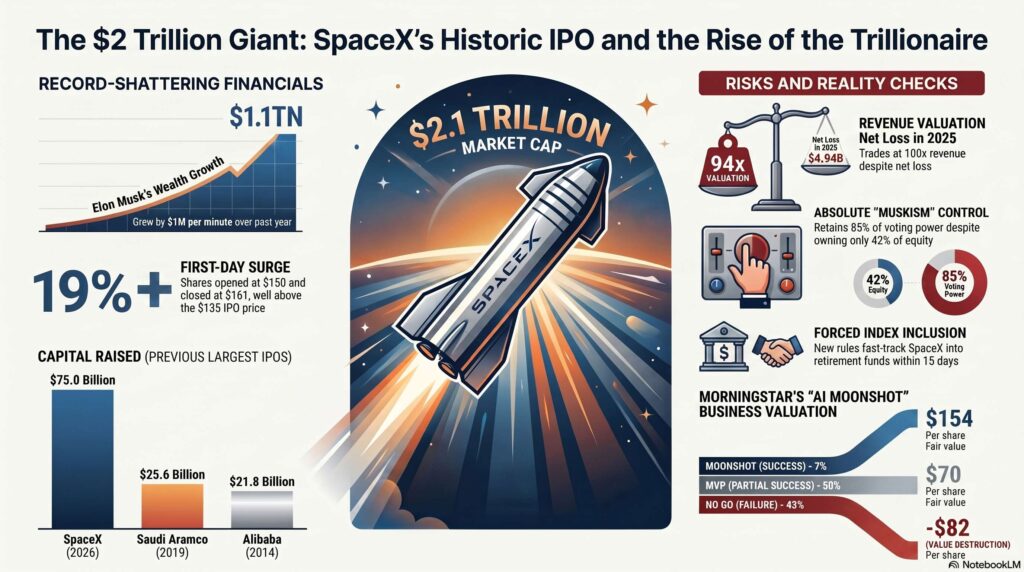
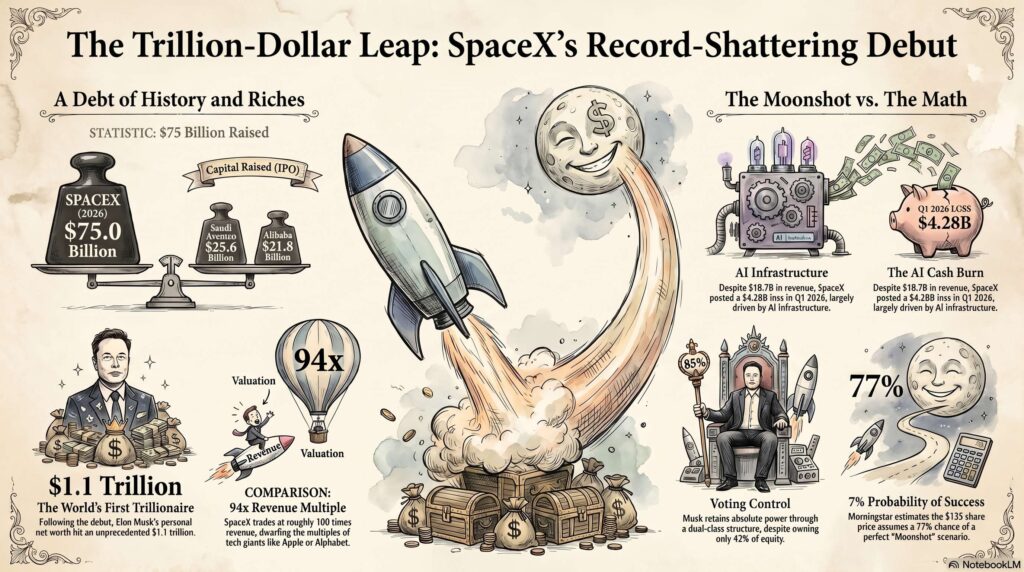
On June 12, 2026, the global financial landscape shifted as SpaceX made its historic debut on the Nasdaq exchange. Nearly two and a half decades after its founding in a warehouse, the aerospace and AI giant executed the largest initial public offering (IPO) in history, raising 75billion. Themarketrespondedwithimmediatefervor:sharesopenedat ∗∗150**—well above the initial 135 price—and closedat ∗∗161**, propelling the company’s valuation to a staggering $2.1 trillion.
This milestone didn’t just break corporate records; it minted the world’s first-ever trillionaire. Elon Musk’s personal fortune reached an estimated $1.1 trillion by the close of the first trading day, an increase of more than $62 billion in 24 hours.
A New Kind of Conglomerate: The AI Pivot
While SpaceX is famous for its rockets, its $2 trillion valuation is increasingly tied to its evolution into an integrated aerospace, AI, and telecommunications conglomerate. A critical driver of investor enthusiasm was the pre-IPO merger with xAI, Musk’s artificial intelligence startup.
Strategic highlights from the prospectus include:
- Orbital Data Centers: SpaceX plans to launch up to 1 million data centers into space to support lunar and Martian colonies.
- Starlink’s Dominance: The satellite internet division generated $11.4 billion in 2025 (61% of total revenue) and remains the only consistently profitable segment on a GAAP basis.
- The Anthropic Deal: SpaceX secured a massive contract with AI firm Anthropic worth $1.25 billion per month through 2029 for data center capacity.
The Risk Factor: “Nonsensical” Valuation or Moonshot?
Despite the excitement, the IPO has faced intense scrutiny from regulators and analysts. Senator Elizabeth Warren urged the SEC to delay the listing, citing “unanswered material questions” about potentially misleading accounting and the lack of traditional governance.
Critics point to a glaring disconnect between the company’s valuation and its fundamentals:
- Revenue vs. Value: SpaceX is valued at roughly 100 times its annual revenue ($18.7 billion), a multiple with “little precedent” among global giants.
- Massive Losses: The company recorded a net loss of $4.28 billion in Q1 2026 alone, with an accumulated deficit sitting at $41.3 billion.
- Governance: Musk maintains an unprecedented 85% of voting power through a dual-class share structure, leaving public shareholders with significantly fewer rights, including mandatory arbitration for legal disputes.
Market Ripples: The “Siphon Effect”
The SpaceX listing triggered a “capital siphon effect” across the space sector. As investors rebalanced their portfolios to make room for the $2 trillion giant, competitor stocks plummeted: Rocket Lab (RKLB) fell 13%, while Virgin Galactic (SPCE) tumbled over 37%.
Furthermore, the IPO is set to impact millions of ordinary investors through index fast-tracking. The Nasdaq 100 implemented a new rule allowing “fast entry” within 15 trading days for megacap companies. This means many passive index funds and retirement accounts will soon be forced to purchase billions in SpaceX shares regardless of their fundamental view on the stock.
Expert Perspectives: Bullish vs. Bearish
Analysts are deeply divided on the stock’s intrinsic value. Morningstar issued a bearish report, estimating a fair value of just $63 per share—a 53% discount to the IPO price. They argue the $135 price requires a “leap of faith,” assigning only a 7% probability to the “Moonshot” scenario where orbital data centers succeed at scale.
Conversely, others point to Musk’s track record of creating sectors from nothing. As one Harvard Business School professor noted, many investors view AI as a “once-in-a-millennium opportunity” that merits these extravagant expectations.
The Bottom Line
The SpaceX IPO is more than a financial event; it is a cultural and economic phenomenon. It has minted over 4,400 new employee millionaires and solidified a level of concentrated wealth—where one man is richer than the combined bottom 46% of the world population—that organizations like Oxfam call a “dark day for democracy”.
Whether SpaceX is a “financial cult” or the architecture of a multiplanetary future, the world will be watching its first quarterly earnings call in September 2026 to see if the reality can match the orbit-high expectations.