

The landscape of higher education has undergone a fundamental shift, moving from a world of traditional textbooks and manual notes to one where Artificial Intelligence (AI) acts as a powerful study partner. In 2026, the most successful students are not those who use AI to bypass their work, but those who leverage it to learn faster, revise better, and improve productivity.
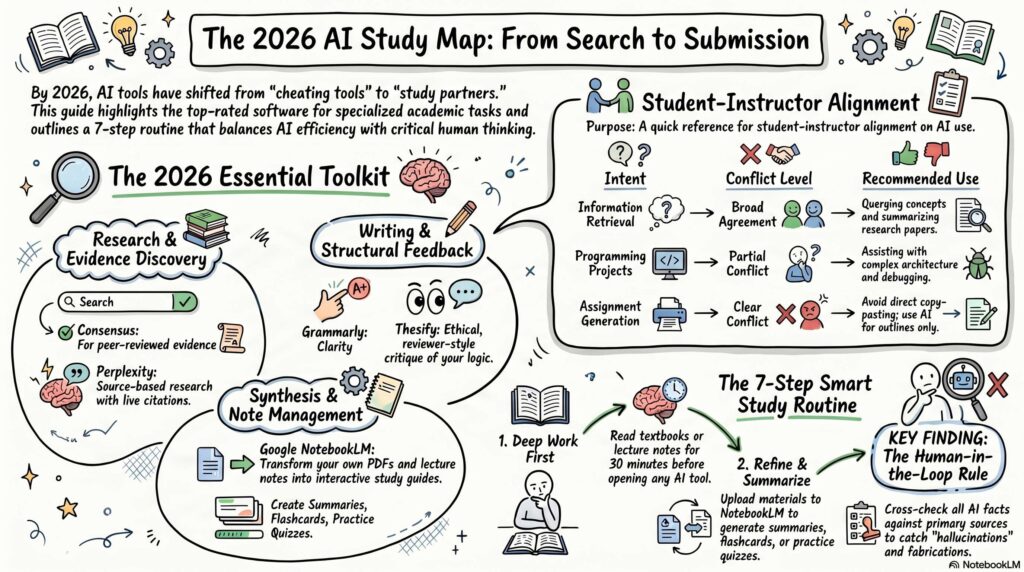
The Essential AI Toolkit for 2026
Rather than “tool hopping” between dozens of trending apps, experts recommend mastering a core set of 2-3 tools to build a repeatable workflow.
- For Research and Deep Learning: Google NotebookLM is a standout tool for serious students because it works directly with your uploaded materials, such as PDFs and lecture notes, to create summaries and study guides. For finding peer-reviewed evidence, Consensus and Elicit provide access to hundreds of millions of papers with source-backed answers.
- For Writing and Feedback: While ChatGPT remains a versatile all-purpose assistant, Claude is often preferred for more nuanced academic reasoning and long document analysis. For the final stages, Grammarly provides real-time writing feedback, while thesify acts as an evaluative tool to check the logic and structural integrity of your research drafts.
- For STEM and Technical Subjects: Wolfram Alpha is indispensable for complex math and science calculations. Computer science students often turn to AskCodi for debugging help and interactive logic explanations.
- For Organization: Notion AI helps manage messy notes and turn them into structured study plans, while Personalized Study Planner Agents can now create adaptive daily schedules based on your specific cognitive patterns and deadlines.
Building a Winning Study Workflow
A typical high-performance study routine in 2026 combines multiple tools for different stages of a project:
- Organize: Dump your raw materials and lecture notes into Notion AI to identify key themes and testable material.
- Study: Use ChatGPT or Vertech prompts to start an interactive quizzing session, utilizing active recall to identify knowledge gaps.
- Refine: When drafting, use Claude for feedback on your argument structure and evidence quality.
- Verify: Use Google Gemini—which can search the live web—to fact-check any AI-generated claims and confirm accuracy before submission.
The Ethics of “Study Mode”
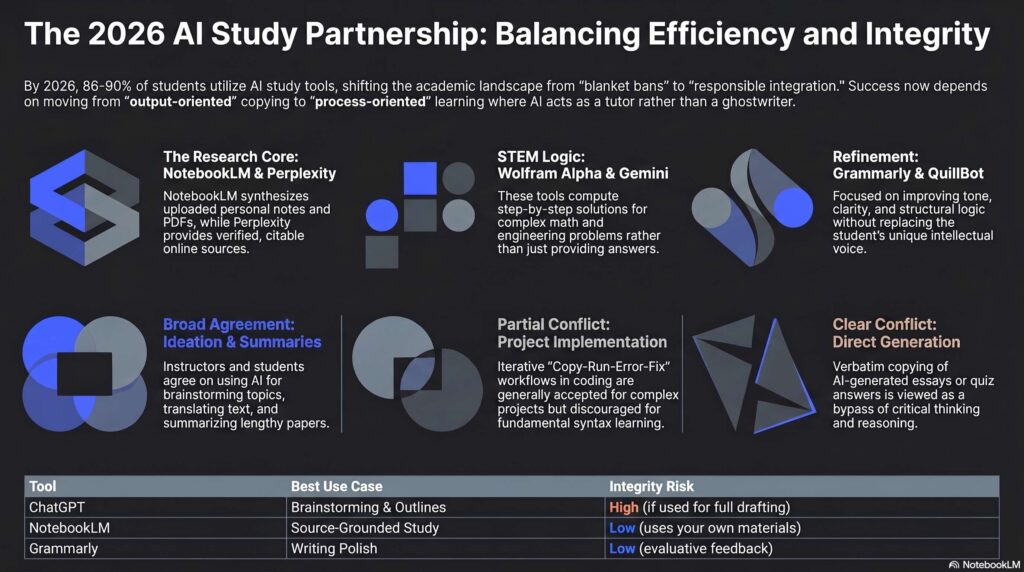
As AI becomes a basic digital skill, the line between assistance and academic dishonesty has been clearly drawn. Acceptable AI use includes brainstorming, grammar editing, and concept clarification. Unacceptable use involves submitting AI-generated text as your own or fabricating citations.
To stay on the right side of academic integrity, students should apply the three-question test:
- Does this use help me learn, or does it replace my learning?
- Would I be comfortable showing my instructor exactly how I used this tool?
- Does the final output represent my own understanding and work?
A New Classroom Dynamic
Instructors are also evolving, shifting from prohibiting AI to recognizing its use in high-quality work. Many now allow the disclosure of AI usage records, such as prompt logs, as part of the assessment process to evaluate a student’s research and information-gathering skills. In 2026, prompt engineering is increasingly seen as a core competency reflecting a student’s understanding of a subject.
Ultimately, the future belongs to students who can combine human intelligence with AI tools to think critically, ask better questions, and create truly original work.