
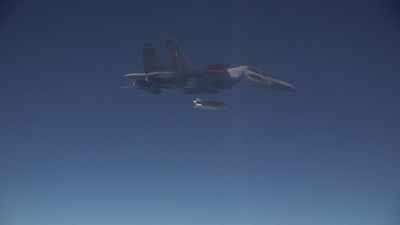
In an era of prolonged, contactless kinetic conflicts, air forces are looking for cheaper ways to hit targets from a distance. Missiles do the job well, but prolonged conflicts in Ukraine and west Asia have shown how quickly the cost of a missile-led campaign mounts. That is the thinking behind the US Air Force’s latest move to explore a new unpowered glide bomb under its Extended Range Attack Munition (ERAM) programme.The US air force life cycle management center’s stand-in strike division has issued a request for information on what it calls ERAM Glide, along with additional powered options. The proposed weapon would be in the 500-pound class, or about 250kg, with a warhead of roughly 50kg of explosives designed for blast fragmentation and limited penetration. The requirement calls for a glide ratio of at least 10:1, with a target of 15:1. A 15:1 ratio means the bomb travels 15 units horizontally for every unit it drops, though the actual range depends on the aircraft’s speed and release altitude, and the Air Force has not given a figure. The service is also pursuing two jet-powered cruise missile variants under ERAM, including munitions being acquired for Ukraine.The US already has a similar capability in Boeing’s Joint Direct Attack Munition-Extended Range (JDAM-ER), which uses a wing kit to turn a conventional bomb into a precision-guided glider. Depending on launch conditions, it can reach around 72km, against about 24km for a standard JDAM. Glide bombs let aircraft release weapons from a distance without necessarily entering the reach of hostile air defences, and some countries are adding small turbine engines to extend their range further.
India’s own glide bomb programmes
India is following a similar path through several indigenous programmes. The Defence Research and Development Organisation (DRDO) is working on a powered version of the Smart Anti-Airfield Weapon (SAAW), which has an advertised range of around 100km. A small turbine engine is expected to double that to about 200km. Made by Bharat Dynamics Limited, SAAW is meant to strike airfields and other critical infrastructure.DRDO is also developing the Gaurav family of glide bombs in 500kg and 1,000kg variants, with an advertised range of around 100km, and the Gautham, also planned in 500kg and 1,000kg versions. The Tactical Advanced Range Augmentation (TARA) guidance kit is meant to convert unguided bombs into precision weapons with a range of about 30km. In the private sector, JSR Dynamics has developed a glide bomb with an advertised range of up to 120km.Together, these programmes show how air forces are building up stocks of low-cost precision weapons. By combining conventional bomb designs with guidance kits, wings and, in some cases, small engines, they hope to extend strike range and weapon numbers without relying only on expensive cruise missiles.